Transformation of the SCO for next decade
Shanghai Cooperation Organization needs to move with the times and push forward new agendas to strengthen and optimize practical cooperation









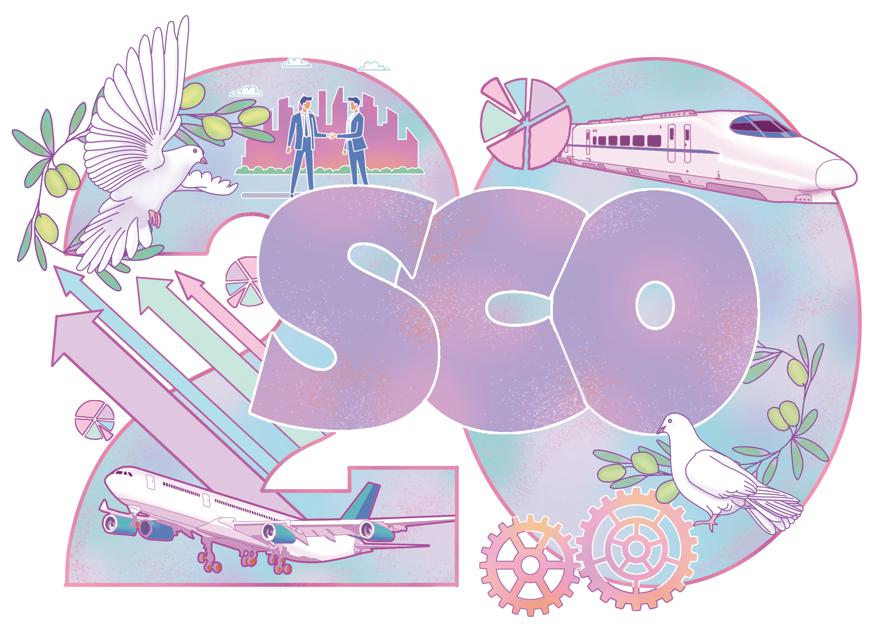
This year marks the 20th anniversary of the establishment of the Shanghai Cooperation Organization. Since its inception, the SCO has proved to be a multi-layered framework for political, economic and security cooperation, with China and Russia as the two engines driving it. The birth and development of the SCO have embodied China's participation and leadership in regional governance.
After developing for 20 years, the SCO has been playing an increasingly important role in Eurasian regional affairs. First, under the banner of the "Shanghai Spirit", the organization provides an alternative to Western-dominated global governance. It emphasizes the equality of all countries regardless of their size and takes this as a prerequisite to develop and expand the common interests of its members, practicing the democratic principle of international relations.
Second, it advances cooperation among all parties through negotiation and consultation when they are navigating through internal and external complexities. Internal complexity refers to the vastly different sizes of the economies of member states, their cultural traditions and political systems. External complexity refers to the seismic changes in the regional and international landscapes over the 20 years since the organization was established. Nevertheless, thanks to its artful management, the SCO has made new headway in many areas of cooperation.
Third, the organization has become increasingly indispensable for defending peace, stability and development in the Eurasian region. It was established with the purpose of resolving historical border issues among its member states and maintaining regional peace and stability. In its infancy, Central Asia was rife with separatism, extremism and terrorism. The instability was exacerbated by the war on terrorism the United States waged in Afghanistan. It is fair to say that without the SCO and its expansion, the Central Asian region would have been mired in conflicts and wars.
Political and security cooperation has been a priority for the organization, while its multilateral economic cooperation has been lackluster. However, recent years have seen progress in economic cooperation. China's cooperation with other SCO member states in the areas of trade, investment and development assistance continues to grow, and the Belt and Road Initiative is gaining more traction as more regional nations have got onboard.
For example, at the beginning, the Kazakhstan academia had doubts about economic cooperation with China under the framework of the Belt and Road Initiative, fearing that Kazakhstan would become a resource vassal of China. However, Kazakhstan gains more than $500 million a year from just the China-Europe Railway Express that crosses its territory, and the earnings are expected to grow in the long run. Statistics from the Prime Minister's Office in Kazakhstan show that the number of containers transported through the country via the CERE in 2020 reached 517,500 twenty-foot equivalent units, a year-on-year increase of 65 percent.
In addition, a raft of major collaborative projects with China has diversified its industrial mix and reduced its overreliance on oil and gas resources. Now Kazakhstan, which has been awakened to understand the benefits of a strong economic bond with China, is more determined to advance a permanent comprehensive strategic partnership with China. Similar "from doubt to belief" examples can be seen in China's bilateral cooperation with other SCO member states.
At a time when the novel coronavirus outbreak has dealt a heavy blow to SCO member states, cross-border e-commerce has maintained robust growth. Some new forms of practical cooperation in other fields have also emerged, becoming new development engines.
First of all, accelerated restructuring and transformation of the global system are causing great uncertainty and underscore the value of regional organizations. The changing dynamics are providing the SCO with favorable external development opportunities.
Second, as major powers are contending with different plans to advance Eurasian integration and Central Asian countries are showing more solidarity, the SCO is in a good position to discuss a new development agenda.
Third, the accession of India and Pakistan as full SCO members, which of course has posed potential challenges to the organization (because of contradiction between efficiency and equity, the relationship between old and new members, and the conflict between responsibility and capacity), has given the SCO a greater say in dealing with regional hotspot issues.
But the SCO, which has unbalanced cooperation in security, economy and culture, is going through a kind of mid-life crisis like many other international organizations. It is hard to push forward practical cooperation due to lack of consensus, after a go-go period of formulating charters and rules. And as cooperation expands and more stakeholders are involved, the organization is finding it hard to maintain momentum. Therefore, it has become imperative and necessary to transform the SCO on its 20th anniversary.
Over the past 20 years, there have been many SCO skeptics in the international community. Even several think tanks of some member states believe that the organization has entered a period of dormancy after its first expansion. But such a viewpoint is too pessimistic, because it underestimates the institutional resilience of the SCO and fails to see that new conditions conducive to the development of the SCO are taking shape.
However, with the international situation becoming more chaotic and the international order rapidly changing, it must move forward with new agendas to optimize practical cooperation.
The author is executive president of Shanghai Academy of Global Governance & Area Studies at Shanghai International Studies University. The views do not necessarily reflect those of China Daily.