Thriving on war









The military-industrial complex in the US has already moved on from the country's failure in Afghanistan
There is nothing in the United States' ignominious withdrawal from Afghanistan to compare with the hubris that accompanied their second occupation of Afghanistan, which was couched in terms of assisting the population. The first occupation was to crush al-Qaida, responsible for the Sept 11 attacks on the US in 2001, which had been permitted to use Afghanistan as a base. The second occupation was during the war with Iraq when it decided to deny other "terror" organizations using Afghanistan as a base and give the US a Central Asian pivot from which to control surrounding regions including the Middle East.
About 160 years ago, colonial Britain had a similar notion. It wanted to deny Afghanistan as a route to British India for the Russians. That resulted in the massacre of the British force. Later punitive expeditions failed to occupy the country. The Soviet Union invaded in 1979 ostensibly to support an Afghan communist party under domestic pressure but also with an eye to gain access to a warm weather port, oil and minerals. That resulted in a forced withdrawal in 1989.
The British, the Russians and the Americans all knew very little about Afghanistan. It was all to do with them rather than the people of Afghanistan and that very quickly became apparent with the now well-documented consequences.
The US has an unerring ability to misread the rest of the world; particularly those states it feels are inferior. The US saw North Vietnam as a backward state which could be bombed into submission. Despite the deployment of 500,000 troops, the US lost the war to a far more determined and skilled army which possessed little of the technology available to the US.
The US came out of that war humiliated, its prestige in tatters. However, its self-confidence was soon restored by an array of new military technologies. The military-industrial complex whispered in the ear of Washington that Vietnam was an aberration and that the US was a powerful country once more with all the new technology now available to it.
So, it went in hard in Kuwait following Saddam Hussein's invasion. That worked. The US felt confident again. After the Sept 11 attacks, it followed up with a full-scale attack on Iraq which created a mess in the Middle East.
Faced with these complications the US decided to follow up its earlier mission into Afghanistan and reshape the country in its own image to provide a haven for US power in Central Asia and the Middle East. The problem for the US was that Afghanistan exists as a country only in the minds of major powers and the media. To the people that live there it is no such thing. Tribal groupings and villages are of far greater relevance and the center of their existence, the broader notion of country or nation is not a notion they embrace.
Afghanistan is in many ways the creation of colonial boundaries. The Pathan tribal grouping was arbitrarily divided by a British imperial decision to draw a line through its tribal area. It is known as the Durand Line and was ratified in 1919. The presence of a large number of Pathans in Pakistan with family, friends and commercial ties on the other side of the border gives Pakistan a great deal of leverage in the affairs of Afghanistan.
There are four major tribal groupings. The Pathans constitute around 50 percent of the population and are the dominate tribe; they are Sunni and comprise the majority of the Taliban. They oppress and dominate the other tribal groups, particularly the Hazaras who are Shia. Kabul is and will remain a city state, divorced from much of what goes on in the rest of the country.
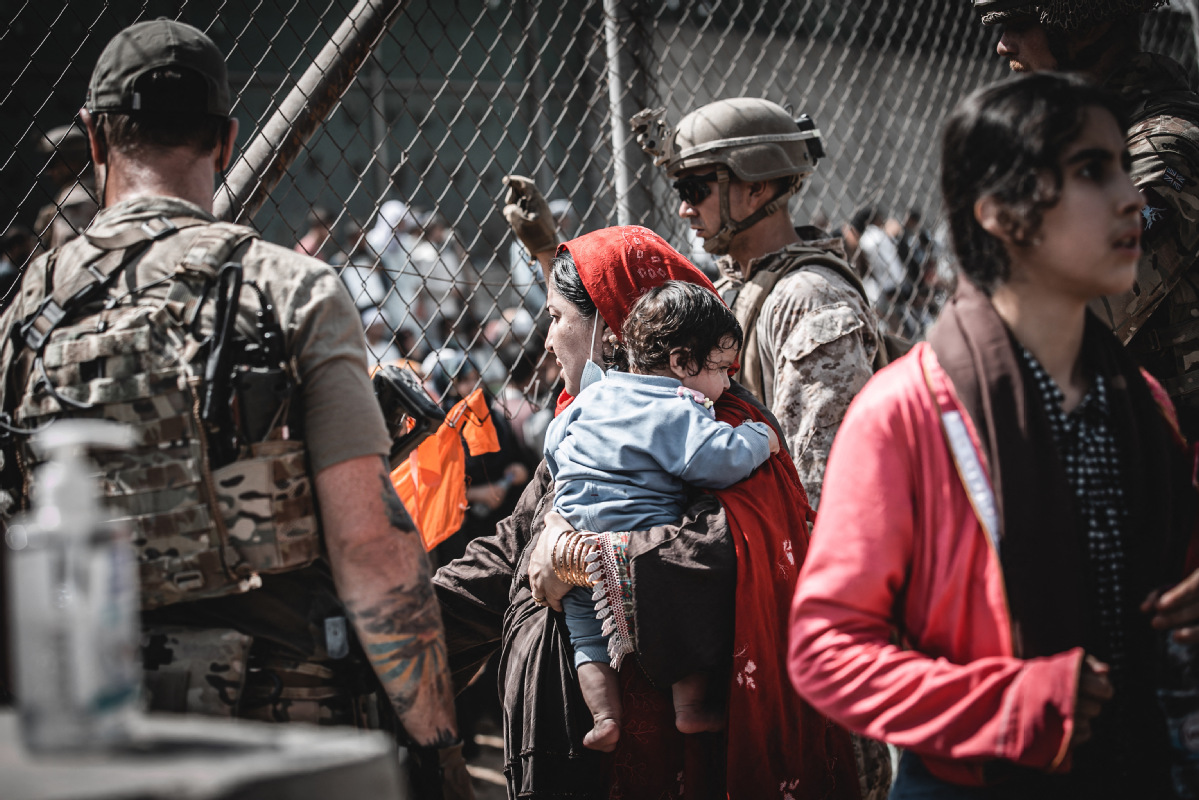
We have witnessed the US scrambling out of Kabul. They have learned little from their other wars and they seem incapable of doing so. The military-industrial complex will ensure that. There is too much money involved. The complex props up the American Stock Exchange. War is factored into the US economy.
The US is a dangerous failing state.
The US has been forced to leave Afghanistan for the same reason it was forced to leave Vietnam; a lack of objectives and strategic plan, which demonstrated it did not know what it was doing. They made up reasons to justify the insatiable needs of the military-industrial complex, until public opinion and the ill discipline and weariness of US and Afghan troops forced a decision. In addition, hubris, an over-reliance on technology, poor intelligence and the topography all added up to a failed venture. In military terms the US should have left Afghanistan in 2006 or 2007.
US prestige has suffered but the complex has moved on to what it sees as a bigger prize, China. It has been boosting the confidence and egos of US and allied politicians with talk of the inferiority and weakness of the Chinese system of government and superiority of Western democracies in meeting future challenges, a claim that is not upheld in light of their response to the COVID-19 pandemic and climate change.
China is in the sights of the military-industrial complex and is a bigger prize than Iraq and Afghanistan. Demonization of China by the US and its allies promises the construction of many new planes, ships and submarines. The military-industrial complex is not noted for its social conscience or consideration of the long-term consequences. Nor does climate change figure in its plans for a profitable future.
The author, an Australian political commentator, author and retired diplomat, has served with Australian outposts in South Africa, Pakistan, Afghanistan, Saudi Arabia and Sri Lanka among others. The author contributed this article to China Watch, a think tank powered by China Daily. The views do not necessarily reflect those of China Daily.