


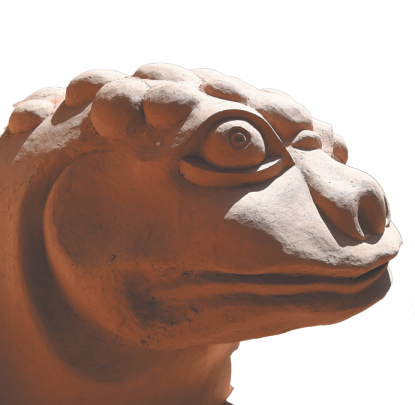
Statues at museum
Eighteen caves remain in Tiantishan today. In 2001, the grottoes got inscribed onto the list of national-level cultural heritage units under key protection.
Though the site's popularity among tourists cannot compete with Mogao Caves, the significance of Tiantishan has always been highlighted by scholars.
The oldest grottoes in Tiantishan were carved in the fifth century, hosted by a regional king, and its construction lasted until the Qing Dynasty (1644-1911).
"Consequently, it has a key status in the history of Chinese grotto temples and remains an important witness of how Buddhism spread in China," says Liu, the Tiantishan institute's director.
According to studies by the late Su Bai, a renowned archaeologist at Peking University who focused on Chinese grotto temples, Tiantishan represents a typical style of early-stage Buddhist statues in China that had great influence on grottoes of later periods.
For example, Longmen Grottoes in Henan province and Yungang Grottoes in Shanxi province, both UNESCO World Heritage sites, were deeply influenced by Tiantishan. Even Mogao Caves largely absorbed elements of Tiantishan.
"Tiantishan is seen by historians as an origin of Chinese grotto temples," Liu says. "But systematic studies of it are still quite new, compared with the more well-known sites."
Tiantishan first came to the attention of the wider public due to the construction of the reservoir to facilitate irrigation in the arid region.
According to the calculations of its designers from the former Soviet Union, the grottoes would be inundated once the construction of the reservoir was finished. Consequently, all frescoes and Buddhist statues in the grottoes were relocated to Gansu Provincial Museum in Lanzhou, capital of the province, in 1959.
Due to the huge size of the statue cluster in No 13 Cave, they became the only ones to remain in situ.
People later found that, over the following decades, the highest level of water in the reservoir was still 5 meters below the lowest grotto of Tiantishan.
In 2006, the relocated relics from Tiantishan were transferred back to Wuwei.
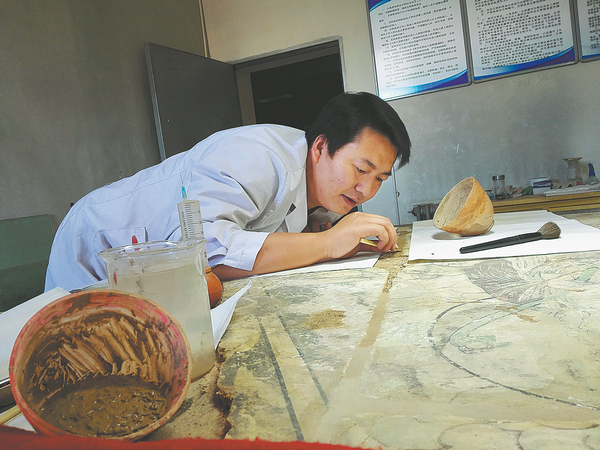
A comprehensive conservation program covering the returned relics started in 2015, led by Dunhuang Academy. The project was completed in June, giving new life to over 70 statues and frescoes, which cover over 300 square meters. For the stability of the relics, Liu says it is not suitable to put them back in the caves.
"Unlike statues in many other grotto temples, these statues have become 'movable' relics, and are better placed in museums," he adds.
A new museum for the display of the returned relics has been planned on the site of Tiantishan. Before their new home is set up, some are now being temporarily exhibited at Wuwei Museum.
About 170 old photos of the 1959 relocation have been collected from scholars and Wuwei residents, which Liu says are important references for future display of the relics.
The lack of research capacity is another bottleneck. Liu's institute is composed of 23 people, but only five are full-time researchers.
Though academic exchanges with other institutions like Dunhuang Academy will continue to play an important role in the study of the site's treasures, Liu says efforts will be made to introduce more researchers to Tiantishan.
To echo the first national-level guidelines, specifically for the protection and study of Chinese grotto temples, which was issued by the State Council in October 2020, a comprehensive study of Tiantishan Grottoes was carried out from November to April and the first official "status quo" report of the grottoes was produced.
"We want to have the best conditions to welcome the relics home," Liu says.
"The newly completed restoration is just a beginning. Many more projects will follow."
Contact the writers through wangkaihao@chinadaily.com.cn








