Different ways of being
It is an arrogance to believe that the Western political and economic model is universal









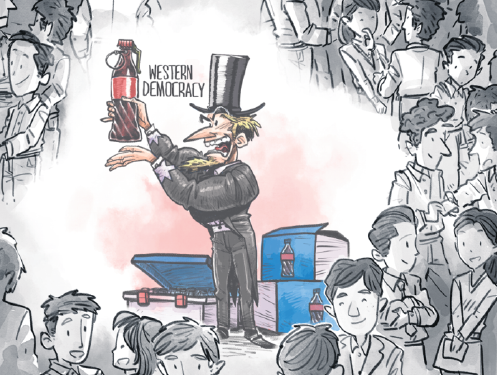
China's unparalleled development over the past 40 years, the tremendous scientific and technological advances, and the strong legitimacy of the Communist Party of China have frustrated international analysts who defend the so-called modernization theory, such as political scientists Seymour Martin Lipset or Samuel P. Huntington.
According to this theory, as economic growth advances it leads to the creation of an extensive middle class. In countries they consider "authoritarian", this should be the basis for regime change and the adoption of the liberal democratic model, the only one that they believe creates the necessary foundations for the continuous innovation that can fuel a new cycle of prosperity.
Along the same lines, another conservative political scientist Francis Fukuyama even decreed, shortly after the demise of the Soviet Union, that the "end of history", in Hegelian terms, would be the consolidation of the Western political model throughout the world.
Such perspectives reveal an arrogance in imagining that the Western political and economic model is universal and the only one that can lead individuals to the full realization of their being. Recently, the United States government was able to prove, in practice, that this idea is wrong, as they maintained a billion-dollar war in Afghanistan and had to withdraw when it was impossible to impose a model rejected by the majority of the population, who sacrificed themselves to expel the invaders.
"As we turn the page on the foreign policy that has guided our nation the last two decades, we've got to learn from our mistakes," said Joe Biden on Aug 31. "To me, there are two that are paramount. First, we must set missions with clear, achievable goals-not ones we'll never reach. And second, we must stay clearly focused on the fundamental national security interest of the United States of America. This decision about Afghanistan is not just about Afghanistan. It's about ending an era of major military operations to remake other countries." What is valid for Afghanistan is also valid for Syria, Libya, Iraq and Yemen.
Taking a historical view, the Judeo-Christian cultural matrix, which prevails in the West, is based on two assumptions: the first, that happiness and "salvation" result from individual actions; the second, that their values are "universal".Added to this is the empiricist theory, developed in the 17th and 18th centuries in England, which states there are "natural laws", such as the right to life, individual freedom and private property. The defense of such "values" justified 19th-century English imperialism, which, in order to mask the exploitation and plunder of non-European peoples, engaged in an "evangelizing" and "civilizing" mission. With the rise of the US in the 20th century, such values started to include the "defense of human rights", justifying military interventions and sponsored coups d'état in several countries worldwide, mainly in Latin America.
It is important to stress that there is no single path that the people of the world can take to achieve the goal of the common good. There are pillars on which sociability is consolidated, such as history, religion, and culture. The simple transplantation of foreign models does not guarantee effective adjustment in traditional structures. We can cite a country where it establishes a system of electoral competition like a Western democracy. However, in this same country, social practices coexist in which a person's destiny is determined by the caste where he is born. How can one speak of democracy if the social origin previously determines the burdens and benefits offered by society?
Even where these rights are theoretically guaranteed, how does competition for power take place? In making the rules that can guarantee equality in electoral competition, or do they end up favoring certain groups with access to the most money or to mass media and, more recently, to technology companies that manipulate algorithms? Additionally, on these inquiries, we have witnessed the creation of electoral rules that seek to dilute the political weight of minorities, known as "gerrymandering," or curb access to the vote of the poor and minorities in some states of the US. It shows how hypocritical the US political elite's speech assures "a democracy is a government of all the people, by all the people, for all the people." Poor people and minorities are treated as second-class citizens.
Furthermore, it is necessary to reflect on the definition of human rights itself. If, on the one hand, the right to expression needs to be valued, it is necessary to consider the material aspects of these rights, such as access to education, health, adequate housing, employment, security, peace, etc.
Another aspect concerns the so-called competitive electoral systems, as they also bring considerable distortions in the quality of representation. Without a political system that ensures the effective participation of ordinary people in discussions of the country's main problems from the bottom (committees of neighborhoods, villages and cities), disastrous leaders may emerge spouting lies and engaging in electoral manipulation.
Each country has to build a model that guarantees its citizens prosperity, security and stability. There is no universal model that fits all realities.
The author is professor of international political economy at Sao Paulo State University (UNESP). The author contributed this article to China Watch, a think tank powered by China Daily. The views do not necessarily reflect those of China Daily.
Contact the editor at editor@chinawatch.cn