Economic growth guarantee









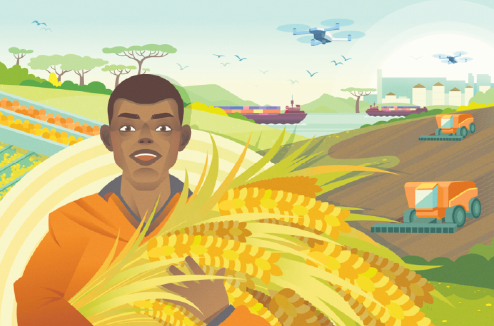
The upcoming Forum on China-Africa Cooperation provides an opportunity to further promote South-South agricultural cooperation
Over the first two decades of the 21st century, cooperation among countries in the Global South has contributed to a shift in the perspectives on international development toward reciprocity, mutual learning and win-win relations. It is now time to explore ways in which South-South cooperation can promote the ecologically sustainable and socially inclusive development of Africa.
South-South agricultural cooperation has contributed to African development through technical support, human resources mobilization, capacity development, innovation of the agri-food system, and integration of value chains. The modalities of South-South agricultural cooperation include bilateral, trilateral and multilateral cooperation, involving diverse stakeholders including government departments, international development organizations, private enterprises, social organizations, individual producers and cooperatives. Those countries or regions in the South engaged in agricultural cooperation include emerging economies such as Brazil, India, China and South Africa, and most of the developing and transition countries on all continents.
In China's case, South-South agricultural cooperation began in the 1950s and there has been significant progress in the new era. In terms of bilateral cooperation, the main approaches are the construction and operation of agricultural technology demonstration centers in partner African countries, dispatching of agricultural experts to these countries, and human resources development. From 2010 to 2020, 22 agricultural technology demonstration centers were set up through bilateral cooperation agreements between the Chinese government and the governments of 21 African countries. In terms of specific capacity development, China has provided training and exchange programs and vocational education support. For example, China has helped African countries such as Uganda, Rawanda, Malawi, Sudan and Liberia build vocational technology schools. China has also provided technical support for improving vocational education quality such as the 20-year support it has extended to Ethiopia's agricultural vocational technology schools through sending qualified teachers every year since 2001 in the areas of plants, livestock, natural resources, veterinary, agricultural cooperatives and so on. At the same time, China is actively implementing multilateral cooperation. In 2009, the China-Food and Agriculture Organization South-South Cooperation Trust Fund was set up, to which China has donated $30 million and $50 million in the first and second phases, respectively, and will donate $50 million in the third phase, which aims to support African countries and other developing countries establishing sustainable and inclusive agricultural value chains. China-FAO-Uganda South-South cooperation is one example of multilateral South-South cooperation efforts. Implemented from 2012 to 2014 and from 2016 to 2018, it covered integrative technical support in the areas of agri-food, horticulture, aquaculture, livestock and irrigation. More than 80 new technologies were disseminated to more than 15,000 farmers and technicians through 200 training and exchange events. This cooperation promoted the setting up of the China-Uganda Agricultural Industrial Park with $220 million investment from seven Chinese companies, representing an innovative cooperation approach through technical assistance and industrial parks.
China-Africa agricultural cooperation encompasses the whole agri-food value chain, from materials provision, production and processing to marketing. Furthermore, collaboration also focuses on management and collaboration systems that are critical for achieving agricultural development and food security. A joint project between China Agricultural University and the Morogoro provincial government in Tanzania built up a collaboration platform to improve local smallholders' maize production and its value chain. This project involved not only technologies but also partnership building among the Tanzanian government, the local government, private sector, research institutions and smallholders. This collaboration named "small technology, big harvest" has been recognized by the United Nations Office for South-South Cooperation as a reference for an alternative development approach in Africa.
Several key concerns have been integrated into China's South-South agricultural cooperation. Environment and climate concerns lead the selection of agricultural technologies. Not only new varieties of crops and mechanization but also environmentally friendly innovations have been taken into consideration. For example, together with the Center for Sustainable Agricultural Mechanization of the United Nations, China Agricultural University has introduced integrated products residues management into agricultural mechanization programs in African countries. Another concern is the resource structure in different African countries. In those areas where smallholders lack physical capital, the collaborations prefer labor-intensive rather than capital-intensive innovation. In the case of aforementioned "small technology, big harvest" project, smallholders learned a package maize production technology that resulted in triple productivity and adjusted income structure by adding only simple labor input in spacing, thinning, weeding and inter-cropping. A more important concern is capacity development for local people and organizations. Cooperation is not only for technology supply, but more importantly for improving the resilience and sustainability of the local agri-food system through increasing the recognition and competence of local stakeholders in the development of the agricultural value chain.
Looking ahead, more knowledge sharing of agricultural innovation for food security and nutrition among all stakeholders is important for effective collaborations adapted to the various conditions and needs of African countries. Since international development organizations such as those in the United Nations system, bilateral organizations, social organizations and private sectors have different advantages in encouraging agricultural innovation and cooperation among the countries in the South, the engagement of more actors in multilateral South-South collaboration needs to be promoted. The adaptive collaboration strategy needs to be improved, focusing on differentiated socioeconomic conditions in different areas. And cooperation to improve the agricultural research capacity of Southern countries is the basic guarantee for sustainable agricultural development in Africa.
The author is a professor at the College of Humanities and Development Studies and the College of International Development and Global Agriculture at China Agricultural University. The author contributed this article to China Watch, a think tank powered by China Daily. The views do not necessarily reflect those of China Daily.
Contact the editor at editor@chinawatch.cn