Number of Chinese students in US falls









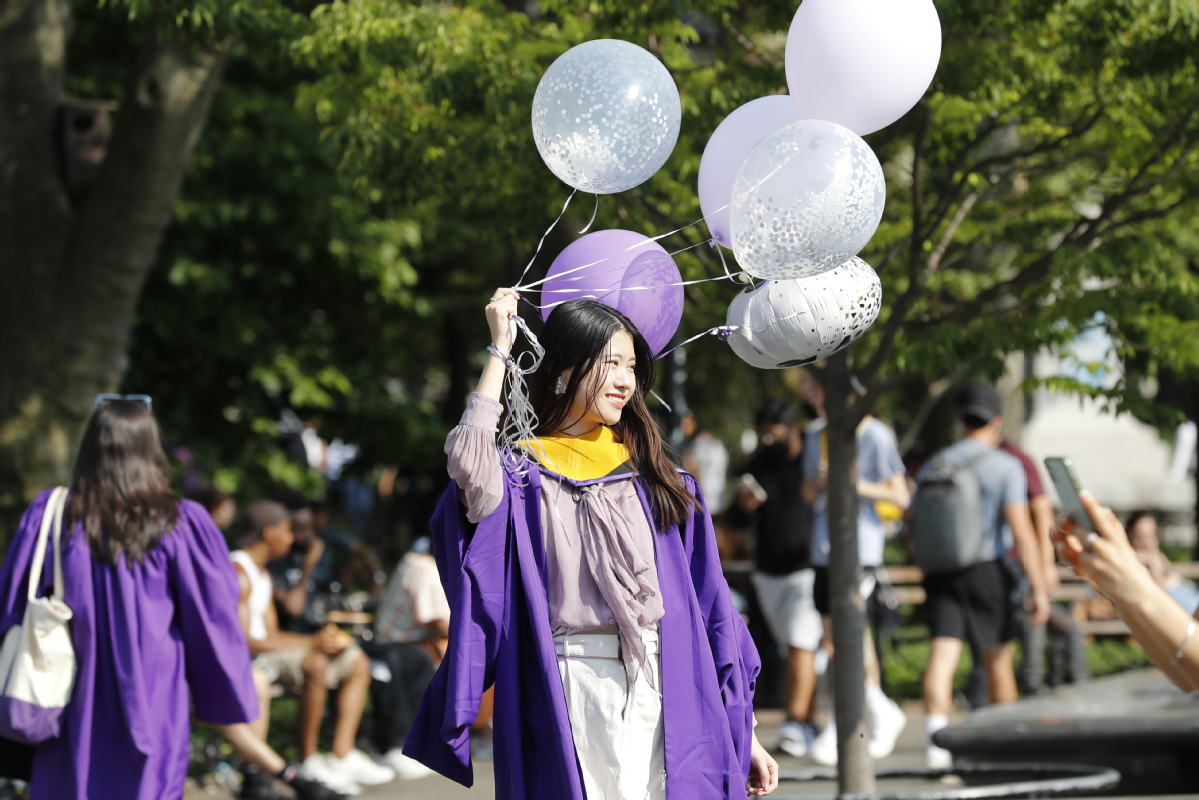
The number of international students from China pursuing studies at US colleges and universities declined by nearly 15 percent last year, the biggest drop in a decade, educational authorities said Monday, as American institutions reported they are prioritizing outreach and recruitment.
All places of origin and regions saw declines in the number of students enrolled at US higher education institutions and online from abroad due to the COVID-19 pandemic, according to The Open Doors 2021 Report on International Educational Exchange, released Monday.
The global pandemic primarily affected international students studying at a US university for the first time, or new international students. That segment declined by 46 percent, according to the report, launched by the US Department of State's Bureau of Educational and Cultural Affairs and the Institute of International Education.
China remained the top place of origin of all international students, contributing slightly more than one-third of the total 914,095 foreign students in the 2020-21 academic year. That overall number represented a decrease of 15 percent from the previous academic year, according to the annual report.
The second-largest place of origin is India, which had 18.3 percent of all international students in the US. Both Chinese and Indian groups declined this year by 14.8 percent and 13.2 percent, respectively.
As in previous years, slightly more than half of international students pursued a major in a science, technology, engineering and mathematics (STEM) field, and in all, foreign students represented 4.6 percent of all students in US higher education, the lowest mix since the 2014-15 academic year.
While the COVID-19 pandemic was a primary factor affecting enrollment, the strained relationship between the US and China, the largest source of international students for the US, has made itself felt for some Chinese students who sought to enter the US recently.
There have been "frequent incidents of unwarranted harassment and suppression" targeting Chinese students and visiting fellows to the US, Chinese Foreign Ministry spokesperson Wang Wenbin said on Nov 3.
Just the other day, a Chinese visiting scholar holding a valid visa issued by the US government was repatriated after being interrogated without cause upon entry, and about 30 Chinese students and visiting scholars have been subjected to the same "unjust" treatment by the US since August, Wang said at a daily news briefing.
Wang noted that the US had "stretched" the concept of national security to "wantonly harass" Chinese students and scholars in an attempt to produce a "chilling effect" among Chinese personnel pursuing studies in the US.
Asked to comment on how the tightened rules the Trump administration put in place on Chinese student visas were related to the "noticeable dip" in the number of Chinese students, Ethan Rosenzweig, deputy assistant secretary of state for academic programs, said "we can welcome students and protect our national security at the same time".
"I'll stress that we've tripled the number of Chinese students here in the US over the last decade. And in the Biden administration with our joint statement, you can see that we are amplifying, that we welcome students to the United States here for their educational purposes," he said at a briefing on the release of the Open Doors report.
The joint statement of principles in support of international education, co-signed by both the US state and education departments, said that international students are central to diplomacy, innovation, economic prosperity and national security, according to Rosenzweig.
International students contributed $39 billion to the US economy in 2020, of which $14.3 billion, or 36 percent, came from Chinese students, according to the US Department of Commerce.
"So whether students from Guangzhou, Beijing, Shanghai, Qingdao, they're welcome here along with everyone else in the Chinese community that wants to study here," Rosenzweig told China Daily.
The US embassy and consulates in China had issued more than 85,000 student visas to applicants in the fiscal year 2021, an American official on consular affairs said at the online press briefing.
Following a challenging year in international educational exchange, higher education institutions reported a 68 percent surge in the number of new international students enrolling for the first time at a US institution for the 2021 fall semester, according to a preliminary survey on US higher education institutions hosting international students.
The 2021 Fall Snapshot, released at the briefing, found 99 percent of responding US institutions reported that they are holding classes in-person or implementing a hybrid education model.
China remains a top country for US colleges and universities to prioritize for outreach and recruitment, noted Mirka Martel, Head of Research, Evaluation and Learning with the Institute of International Education.
Slightly half of the surveyed 860 US higher education institutions, or 51 percent, are giving priority to target prospective international students in China, leveraging current international students, online recruitment events, and social media outreach, according to the survey.
In the 2019-20 academic year, 162,633 American students studied abroad for academic credit, representing a 53 percent decline overall, according to the Open Doors report.
The European countries remained the most popular destination for American students, and the number of US students studying in China dipped by 78.7 percent in the 2019-20 academic year, according to the report.