Australia EV plans hit a bump with factory project collapsing and government's strategy found wanting









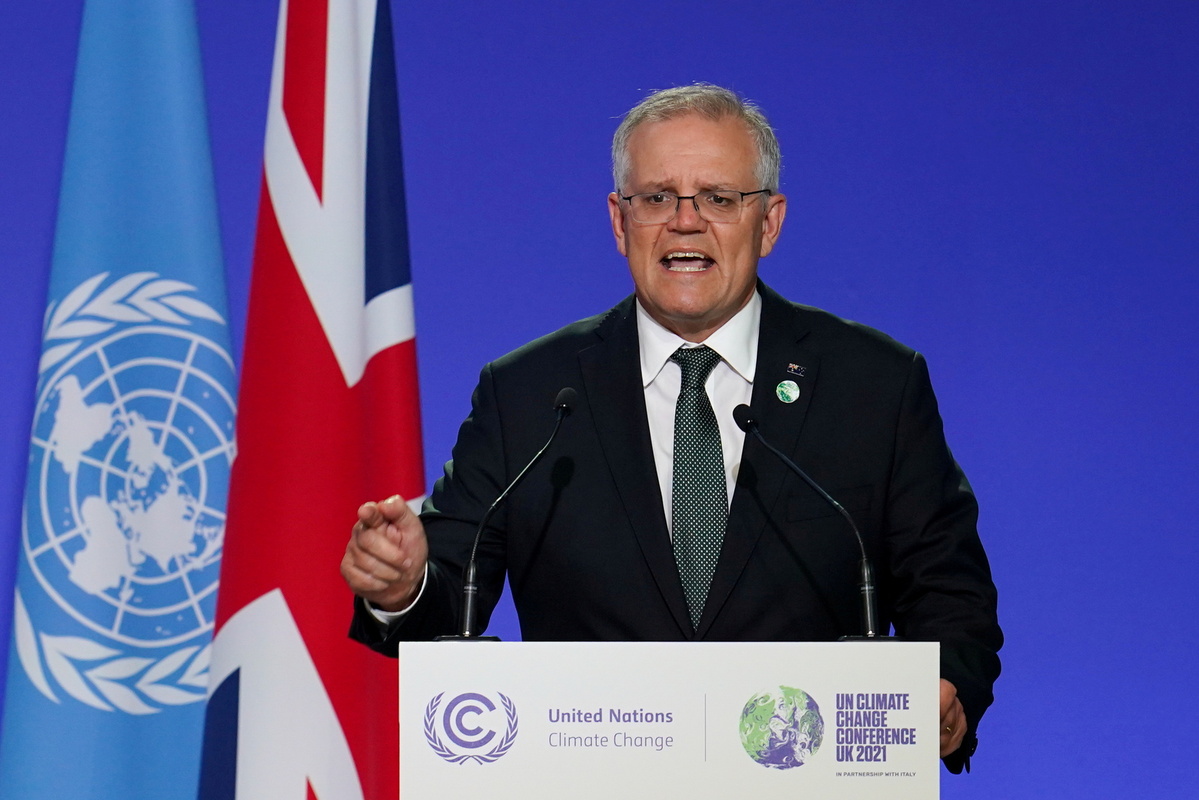
Less than 24 hours after Australia's Prime Minister Scott Morrison announced on Nov 9 a much-anticipated policy on electric vehicles, news emerged that the company behind a proposed EV plant in the state of Victoria had scrapped its plans.
SEA Electric told the Victorian government on Nov 10 that it was ending its agreement to build an electric vehicle, or EV, factory in the Latrobe Valley. No reason was given for the decision.
Australia's gasoline car manufacturing industry closed in 2017, ending 70 years of domestic vehicle assembly as General Motors-Holden — a subsidiary of US auto giant General Motors — Ford and Toyota ceased large-scale production in the country citing cost as a major factor.
The SEA Electric deal was seen as an attempt to give new life to the sector and give Australia a foothold in the EV market.
News of the project's demise comes amid a renewed focus globally on EVs after the COP26 climate summit in Glasgow.
The Victorian government has not said how much money had been paid to the company or whether any had been repaid, saying the matter was "commercial" and in "confidence".
Announcing the government's "Future Fuels and Vehicles Strategy", which aims to promote low- and zero-emission vehicles, Morrison said on Nov 9 that he did not want to force Australians into electric cars.
He said the federal government will partner with the private sector to fund 50,000 EV charging stations, in a bid to encourage more people to buy electric vehicles.
Analysts, however, say the strategy will do little to encourage drivers to swap their gasoline or diesel vehicles for electric cars.
In many countries governments are offering massive subsidies and tax incentives to make EVs more affordable, a policy approach wherein Australia is still found wanting.
Back in 2019, during the last federal election, the opposition Labor Party took an EV policy to the people. But Morrison tore the policy apart, claiming it was a war on the family weekend.
"They (EVs) cannot pull trailers, caravans or boats," he was famously quoted as saying during the election campaign. But in his defence Morrison now says he was not against those vehicles but "simply opposed to government telling people what to do."
"Reducing the total cost of ownership through subsidies would not represent value for the taxpayer, particularly as industry is rapidly working through technological developments to make battery electric vehicles cheaper," Morrison said as he unveiled the government's new strategy on Nov 9.
He said the new plan was "built on the back of the core principles. Technology, not taxes. Choices, not mandates".
Under the strategy, the government will spend A$250 million ($182 million) to build charging stations around the country for heavy commercial vehicles, passenger cars and households.
Analysts said the government's strategy was light on details, such as how it defines zero-emission vehicles.
More than 80 percent of the global car market — including Europe and the United States — now requires new cars to meet minimum emissions standards before they can be sold, the Australian Broadcasting Corporation noted in a report on Nov 10.
"The strategy confirms Australia does not plan to adopt these standards, which would require more stringent restrictions on pollutants in petrol and require new cars to emit far less particulate matter than currently allowed," the ABC said.
Many countries in Europe have already announced the phasing out of gasoline vehicles and are offering tax incentives so that people can move to EVs.
Norway and South Korea have announced that they will end the sale of new petrol and diesel cars from 2025. The United Kingdom intends to ban the sale of new petrol cars from 2030, and the sale of plug-in hybrid vehicles by 2035.
The US wants to phase out new petrol and diesel cars by 2035, with the Biden administration also outlining a goal for half of all new cars sold in the US to be electric by 2030.
China, the world's single largest car market, has plans to end the sale of petrol and diesel passenger cars by 2035.
Behyad Jafari, CEO of Australia's Electric Vehicle Council, said the nation's new strategy ignored the most important measures to improve EV uptake, including subsidies, tax incentives and sales targets.
"Future Fuels is certainly an advance on the government's rhetoric of the last election," Jafari said.
"The strategy has identified some of the correct benefits and pathways, but it does little to realize them."
In October the Council issued a report in which it said: "Australia is among the few developed countries on earth where it makes no difference to a car maker whether they sell a dirty, high-emission car or a zero-exhaust alternative. As a result, we're now a global dumping ground for high-exhaust vehicles that can't be shifted elsewhere."
Surveys show Australians want to buy EVs, but those vehicles continue to languish in the market — at less than one percent of new car sales.
A report released by Deloitte Access Economics on Oct 23 pointed out that Australians could save around A$492 billion within the next decade by switching to EVs.
Deloitte partner Eamon McGinn, the report's principal author, said the potential benefits of EVs are "truly staggering".
"Transport is a significant contributor to Australia's greenhouse gas emissions, and we're now at a real inflection point where we can realistically look at the benefits from a fast and complete transition to EVs in this country," McGinn said.