



Push comes to shove
Build Back Better World is an attempt to counter the success of Belt and Road Initiative rather than offering a helping hand for developing countries









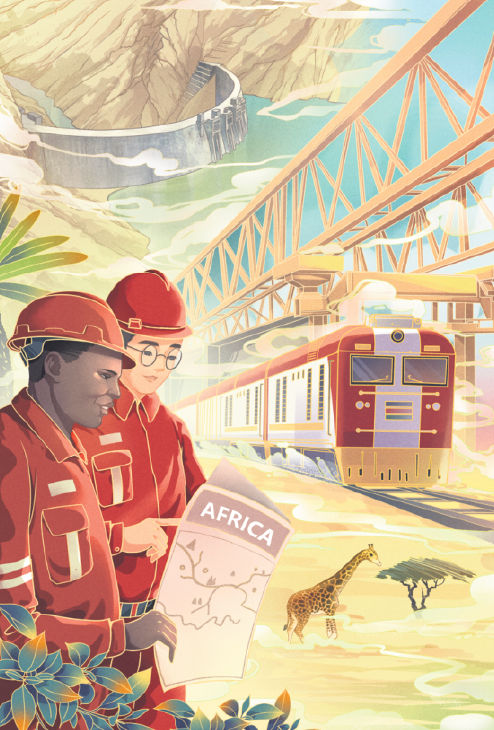
The Build Back Better World, a US-championed global infrastructure investment program adopted at the G7 Summit in the United Kingdom, will see major Western countries availing resources to help narrow the more than $40 trillion infrastructure gap in the developing world. It was explicitly earmarked as a pushback against China's growing infrastructure and development footprint in low and middle-income countries through the Belt and Road Initiative. Thus, through the mechanism of the B3W, the United States and its Western allies hope to challenge and undermine China's influence in the developing countries.
Since 2013 when China proposed the Belt and Road Initiative, it has invested over $700 billion in various infrastructural projects in Asia, Latin America, Africa, and Eastern Europe. About 140 countries have signed up for the initiative, 40 of them in Africa, which has been one of the major beneficiaries. China has funded infrastructure projects across Africa to the tune of $187.59 billion (over $23 billion per year) under the framework of the Belt and Road Initiative. And at the 2018 Forum on China-Africa Cooperation, President Xi Jinping announced a $60 billion aid package for Africa, a significant chunk of which was going to be spent on infrastructure. China's share of infrastructure contracts has been rising since 2011, reaching 40 percent in 2020, while the share of the European Union has declined from 44 percent to 34 percent and that of the US has declined even more from 24 percent to 6.7 percent.
Seeking to rival China's Belt and Road Initiative, the G7 countries under the leadership of the US have put together the B3W plan. It claims to create a green, digital and climate-resilient economy by investing in environmentally and socially friendly quality infrastructure both in the G7 countries and in the developing world, with the objective to cut greenhouse emissions completely by the year 2050.
As part of what it called "a new deal with Africa", the G7 has promised to make available up to $100 billion in climate finance to developing and low-income countries working with the International Monetary Fund. The B3W plan proposes to use such instruments as the Debt Service Suspension Initiative, concessional finance and the IMF special drawing rights to boost developing countries' access to capital. The IMF and the World Bank, which are dominated by the G7 countries, will be tasked with providing technical advice on infrastructure projects ensuring they are climate resilient and also mobilizing private finance for developing countries.
The emergence of the West as a significant player in Africa's infrastructure market will have important implications for the continent. Africa needs between $130 billion and $170 billion annually to develop its infrastructure and there is a huge shortfall ranging between $68 billion and $108 billion. While China has played a tremendous role in underwriting Africa's infrastructure development, there still exists an enormous gap, which the G7 countries can help to narrow.
However, it is far from certain that the G7 countries will honor the promises made in the B3W. To all intents and purposes the B3W plan seems to be primarily a response to the Belt and Road Initiative's inroads in the developing world rather than a genuine attempt to improve the infrastructure in developing countries. The US has criticized China's Belt and Road Initiative as a foreign policy tool used by Beijing to further its influence around the world. And the B3W is presented as a preferable alternative to the Belt and Road Initiative anchored on the preservation of the environment, transparency, primacy of the market, human rights, respect for sovereignty and public interest.
Despite the intense criticism of the Belt and Road Initiative in the West, it remains popular in Africa with 40 countries having signed up to it. One reason for its popularity is the effectiveness with which China delivers on infrastructure projects. Chinese enterprises do not take a long time to approve and execute projects. Another is that China's projects do not come with conditions attached such as economic restructuring or change of political leadership that usually characterize Western-funded projects. The Belt and Road Initiative is overseen by the Chinese government which retains significant decision-making powers. The Chinese government is thus able to fast-track the decision-making process.
While the B3W proposed by the US and its allies is certainly attractive, one cannot help but wonder whether it's not overly ambitious. First, to set itself apart from the Belt and Road Initiative, the B3W will be driven by the private sector. Unlike the state, the private sector may not be willing to take risks and invest huge amounts of capital in a continent rife with political and economic uncertainty. Second, the B3W is a group project meaning many countries will be involved in the decision-making. Under such conditions, decision-making may be very slow thus delaying the approval of potential projects. Further, the major proponent of the B3W, the US, which is also expected to underwrite the program, is struggling with its own deteriorating infrastructure. Committing huge amounts of money for the development of infrastructure abroad may not be politically palatable. The political system of the US will not make things any easier. A project of the magnitude of the B3W will require the executive and the legislature to work together. However, the two arms of government in the US rarely agree on anything. Their bickering will leave the B3W in limbo.
But should the B3W come to fruition, African leaders must assert African priorities and interests in their interactions with the G7 countries to ensure that the infrastructure projects serve African people.
The author is director for the Centre for Africa-China Studies at the University of Johannesburg. The author contributed this article to China Watch, a think tank powered by China Daily.
The views do not necessarily reflect those of China Daily. Contact the editor at editor@chinawatch.cn

















