China's 'community of shared future' is a call for global brotherhood










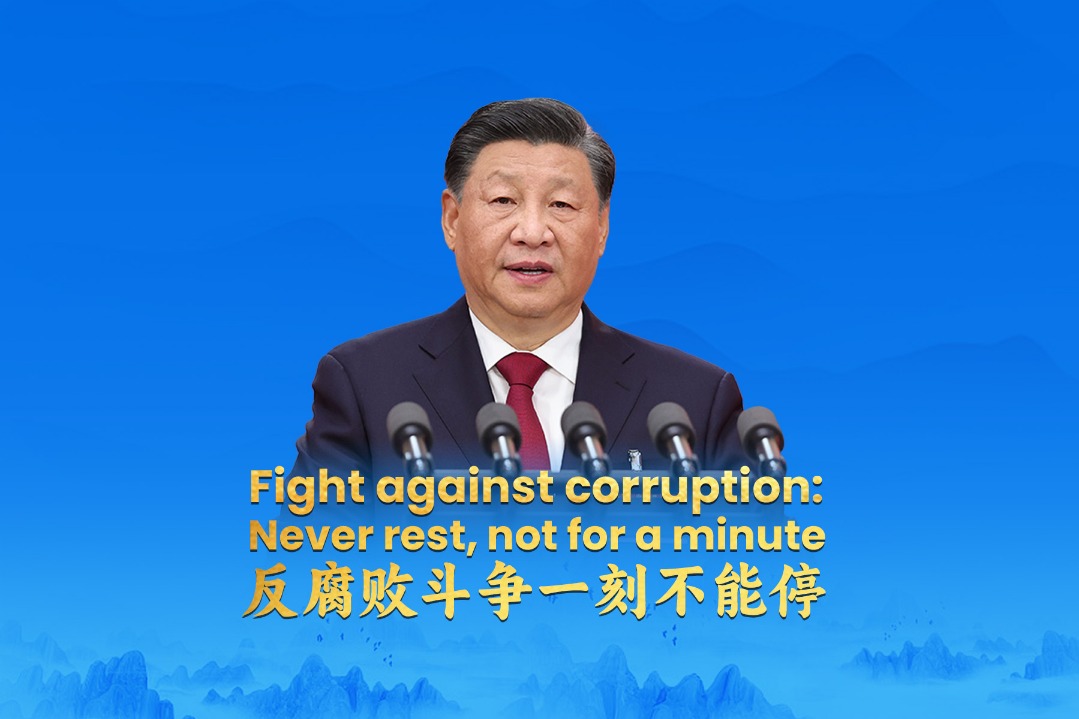
The first time I heard the idea to "promote a sense of community of shared future for mankind" proposed by President Xi Jinping at the 18th National Congress of the Communist Party of China (CPC) in November 2012 and in 2013 at the Moscow State Institute of International Relations, one word came to mind: brotherhood. This is the idea behind the concept that highlights China's hope in establishing a harmonious world where all could live peacefully in a spirit of brotherhood.
Judging from existing worldwide trends, the disturbing trend toward snowballing political divergence in the global community, and the socioeconomic disparities existing among developed and developing nations, the vision for a community of shared future is the culmination of China's notions to improve the existing international order. Therefore, China thinks working with the key players as well as other nations has become all the more important toward sustaining economic globalization, maintaining the system of global governance and ultimately promoting a community of shared future, based on equal opportunity and access to economic wealth, development and growth.
Based on this, the concept, which represents China's vision of a more just, secure and prosperous world order, has the potential and promise to contribute toward a more equal and economically equitable world. The community of a shared future offers the world Chinese wisdom and a new solution toward the advancement of human society. The idea is politically, socially and culturally inclusive of all societies with the end goal of building a world which is not only open and inclusive, but which enjoys lasting peace, universal security, and common prosperity. Since the community of a shared future is inclusive of all nations and regions, it is worth saying that the concept has direct applicability to the United Nations Sustainable Goals. As such, the Chinese leadership thinks cooperation toward attaining the goals of African Union's Agenda 2063 and the United Nations 2030 Agenda for Sustainable Development and building on the principle of "leaving no one behind", the novel agenda, which emphasizes a holistic approach to attaining sustainable development for all based on mutual respect, fairness, justice and win-win co-operation, should be a top priority for the international community.
In terms of multilateralism, this reaffirms why China multilateral diplomacy – the pillars underpinning the community of a shared future and the nation's long-standing Five Principles of Peaceful Coexistence: mutual respect for sovereignty and territorial integrity, mutual non-aggression, non-interference in each other's internal affairs, equality and mutual benefit, and peaceful coexistence, still apply to the nation's foreign policy and external engagements. Through the positions taken at multilateral platforms aimed at embracing and promoting global peace and stability, as well as through its development projects, such as the Belt and Road Initiative, China's leadership at the global level has further been accentuated by the contribution the nation has made in terms of supporting nations in fighting the COVID-19 pandemic.
This is because after the world was affected by the COVID-19 pandemic, China instantly attached significant importance to promoting global cooperation, which included the sharing of information on the COVID-19 pandemic with the global community, providing bilateral and multilateral assistance to affected nations, particularly in the continent of Africa, as well as other forms of multilateral assistance.
The above contributions that China makes to the international community and toward multilateralism stem from the remarkable headway that the Chinese government has made domestically, in terms of its internal reform process, its engagement with the outside world, and its integration in the global economy. These factors are some of the ingredients that have injected rich vitality into the China-Africa relations and promote sustainable development to build a community with a shared future.
As for China-Africa cooperation, and in terms of promoting development and growth on the African continent, China's vision for a shared future has turned out to be increasingly relevant as this implies striving toward a common and mutually beneficial future, wherein the continent of Africa can meaningfully benefit and take part in the vision. Since China has advocated for a policy of peaceful development and the promotion of stability through development and economic growth, China has proved to be an ideal partner for the African continent and is an integral move toward promoting growth and development in Africa. China's engagement with the continent is underpinned by the China-Africa Forum of Co-operation, including its bilateral relations with African countries at political, economic, social and cultural levels.
While FOCAC under the community of shared future continues to be a fruitful instrument for Africa and China policy, a successful international cooperation model setting the pace for sustained multilateralism; it is also a reminder of the United States diplomatic shortfalls in Africa. No wonder it is hard to remember the last time many African nations had their president photographed with a United States president let alone received an invitation to visit the White House. Even when Zambian President Hakainde Hichilema went to Washington this September, he met with Vice-President Kamala Harris but not Biden. And yet, a regular meeting with the president of China is something that every African leader can count on through FOCAC. This is a testament to the fact that the strength of FOCAC under the community of shared future lies in the principles of sincerity, pragmatism, affinity good faith, cemented by warm friendship, solidarity, trust, mutual respect, following the solidarity and cooperation in addressing the COVID-19 pandemic and, while supporting it with major economic and financial initiatives, for instance, the BRI and the Asian Infrastructure Investment Bank.
While the United States has simultaneously focused on keeping sanctions and security engagements on the high side with the United States President Joe Biden recently announcing that Ethiopia, Mali, and Guinea would be ineligible for duty-free trade access to the United States starting January 1, 2022, , China public diplomacy campaigns focus on relationship-building with African nations and broad media coverage of all forms of cooperation. As such, under FOCAC, China has focused on health, economic engagements and anything that can inject economic vitality into China-Africa cooperation over and above security and normative concerns, and on face time with African leaders and people-to-people exchanges.
Therefore, as the world strives for recovery, we might have turned a blind eye to the feats of a community of shared future, the truth is, for a changing world eyeing for closer cooperation and a stronger, more resilient post-pandemic global economy, the world coming together under the platform of the community of shared future would be a powerful tool for the post-COVID-19 global economy recovery.
The author is executive director, Center for Nigerian Studies, at the Institute of African Studies, Zhejiang Normal University.
The opinions expressed here are those of the writer and do not necessarily represent the views of China Daily and China Daily website.
If you have a specific expertise, or would like to share your thought about our stories, then send us your writings at opinion@chinadaily.com.cn, and comment@chinadaily.com.cn.