Escape from the zero-sum trap
Western policymakers must relinquish their ingrained value-judgments and assumptions that are leading the world to a disastrous confrontation









The 50th anniversary of the historic visit of former US president Richard Nixon to Beijing in 1972 is an important opportunity to reflect on the current situation in the China-US bilateral relationship. That visit had worldwide repercussions. It changed the course of the Cold War. It helped the integration of the People's Republic of China into the international system, especially at the United Nations. But the formal establishment of China-US diplomatic relations only took place in 1979, after the United States agreed to the principle of one China. This step boosted the reform and opening-up process and facilitated the access of US companies to the giant Chinese market.
Despite some disputes, Washington and Beijing nurtured a respectful and collaborative relationship until 2011, when the Barack Obama administration announced the US would "pivot to Asia", revealing the US strategy to contain China. During the Donald Trump administration, this policy of containment intensified with the US launching a trade war and initiating sanctions against Chinese companies, such as Huawei. Recently, contrary to expectations of a "detente", the Joe Biden administration deepened the sanctions against China, further deteriorating the relationship.
In the past 50 years, China has overcome the shackles of underdevelopment and become the world's largest economy in terms of purchasing power parity and made significant advances in technological and scientific fields.
The relationship between China and the US is no longer asymmetrical, but has become equal. Currently, none of the major problems faced by the international community can be solved without China's participation.
This situation has shocked the hegemonic power. The US has always seen itself as an exceptional country destined to lead the world. However, the reality is dynamic, as Paul Kennedy stated in his book The Rise and Fall of the Great Powers: "The relative strengths of the leading nations in world affairs never remain constant, mainly because of the uneven rate of growth among different societies and of the technological and organizational breakthroughs which bring a greater advantage to one society than to another."
The increase in rivalries has fueled a great debate in the field of international relations, especially among those who consider a war between an established power and an emerging power to be inevitable. Even before the adoption of the so-called pivot to Asia strategy, conservative political scientists in the US had already suggested the inevitability of confrontation with China. But this assumes that international relations only work on a "zero-sum game" basis, in which the development of one country must necessarily overshadow the position of another.
This logic is deeply rooted in realism, the primary theoretical current of international relations, whose greatest exponent was Hans Morgenthau. In his perspective, the ultimate goal of any state is its survival, and its power must serve to defend its national interests against others.
Regarding this mainstream in international relations theory, the British academic Susan Strange states in her book States and Markets, "I think the literature of contemporary international political economy has, first, been too much dominated by the US academics and has therefore been permeated by many hidden and even unconscious value-judgments and assumptions based on US experience or on US national interests." The assumption about an inevitable conflict starts from this assumption.
The perspective that international relations work as a zero-sum game is implicit in Graham Alison's book Destined for War: Can America and China escape from the Thucydides's Trap. In this work, he reduces Western history since the 15th century to a pattern of behavior between the established power and the rising power in the context of a struggle for hegemony. In this pattern, war occurs in 12 out of 16 situations. Because of this, he notes that a war between the US and China would be very likely these days.
However, in the fourth part of the book, Allison tries to identify points that could serve as a basis for both to avoid confrontation, particularly because of their strategic weapons, in which a conflict would have no winners:"... If the US and China were to stumble into a war in which their full nuclear arsenals were launched, both nations would be erased from the map. Thus, their most vital interest is to avoid such a war. Moreover, they must find combinations of compromise and constraint that avoid repeated games of chicken that could inadvertently lead to this dreaded outcome."
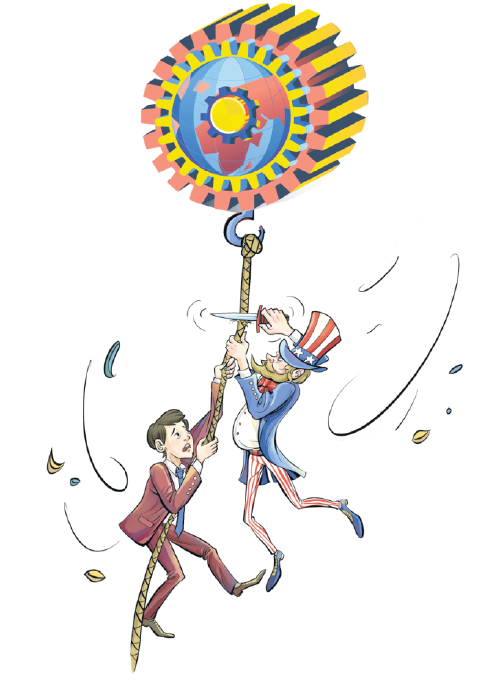
The mindset of US government and Western analysts is trapped in a zero-sum game. They cannot conceive of international relations as a win-win game or the US being a peer among peers. Because of this, they have disregarded the Chinese proposal to build a "new type of great power relations", made in 2010 at the second Sino-US Strategic and Economic Dialogue. Such a formulation proposed the path of shared gain and non-confrontation, not only between China and the US but also considering the interests of Russia and the European Union.
Unfortunately, nothing has progressed in the last 10 years, as the Western perspective of the zero-sum game shapes the warmongering mentality of Western foreign policymakers and imputes its own intentions and prejudices to other international actors.
Unlike the US, China does not assign itself a civilizing mission, does not want to export its values and political system, and does not have an official religion. In short, it does not seek hegemony.
A healthy China-US relationship is the only way to bring greater peace, prosperity, health, security and a sustainable environment for all mankind. For that, it is necessary for the US to relinquish its zero-sum mentality.
The author is a professor of international political economy at Sao Paulo State University. The author contributed this article to China Watch, a think tank powered by China Daily. The views do not necessarily reflect those of China Daily.
Contact the editor at editor@chinawatch.cn