Humans and the evolution of algorithms
Cultural influences mean Chinese and US views on the rise of artificial intelligence are markedly different









Nowadays, the discussions on artificial intelligence mostly focus on the technology and its application in various industries. Relatively little has been said about how AI can affect humanity and society. But in the second half of 2021, two books offered different answers.
In September 2021, The Intelligence Industry Revolution by Lin Dong, a professor at the National Defense University, was published, followed by the Chinese translation of The Age of AI: And Our Human Future by former US National Security Advisor Henry Kissinger, former Google CEO Eric Schmidt, and Daniel Huttenlocher, the inaugural dean of the MIT Schwarzman College of Computing.
In an article Kissinger published in The Atlantic magazine in 2018, he said human society is unprepared for the rise of AI. Based on research since the emergence of AI, the two books outline the relations between the technology and politics, discuss the impact AI is having on societies, and propose introducing a global mechanism for the controlled use of AI.
However, the positions of the two books are different. The former stresses that humans will drive the intelligence industry revolution through AI, while the latter highlights that human beings will have to face an AI-driven revolution. Both books propose that the rise of AI is unstoppable and that human societies face a great upheaval, with the authors expecting different prospects.
While The Age of AI: And Our Human Future proposes that with the development of AI, the world will increasingly rely on machines powered by data and algorithms and be less guided by ethical or philosophical norms, which will affect human perception, cognition and interactions, The Intelligence Industry Revolution proposes that as machines take over many tasks, humans can focus on higher-level work requiring perception, cognition and awareness. The greatest difference in the conclusions can be attributed to the differences between Eastern and Western culture. While Western culture focuses on reasoning, Eastern culture features on insight.
Both books set the year of 2020 as a watershed moment while offering different development plans for the revolution of the industrial society.
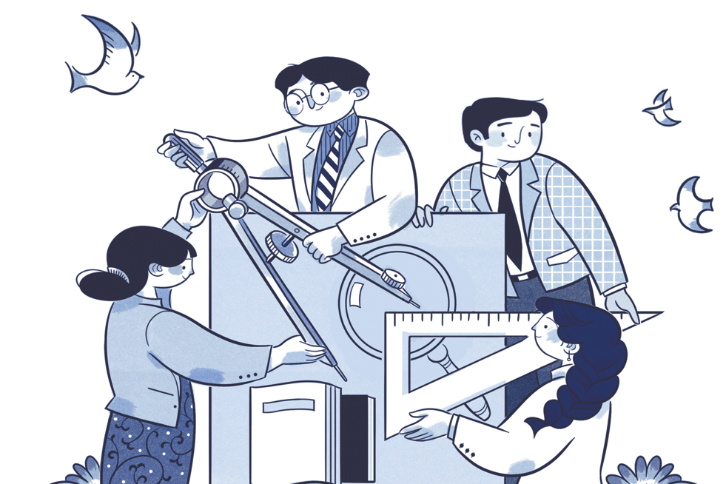
China's intelligence industry revolution explains how AI can assist humans to build an intelligent society to replace the industrial society. According to the "holistic futurology" proposed by Lin, the industrial society will be transformed into an intelligent one. Lin proposes that human labor will be transformed during the intelligent industry revolution, leading to changes in most work scenarios. The revolution of production modes will lead to reforms of productivity and production relations, which will drive the reshuffling of the social division of labor and change social classes. Lin's predictions include that intelligence will become the means of production, and as humans shift their focus to intelligent creation, the intelligent creation industry will outmatch industrial production and agricultural production, and interaction and sharing will replace division and exchanges in social production. Internet-based cooperation will replace jobs in the workplace, and intellectual professionals will rise and break the capital monopoly. In an intelligent industry society, the right to use the means of production will be revolutionized, for which Lin proposes economic, institutional and organizational reform based on the sharing economy, and foresees the development of a platform-based, open-source and cooperative economy combining the market-oriented economy and public welfare. The progress of philosophy and scientific thought are also highlighted, suggesting that the Chinese author is concerned about how humans can use AI to create more opportunities for human well-being.
The US authors focus on how to cope with AI's impacts on the industrial society. Their book reviews the development of AI technology and its social impacts, proposes that it may completely overtake human intelligence, and discusses the rise of global internet platforms and possible changes in the geopolitical landscape.
Although both books focus on transnational platforms, the former focuses on economic reform while the latter focuses on the possibility of those platforms participating in international politics. The latter also focuses on the military use of AI and its impacts on international security, and proposes AI arms control and mutual restraint between technologically developed countries. The US authors are more concerned about challenges facing the current international order in the era of AI.
Both books end with philosophical discussions. The Chinese and US authors reflect on rationality, explore the potential of human wisdom, and call for new thinking for the AI era. The difference is that the Chinese book explores a philosophical worldview beyond rationality, while the US warns AI challenges rationality.
The Chinese work stresses that emerging economies can drive the industrial economic revolution through AI and stop copying Western industrialization approaches, while the US work proposes to maintain the Western-dominated industrial and knowledge systems. However, both books illustrate the deficiencies of the Western democratic system and social governance faced with the rise of AI, and turn to morality. The Chinese work proposes to boost the transformation to a society based on a credit system in which governments can empower the application of AI. The US authors call for moral self-discipline and the redistribution of rights, and propose establishing a national AI committee involving political, business and academic communities to address crises.
There may be a third option and more discussions are expected.
The author is director of the Institute of American Studies at the Chinese Academy of Social Sciences. The author contributed this article to China Watch, a think tank powered by China Daily. The views do not necessarily reflect those of China Daily.
Contact the editor at editor@chinawatch.cn