Up in the air









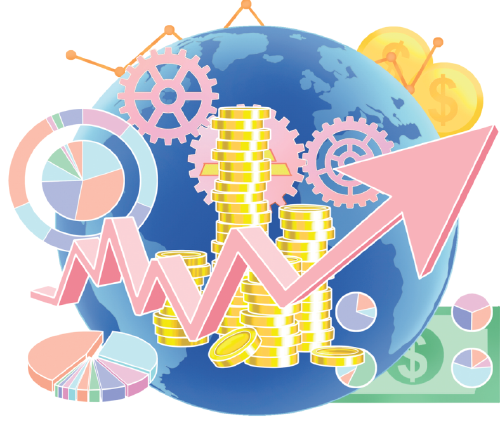
JIN DING/CHINA DAILY
Uncertainties stemming from the US could set back the global recovery
The global economy saw a relatively quick recovery in 2021, with China and the United States being among the first countries to see production returning to pre-pandemic levels. The problems that remain unresolved are the global governance deficit and the long-term confrontation between China and the US.
Looking ahead, there are a number of risks looming though in 2022.
The shift in US monetary policy could spark turmoil in financial markets. As the US inflation rate is rising faster than expected, the Federal Reserve has strengthened its resolve to curb it, with its stance becoming hawkish.
But financial risks associated with interest rate hikes and the shrinking balance sheet are rising. One of the triggers are zombie companies in the US bond market. At present, zombie companies account for nearly 10 percent of listed companies in the US, and nearly half of the corporate bonds in the bond market are rated BBB, which is the lowest level of investment grade.
If these bonds are downgraded to junk bonds, investment funds will be forced to undersell on a large scale, triggering debt risks.
The US stock bubble is also of concern. In 2021, US stock markets repeatedly hit new highs. In early November, the price-earnings ratio of the Dow Jones industrial average was about 30, nearly the highest level in its history. The bubbles in the US stock market are more severe than the dot-com bubbles. During the last policy tightening cycle, after the US federal funds target rate was increased to 1.5 percent and the 10-year Treasury yield rose to 2.5 percent, the stock market experienced a sharp correction.
Meanwhile, some developing countries have defaulted on their debts. With the increasingly uneven global recovery, the debt burden of developing countries has soared. The International Monetary Fund predicted in October 2021 that the output of the advanced economies will return to pre-pandemic levels by 2022, while aggregate output of the developing economies (excluding China) is expected to remain 5.5 percent below the pre-pandemic forecast in 2024.
The uneven distribution of vaccines and the lack of macro policy space have delayed the economic recovery of developing countries and further aggregated their debt burdens. In 2020 alone, the debt-to-GDP ratio of such countries increased by 18 percentage points, the largest increase in 40 years.
Due to the Fed's monetary policy shift, developing countries will face multiple shocks such as capital outflows, currency depreciation and rising financing costs. Nearly half of all low-income countries are facing debt troubles.
A targeted decoupling of supply chains is also in the pipeline. In February, the US will issue a comprehensive report reviewing and evaluating supply chains, and it could roll out more targeted policies for its technological blockade and the return of key supply chains. A series of laws that have been adopted by the US recently, such as the Infrastructure Investment and Jobs Act and the Build Back Better Act, will come into force this year, and the United States Innovation and Competition Act, which is now under legislative process, will probably be passed and implemented. These laws are all aimed at enabling the return of supply chains, while promoting the targeted decoupling in terms of products, technologies, industries and regions with China.
This year, there could also be further reshaping in the supply chains due to diligence laws in the European Union, which is aimed at strengthening the control of human rights and climate issues in the supply chain. In addition, Western countries may also enhance the ideological and geopolitical nature of supply chains and promote partial decoupling through the US-EU Trade and Technology Council, the Supply Chain Resilience Initiative between Japan, Australia and India, the supply chain cooperation among Quad nations, and the anti-coercion legislation in the US and the EU.
At the same time, resource nationalism is on the rise. The quick economic recovery and global energy transition have widened the gap between the supply and demand of natural resources, and the bargaining power of resource-rich countries has increased. Meanwhile, with the pandemic exacerbating their fiscal crises, the governments of resource-rich countries are eager to increase their revenue. These factors have all contributed to a significant rise in resource nationalism in the context of rising global protectionism.
Since the onset of the pandemic, key resource exporters have stepped up intervention by nationalizing resources, increasing taxation, prohibiting exports, and stipulating that higher value-added processes must be completed domestically.
In the coming years, the mining sector could be the hardest-hit by resource nationalism. In the context of the energy transition, the strategic importance of mineral resources, including copper, aluminum, cobalt, lithium and nickel, have been reinforced. Resource-rich countries that are highly dependent on resource exports are most susceptible to resource nationalism. Key countries include the Democratic Republic of the Congo and Zambia in Africa, Peru, Chile and Mexico in Latin America, and Indonesia and Mongolia in Asia.
The intertwining of various risks mentioned above will likely make the global economic growth rate in 2022 significantly lower than international institutions' forecasts which have been between 4.1 and 4.9 percent. To be more specific, if developed countries scale back their stimulus policies, financial risks could be triggered and spread to the world. Meanwhile, the intensified rivalry between major countries, the abuse of sanctions by the US, the intensification of geopolitical conflicts and the rise of resource nationalism may all trigger a butterfly effect in the complex global output network, bringing about serious supply shocks and even stagflation. With the resonance between traditional and non-traditional security risks, and in particular the possible mutation of the novel coronavirus and its continuous spreading, the economic recovery of some countries could be interrupted.
The author is director of the Institute of World Economics and Politics at the Chinese Academy of Social Sciences and the leading expert of the National Institute for Global Strategy. The author contributed this article to China Watch, a think tank powered by China Daily. The views do not necessarily reflect those of China Daily.
Contact the editor at editor@chinawatch.cn