Catering for continent's needs









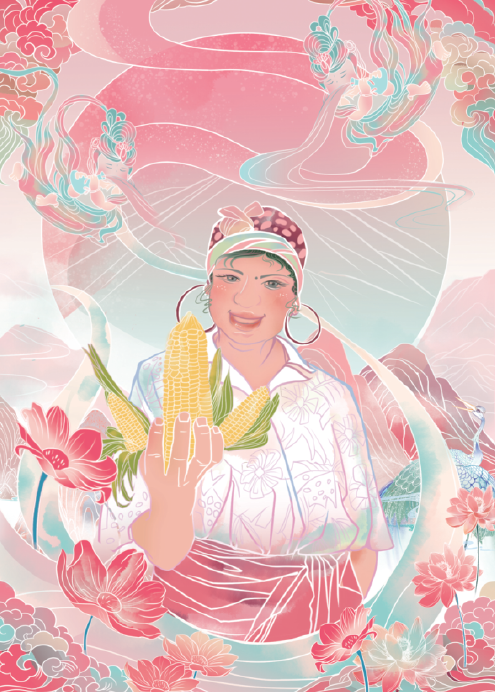
China is committed to supporting Africa to achieve food security through agricultural modernization
Food security reveals the embarrassing predicament of Africa's agricultural development. On the one hand, Africa accounts for nearly 60 percent of world's uncultivated fertile land. On the other hand, it spends $35 billion a year importing food to feed its population of 1.3 billion. The unsuccessful transformation of resource endowment into practical productivity that can guarantee people's livelihoods lies in the intrinsic fragility of African agriculture.
With smallholder farmers as the primary practitioners, agriculture in most African countries has yet to embrace modernization. The insufficient technological engagement and dwindling financial support mean there has not been a stable harvest for years. Additionally, the vulnerability of African agriculture has also been exacerbated in the past decade by the intensified natural disasters emanating from the impacts of climate change, as well as the conflicts and unrest in many parts of the continent. The outbreak of the novel coronavirus has further deteriorated the imbalance between the rapid growth rate of the local population and effective food supply.
According to statistics published by the Food and Agriculture Organization of the United Nations, while global cereal production has been outpacing consumption demand for consecutive years, Africa has still faced cereal scarcity. Local cereal production in 2020 was only 208 million metric tons, or about 7 percent of world's total production, far below Africa's proportion of the global population, which is about 17 percent. Meanwhile, the 8 to 20 percent increase in the price of cereals caused by the ongoing Russia-Ukraine conflict is drastically eroding Africa's purchasing power to offset its food deficit through imports.
Alongside the devastating food security crisis, the prevalence of undernourishment continues to be a stubborn obstacle preventing Africa from giving full play to the dividend of having the world's youngest population. The Cost of Hunger in Africa study, a project led by the African Union Commission and the New Partnership for Africa's Development Planning and Coordinating Agency and supported by the UN Economic Commission for Africa and the UN World Food Programme, has warned that the resurging undernourishment rate, which has already rebounded to above 20 percent, notably among juveniles, may lead to a 1.9 to 16.5 percent GDP loss, constituting a severe challenge to the Agenda 2063 development blueprint drawn up by the AU.
As an integral part of the bilateral comprehensive strategic partnership, China-Africa ties on agriculture are essentially equal cooperation rather than that between a donor and its beneficiaries. With the road map of implementing 10 new poverty reduction and agricultural projects, as well as dispatching 500 agricultural experts in the upcoming three years, outlined at the Eighth Ministerial Conference of the Forum on China-Africa Cooperation in Dakar in November 2021, Africa is empowered to explore a more feasible approach toward sustainable food security through agricultural cooperation with China.
Risk resistance capacity of African agriculture is expected to be boosted. The sluggish year-on-year growth rate of about 3.6 percent of cereal production from 2011 to 2020 only guarantees the continent can harvest 172 million metric tons of cereal a year, according to the World Bank, due to the vulnerability of local backward traditional farming. Technological, financing, talent and equipment support from China will help to transform African agriculture from its current labor-intensive mode to a knowledge-intensive mode, which will cover every single link of the whole production process with protection of scientific management against various external impacts such as natural disasters and epidemics. Together with well-run China-Africa demonstration parks for paddy rice in African countries such as Tanzania, Zambia and Equatorial Guinea, the proposed new agricultural projects will replicate their success to more parts of the continent. The African Development Bank predicts that the host countries of China-sponsored projects in Africa will be pioneers, stabilizing their agricultural production within the time period of Dakar Plan of Action of the FOCAC.
The market competitiveness of African agriculture is also expected to be boosted. Apart from providing a stable food supply, standardized production procedures learned from China can improve quality and help promote brand building for African agricultural products. Through contract farming and e-commerce platforms in China, African agricultural products can be directly matched with consumers' orders from China, and their brand influence can find resonance in the market of the world's second largest economy. Against the backdrop that China has committed to provide preferential treatment such as green channels and zero tariffs to African agricultural exports in the China-Africa Cooperation Vision 2035, Alibaba-sponsored "Hema Village" in Rwanda will provide a reference to integrate more African products, such as chili, pistachios, and sesame, into the robust China-Africa agricultural trade. Through these efforts, improved added value and strengthened profitability of African agriculture will eventually lay a solid foundation of turning the natural endowment into agricultural productivity.
Cooperation for Africa's agricultural modernization is China's concrete and pragmatic step to answer Africa's call for resilient nutrition in the pandemic-impacted anfractuous development environment. As the material basis of African economic and social development, a modernized agriculture will in turn nurture China-Africa cooperation in other fields within their overall partnership architecture, and dynamically pave the way for China's more active and innovative engagement in Africa's persistent exploration toward inclusive and sustainable development.
The author is deputy director of the Security Studies Division at the China-Africa Institute. The author contributed this article to China Watch, a think tank powered by China Daily. The views do not necessarily reflect those of China Daily.
Contact the editor at editor@chinawatch.cn