Mend the gap









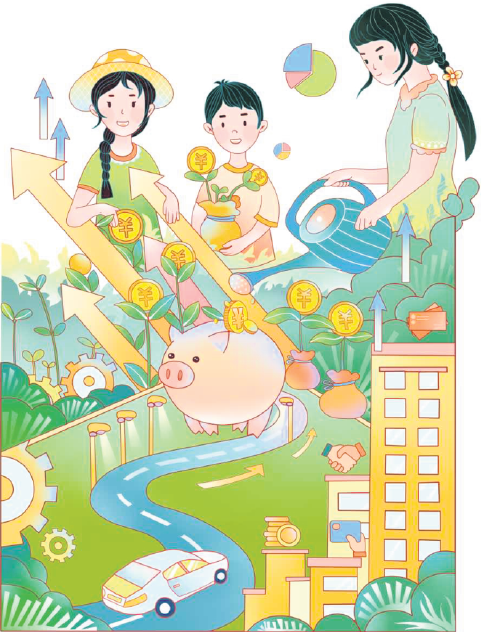
China is in an important period when it must boost its spending on social welfare provision
China's per capita gross national income may well exceed $12,695 this year, which is the threshold between the upper-middle income and high income countries set by the World Bank, and so rank among high income countries, which is the goal for 2025 set by the 14th Five-Year Plan (2021-25) and 2035 Vision. Accordingly, China's goal of joining the middle rank of high-income countries by 2035, which have a per capita GDP of about $23,000, can be confidently expected to be realized.
But those thresholds dividing income groups are only statistical markers of development. What China strives toward and endeavors to realize is the nation's modernization, which is scheduled to proceed through two periods-that is, realizing basic modernization by 2035 and becoming a modern country in all respects by the middle of the century. The tasks and challenges facing China can be depicted by the gaps in a variety of modernization characteristics between the present and the target dates.
While individual countries advance along different roads to their unique modernization, they do share similarities in modernization in terms of objectives and the measures adopted to achieve them. Taking the most suitable path to accomplish the common objectives, therefore, is the general law for success.
There are a handful of indicators that characterize the commonalities shared by the modernized countries. The improvement in those modernization indicators from the status quo to the desired level is the process of modernization. In the final stage of modernization, closing the gaps in key indicators requires a spurt with ever larger efforts. One such gap that China urgently needs to close is between that of the current government expenditure on social welfare and the targeted level, as indicated by its percentage of GDP.
In this regard, German economist Adolph Wagner was the first person to coin a general law for the development process. He asserted that as per capita income grows, people tend to need a greater provision of public goods and services such as social protection, enforcing antitrust law and other regulations, guaranteeing the performance of contracts, and the supply of culture, education and welfare. That forms a positive correlation between per capita GDP and government expenditure. Such a stylized fact has been tested by statisticians and economists and is now recognized by many as Wagner's Law.
World Bank data show that government expenditure as a percentage of GDP grows particularly rapidly during a period in which a country's per capita GDP increases from $10,000 to $23,000. On average, the proportion of government expenditure in GDP increases roughly 10 percentage points, or from 24 percent to 34 percent, which may be referred to as Wagner's acceleration period. In the years to 2035, China will be in this period. Overall, the ratio of government spending to GDP in China is not low by international standards. However, there is room to improve its structural composition. That is, the proportion of government spending used for social welfare is relatively small in China, compared to the member states of the Organization for Economic Cooperation and Development.
Government spending can be broken down into three parts: the expenditure on economic activities, for administrative operation, and for social welfare. According to the Chinese Academy of Social Sciences, in 2019, China's government expenditure as a percentage of GDP was 33.6 percent, while the average of OECD countries based on the World Bank data was 28.7 percent. However, the share of social welfare in government spending was 43.8 percent in China and 68 percent on average in the OECD countries. That suggests that if we are concerned about social welfare growing in tandem with income growth, China will have to raise its public expenditure on social welfare significantly from its current level.
Closing that gap is especially relevant to China in its sprint to realize basic modernization by 2035.
First, it will enhance Chinese people's gratification. Modernization is not only about GDP, in size or per head, but also about happiness. In a more advanced stage of development, people's satisfaction needs to be gained across a much broader range. For example, the Human Development Index calculated by the United Nations Development Programme tries to measure people's well-being based on per capita GDP, education, health, and other indicators in the social sphere. Promoting human development requires enhancing expenditure on social welfare in general.
Second, it will help to expand household consumption. In 2021, the natural growth rate of the population in China was only 0.034 percent and the proportion of population aged 65 and above was 14.2 percent. In an aged society approaching population peaking, China's household consumption tends to be weak and as a result, economic growth tends to be constrained by the weakening demand. A fuller coverage, better quality, and universal provision of social welfare can stimulate consumption by improving society's income distribution and families' propensity to consume.
Finally, it will be helpful in raising the birthrate in the long run. China is no exception to the general trend that the birthrate declines as society and the economy develop. However, there is room for China for a rebound. As a general trend, with a very high level of human development and gender equality, the willingness to have children tends to rebound. In particular, in China's case, given the heavy financial burden shouldered by families in bearing, caring and educating a child, there is a desire for children that is unfulfilled. Beyond all doubt, strengthening basic public services that cover all people and their whole life cycle will promote human development and reduce families' burden alike.
The author is the chief researcher of the National High-End Think Tank at the Chinese Academy of Social Sciences.
The author contributed this article to China Watch, a think tank powered by China Daily.The views do not necessarily reflect those of China Daily.
Contact the editor at editor@chinawatch.cn