US agenda seen as no more than move to contain China









Washington inciting confrontation, undermining peace, analysts say
As a major advocate of the "Indo-Pacific "agenda of the United States, Japan has been calling for early implementation of Washington's Indo-Pacific Economic Framework for Prosperity long before President Joe Biden's visit to Tokyo.
A week after the visit, however, people in Japan have started to ask questions as analysts say the initiative is really little about "prosperity" but more about "proscription".
"Nobody has doubts now that Washington's 'Indo-Pacific' agenda is to create division by allocating so-called allies and partners to counter China," said Liu Qingbin, a former professor at the Institute of Advanced Sciences at Yokohama National University in Japan and now senior researcher at the China Digital Economy Institute. "Their wildest dream is to exclude China, to proscribe signing members from doing business with China."
"Everybody knows that's not possible," Liu added.
Japan has been part of the behind-the-scenes efforts for the establishment of the IPEF since it was notified about the plan last summer. Yet until the launch of the initiative last week, Tokyo was vacillating on whether its main focus should lie on the IPEF or the Comprehensive and Progressive Trans-Pacific Partnership Agreement, or CPTPP, a trade pact that had its origins in the Trans-Pacific Partnership. The latter never got off the ground after its one-time lead backer, the US, pulled out of the deal. Japan has joined the CPTPP.
"We genuinely welcome the rollout of the IPEF in Japan and strongly support it," Japanese Prime Minister Fumio Kishida said when Biden launched the IPEF in Tokyo alongside India's Prime Minister Narendra Modi.
But minutes later, at a joint news conference with Biden, Kishida gave encouragement for the US to join for the CPTPP. He did so despite knowing full well that Biden can't afford to ignore the strong sentiment against the trade deal at home.
Kishida went on to mention the trade agreements six times, while Biden stayed tight-lipped on the subject.
"Japan hopes to see the United States return to the (CP) TPP from a strategic perspective," Kishida said.
As a former diplomat, Kishida had no reason to bring up this moment of awkwardness. The reasons for doing so partly lie in the vague description of the IPEF, which contains big words like "nontraditional", with little detail about its "benefits", if any.
The White House said the IPEF contains four pillars: improving the resiliency of supply chains; cooperation on digital trade; ramping up clean energy and infrastructure; and enhancing tax and anti-corruption measures.
Washington said that IPEF members could choose how many of the four pillars they wanted to join. Japan joined all four of them to no surprise.
But as observers soon found out, the US said the IPEF will not include any new access to the US market for products from Asian countries, despite Japan's suggestion it should be included.
"That makes the situation now that what countries in Asia want is exactly what Biden cannot give," Liu said, adding that it left the arrangement "only a framework" to help blunt criticism that Biden's "Indo-Pacific "strategy is "all guns but no butter", meaning that his approach has been too focused on security and lacked an economic component.
Media reports in Japan said it urged the US to make the IPEF inclusive. The Asahi Shimbun newspaper quoted unidentified government sources as saying that the US had relied on Japan to make US proposals acceptable to other Asian countries during negotiations.
But a recent poll conducted by Japan's Foreign Ministry showed that the foundation and promising prospects of cooperation between China and Southeast Asian countries are unshakable.
The result of the poll showed that China has replaced Japan as the most important partner of ASEAN countries, with 48 percent choosing China as their "important partner in the future" while 43 percent chose Japan and 41 percent favored the US.
Given that China has remained ASEAN's largest trading partner for 13 consecutive years, with two-way trade hitting a high record in 2021 of $878.2 billion, Liu said the IPEF is going against a trend in the region, which is to advance regional integration and build an Asia-Pacific community with a shared future.
Critics of the IPEF have been around in Japan for some time, as Asahi Shimbun said, "It is unclear whether the IPEF will evolve into a significant initiative, given that its objectives do not include reduction of tariffs, unlike traditional free-trade pacts."
Aside from economic reasons, others expressed grave concerns that US "Indo-Pacific" strategies like the IPEF will incite confrontation and undermine peace.
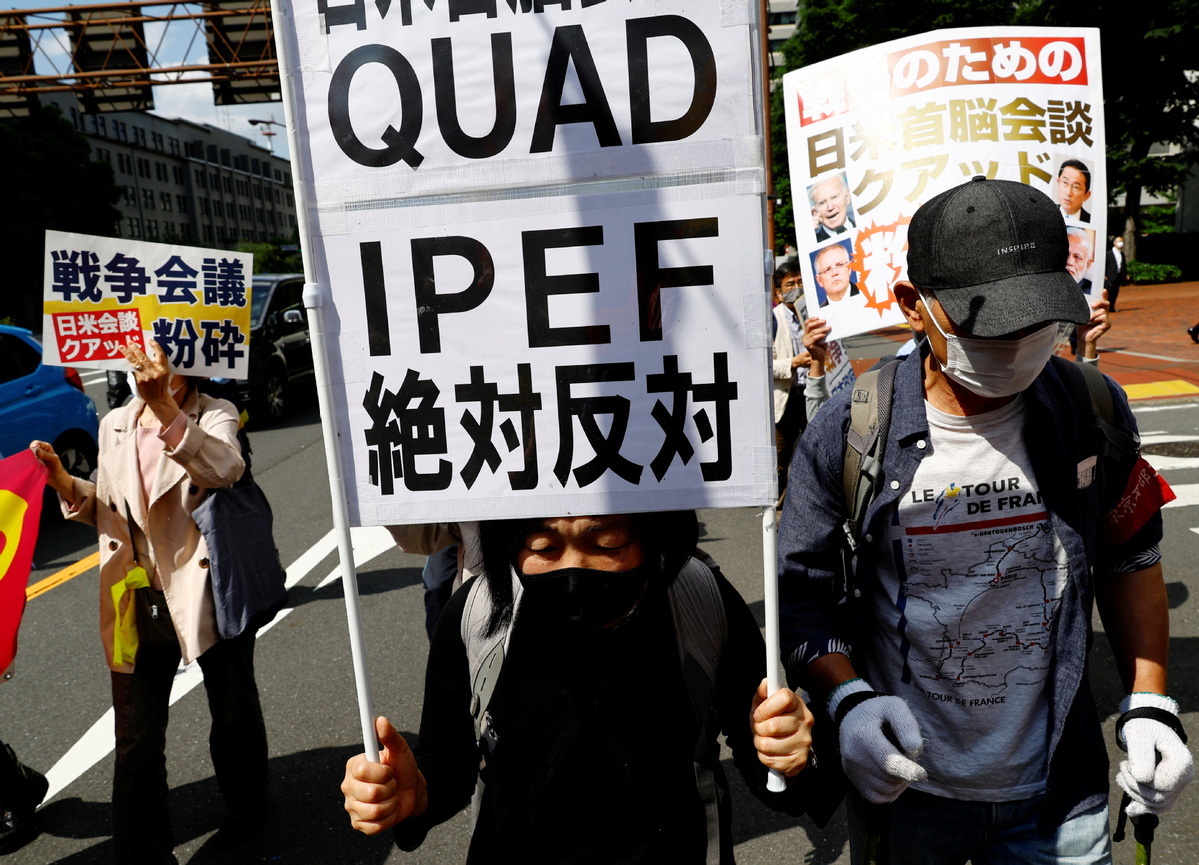
During Biden's first trip to Japan as president, there were rallies and gatherings in a number of places in downtown Tokyo denouncing the Japan-US summit for further strengthening military integration with Washington and accelerating the pace of Japan's military expansion.
On the day Biden arrived in Japan, over 700 people gathered in Shiba Koen, a park near the Tokyo Tower, to protest. Shunkichi Takayama a lawyer in Tokyo and one of the organizers of the event, said Japan is making a very dangerous move.
"Biden's visit to Asia this time will undoubtedly have an immeasurable negative impact on the peace and stability of the region," Takayama said, adding it would sow the seeds of regional unrest.
Outside Japan, politicians of signing members of the IPEF were more frank. Former Malaysian prime minister Mahathir Mohamad criticized the initiative, saying it was intended to isolate China and will not benefit regional economic growth without Beijing.
"The US will always want to use groupings like this in order to isolate China," Mahathir said at an international conference in Tokyo, adding the US should invite China to the IPEF if it is sincere. "Many countries recognize that IPEF is not an economic grouping, but a political grouping."
In an open letter to the Financial Times, Airlangga Hartarto, coordinating minister for economic affairs of Indonesia, said the US market must be part of Biden's "Indo-Pacific "trade initiative.
"I, too, call on the US to provide more details on this framework-and to have the US market added to the IPEF," the minister said.
"We must have equitable and comprehensive agreements which recognize the true potential of all parties," he said.
Another example showing the US is inciting confrontation in the region was the Quad statement, which is another document Biden secured during his Asia trip.
"China was the subtext in the statement," said Sourabh Gupta, a senior fellow at the Washington-based Institute for China-America Studies, even though there is no direct mention of China throughout the statement.
"The goal here is to give the impression that the Quad is not an anti-China encirclement body, but one that has a positive agenda of practical cooperation to furnish public goods in the 'Indo-Pacific' region. I think aside from the four countries, nobody else is fooled in this regard. Everyone understands that the Quad is directed against China. And frankly, even within the four countries, there are very few takers of their foreign policy line that the Quad is not China-obsessed," Gupta said.
Yifan Xu in Washington contributed to this story.