Coal's dominance a challenge for transition









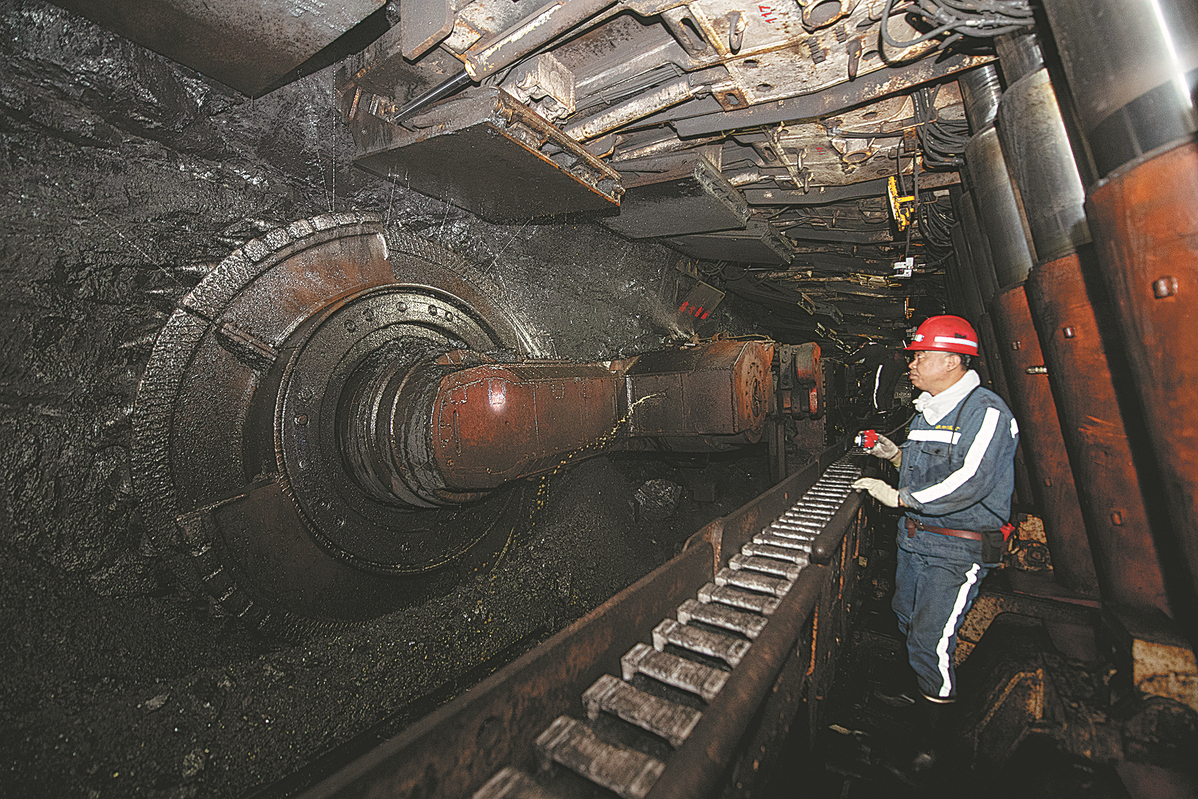
A special policy study from a high-level international think tank for the Chinese government has highlighted the challenges posed to the country's low-carbon transition due to its coal-dominated energy structure, saying that hasty decommissioning of coal-fired power will jeopardize energy security and may result in financial risks.
The study, Policy Measures and Implementation Pathways for the Carbon Emission Peak and Carbon Neutrality Goals, was unveiled on Wednesday on the sidelines of the annual general meeting of the China Council for International Cooperation on Environment and Development.
Coal constitutes 94 percent of the fossil fuel reserves in China. About 70 percent of the oil supply and about 40 percent of the natural gas in China is imported, according to official figures.
In the short and medium term, China's medium-to-high-speed economic development will bring about continuously rising energy demand, the study said.
The demand still needs to be partly met by coal despite this contradicting the country's rigid goal of phasing out coal and reducing carbon emissions.
"Energy security in the transition process is facing a severe test," it stressed.
It lists a series of challenges the country faces as China endeavors to phase out coal so it can peak carbon dioxide emissions before 2030 and go carbon neutral before 2060.
China's coal-fired generator sets are generally new. In 2020, they had operated for an average of 11 years, and 75 percent of them had been in operation for less than 15 years, only half of their designed service life, it said.
Early decommissioning of these units will strand assets worth many trillions of yuan, it said, thus the work should be carried out in a gradual manner.
Wang Yi, a leading author of the study, stressed the principle of "establishing the new before abolishing the old" in the country's low-carbon transition. China needs to build up a new power system and gradually phase out coal-fired power, he explained.
The installed capacity of renewable energy power generation in the country has reached 1 billion kilowatts and is expected to go beyond 6 billion by 2060, he said. Wang is also a researcher with the Institutes of Science and Development at the Chinese Academy of Sciences.
"It needs systematic efforts to build such a huge power system dominated by renewables," he said, adding that concerted efforts, for example, are needed to simultaneously promote the development of grid, energy storage and distributed power generation in the process.
The strong connection coal has with other industrial sectors makes it even more challenging to phase out, said the study. The power generation and steel industries, for instance, consumed 2.19 billion and 730 million metric tons of coal in 2020, respectively.
The study also warned of social issues related to coal reduction.
During the 13th Five-Year Plan (2016-20) period, China phased out outdated coal production capacity by 1 billion tons, it noted. Roughly 1 million workers in the industry were laid off and reemployed in the process.
With no relevant skills, workers in the coal industry are not likely to be favorites for enterprises in other sectors. It can be difficult to get them reemployed via vocational training, the study said.
It recommended that China carry out green and low-carbon energy policies "in a reasonable and orderly manner on the premise of ensuring energy security".
China should strive to realize that the new energy demand in the country is mainly met by renewable energy, it said. The energy transition process along the entire industrial chain should be planned systematically to better coordinate with upstream and downstream industries.