Fishing ban revives Yangtze finless porpoises









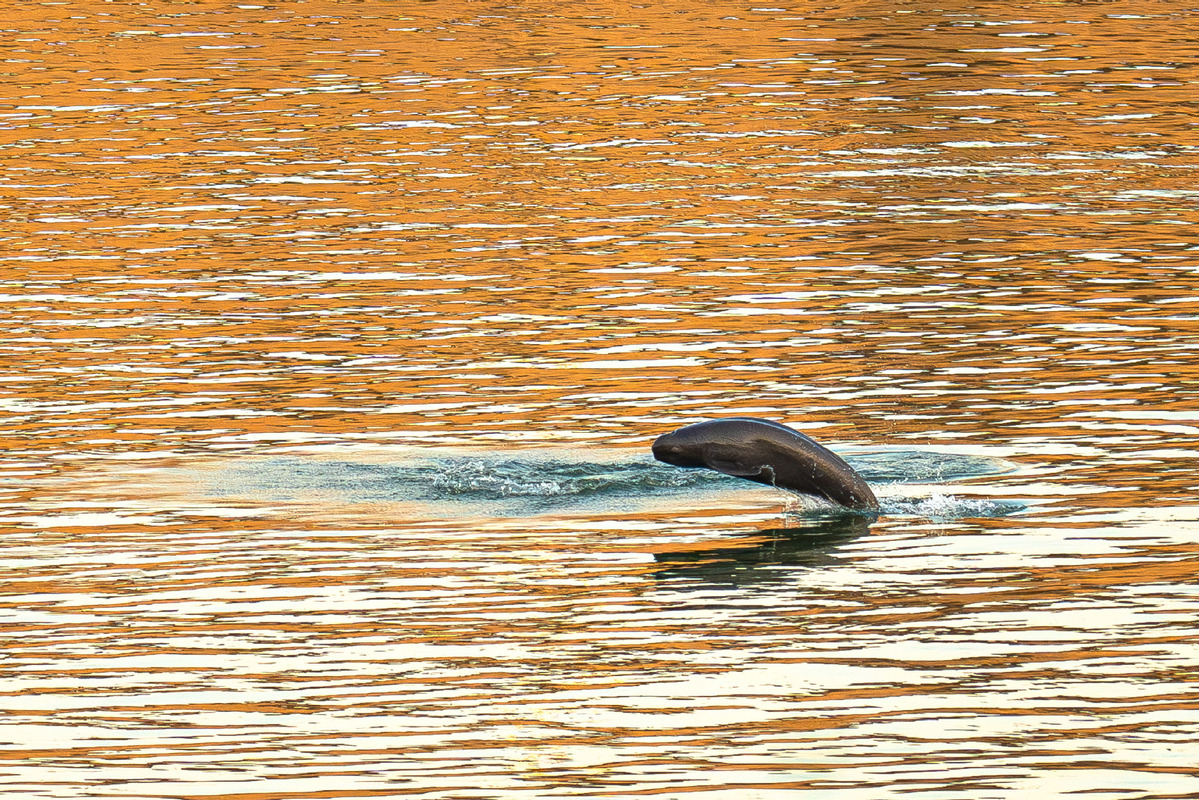
The population of the Yangtze finless porpoise, the only freshwater porpoise species in China's longest river, has risen to 1,426 in 2025, indicating that the fishing ban and other conservation efforts are reviving the ecosystem of the Yangtze River.
The figure, released in a 2025 survey, shows an increase of 177 individuals from the previous assessment in 2022 and represents a continued recovery since the decade-long fishing ban launched in 2021, the Ministry of Agriculture and Rural Affairs said on Friday.
Once numbering about 2,700 in the early 1990s, the flagship species of the Yangtze River fell to just 1,012 by 2017 due to human activities, according to research institutions.
"The recovery of the Yangtze finless porpoise reflects the overall improvement of biodiversity in the river basin and the gradual restoration of ecological vitality in our mother river," said Vice-Minister Zhang Zhili.
In recent years, sightings of porpoises surfacing and playing in river sections near Wuhan in Hubei province and Nanjing in Jiangsu province have become more common, he said.
Apart from the wild population, China has built a network of five conservation zones to protect porpoises relocated from severely degraded habitats. These protected waters now support more than 150 individuals, with more than 10 calves born annually, laying the foundation for replenishing wild populations in the future.
Meanwhile, researchers from the Chinese Academy of Sciences' Institute of Hydrobiology have established a freshwater cetacean sperm bank, providing technical support for overcoming breeding challenges, according to the ministry.
Despite the progress, the species remains critically endangered as the current population is still only about half the number in the 1990s, Zhang said.
To address these challenges, an upgraded action plan to conserve the Yangtze finless porpoise has been released, setting the goal of increasing the wild population to about 1,700 by 2030 and 2,000 by 2035.
The recovery of the porpoise shows broader improvements in aquatic biodiversity. Gui Jianfang, an academician with the CAS and head of the expert group for the fishing ban's midterm assessment, said fish species diversity and abundance across the Yangtze basin have rebounded steadily since the ban began.
From 2021 to 2025, monitoring recorded 351 fish species across the basin, 43 more than before the ban. The trend toward smaller fish sizes has been curbed, and the aquatic biological integrity index has risen significantly.
Gui said the index is a composite indicator reflecting the status of fish resources, the condition of important species, and habitat quality.
Five years after the fishing ban was introduced, fishery resources in the river have shown clear signs of recovery. In 2025, the unit biomass of fish in the main stream of the Yangtze reached 2.4 kilograms. "Overall fish density has doubled compared with the pre-ban level in 2020," he said.
Populations of key protected species have also begun to rebound. After an absence of more than 20 years, natural reproduction of the Chinese high fin banded shark, a nationally protected Class II species, was recorded in 2024 and 2025.
"As China presses ahead with the fishing ban and ecosystem restoration projects, the aquatic life in the Yangtze River is expected to continue its gradual recovery over the next five years," Gui said.
However, the full ecological recovery will take time, he said, adding that a small number of water stretches with severely fragmented habitats may require prolonged and large-scale restoration efforts.




- Fishing ban revives Yangtze finless porpoises
- Foreign diplomats hail Yunnan's opening-up efforts
- Coast Guard curbs foreign infringements
- Zimbabwe veterans hail historic bond
- Dazzling Guangzhou lantern display begins countdown to Spring Festival
- Huizhou takes major step forward as petrochemical hotspot