Belt and Road offers African opportunities for Hong Kong









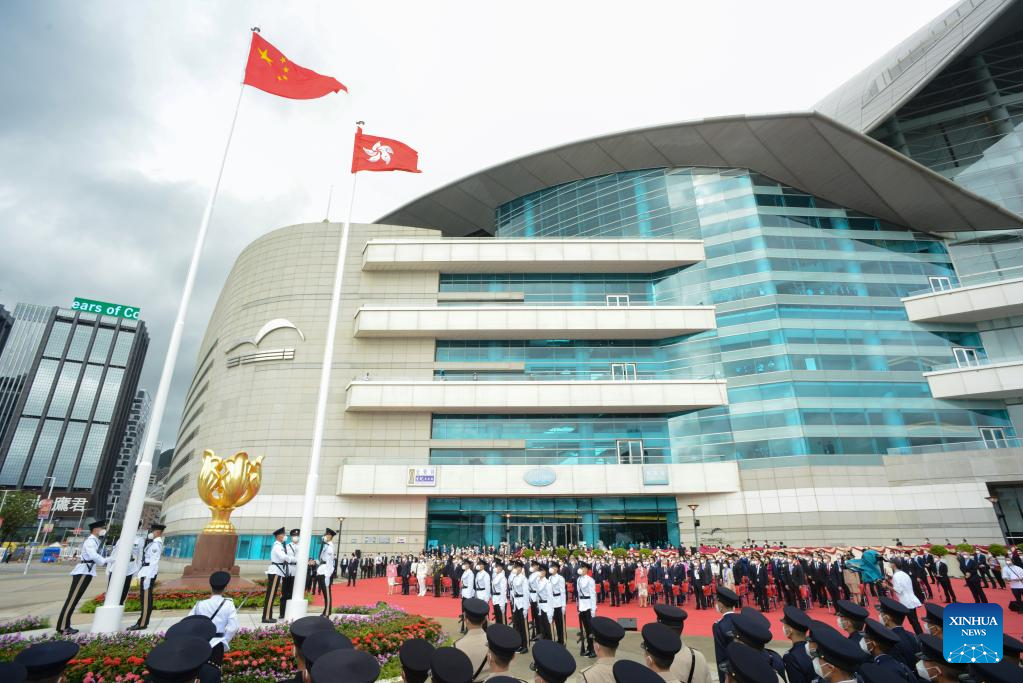
President Xi Jinping spoke of the Hong Kong Special Administrative Region "as an important window and bridge connecting the Chinese mainland with the world" in his keynote address on July 1 marking the 25th anniversary of the return of Hong Kong to the motherland.
The president singled out as a notable strength of Hong Kong that it is "enjoying the backing of the motherland while staying connected with the world".
In an address on June 30, Xi had said that Beijing will support Hong Kong "in leveraging its strengths and role in advancing the Belt and Road Initiative" and Hong Kong will enjoy "the backing of the motherland while staying connected with the world".
A BRI overview shows that nearly all African countries-49 of the continent's 54-have signed memorandums of understanding with China. Africa has seen more major BRI flagship projects than any other continent.
As long ago as 2013, President Xi vowed to intensify ties with Africa. In 2018, he hosted the Beijing Summit of the Forum on China-Africa Cooperation, and in 2021 he set out a blueprint for the development of China-Africa relations and committed to nine cooperative programs.
BRI projects are a vital part of the Chinese leader's vision for China's ties with Africa. Among the most visible African BRI mega-projects is Egypt's new administrative capital, under construction 45 kilometers east of Cairo, halfway to the seaport of Suez. A joint project between Egypt and China is development of the Suez Canal Economic Zone as an industrial, trade and logistics center.
Egypt is part of China's grand plan for the Maritime Silk Road, and so are the coastal countries of East Africa. Thus, BRI projects stretch all the way from Suez to Djibouti on the Horn of Africa, and to all the major ports of the East African coast.
The coastal projects also involve infrastructure linking them to Africa's domestic markets. For example, in Kenya, Chinese companies have built a 480 km railway from Mombasa to Nairobi. The modern track has reduced travel time between the port and the capital from 12 hours to only 4.5. An East African Railway Master Plan envisions rejuvenating the railways serving Tanzania, Kenya and Uganda and adding railways to serve Rwanda and Burundi.
Central African countries have also seen massive infrastructure and economic development projects. For example, President Xi visited Rwanda in 2018 and signed agreements with President Paul Kagame in Kigali. In May this year, construction began on the Nyaborongo II Hydropower Plant. By 2027, the 43.5 megawatt facility will be providing clean energy to Rwanda's national grid.
In West Africa, as well, BRI projects are underway. In Ghana, a Chinese delegation signed agreements to finance $2 billion for development of rail, road and bridge networks in 2019 and released an initial $649 million for road construction projects.
Similar major infrastructure projects are powering development across Africa, and China is also supporting the modernization of the continent's agriculture and education sectors.
Some Western critics have referred to the BRI as so-called "debt-trap diplomacy," in which, they claim, opaque loan terms lead to unsustainable debt. Others have claimed that the BRI has failed to produce economic benefits for African countries, or assert that the BRI is "neocolonialism".
However, objective studies by Western scholars have found that Chinese loans are not major contributors to African debt distress. Positive economic effects have been cataloged for most African countries, and research has suggested that BRI projects have important multiplier and spillover effects that are producing more equal distribution of economic activity.
Finally, it should be remembered that European colonialism was based on military occupation and the exploitation of a country's whole economy for the benefit of the imperial power: China can never be guilty of such "colonialist" actions.
In fact, the BRI's flagship enterprises in Africa are an impressive exercise of China's growing "soft power," demonstrating the success of its economy and its system of government. They are also a well-placed strategic bet on the continent's economic future.
Africa, the second-largest continent in terms of land mass, is clearly destined to become the world's largest market.
Long-term demographic projections of population growth-such as the United Nations' estimate that Africa will be home to more than 4 billion people by 2100-need to be viewed skeptically. We can be very confident, however, in the figures for 2030, for which the UN's median projection is 1.68 billion people.
BRI projects recognize the economic potential of Africa and aim to encourage its development of a middle-income group. They involve not only industrial and commercial infrastructure, but also the modernization of agriculture and education and other aids to social and economic development.
One result is already clear: The BRI has opened up African markets for Chinese businesses, while Africa has also gained tangible benefits from BRI projects.
Today, Hong Kong has better opportunities to follow Beijing's African BRI projects. It can help build new bridges and open new windows to that fast-growing continent. And that could prove to be this century's greatest economic opportunity.
The author is consul general of Egypt in Hong Kong.