Blocs spark concerns on divided world










China seeks to revitalize multilateralism, globalization, unity and connectivity
Editor's note: China Daily presents a series of in-depth reports to analyze how exclusive blocs create divides, conflicts and setbacks in the world, and how the greater international community works to shore up unity, peace and development.
President Xi Jinping used a metaphor to illustrate the clash of interests between exclusive, selfish geopolitical blocs and the greater international community when addressing the 14th BRICS Summit in June via video link.
"BRICS countries gather not in a closed club or an exclusive circle, but as a big family of mutual support and a partnership for win-win cooperation," he said.
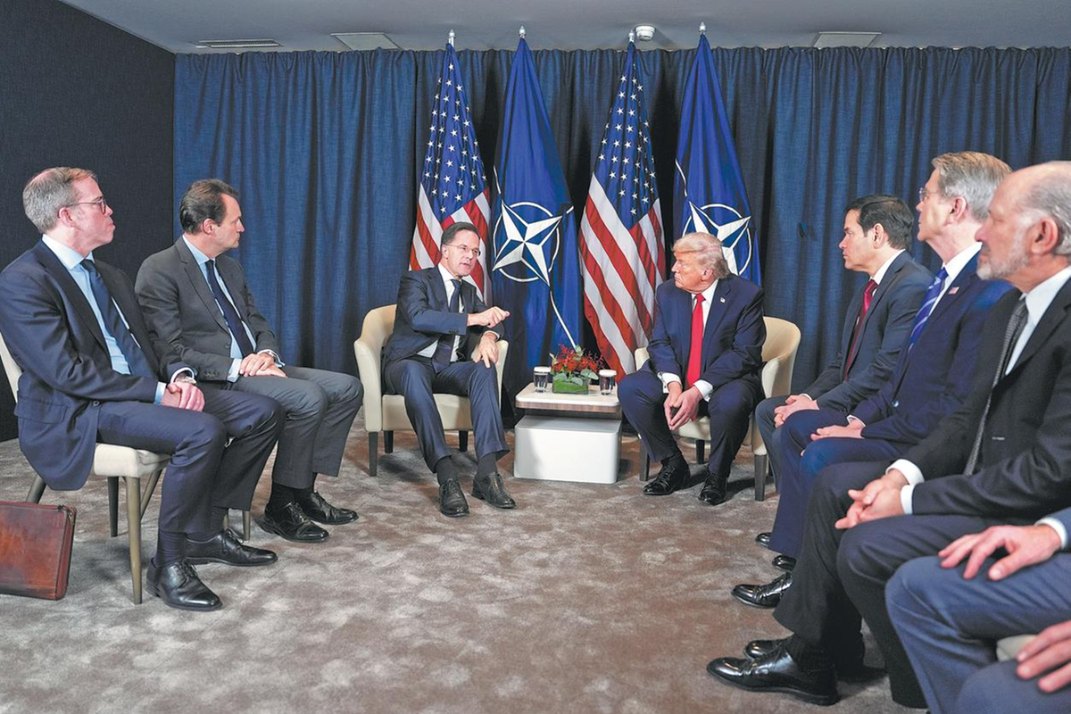
Countries' concerns over the impacts made by blocs such as NATO and the G7 on the world's common good have been rising in recent months.
Amid the lingering COVID-19 pandemic and the Ukraine crisis, the world as a "big family" faces greater divides and lack of momentum for growth because these exclusive blocs would continue to gain strength in the near future to advance their selfish agenda globally, said leaders, officials and experts from around the world.
And efforts made by countries such as China in order to revitalize multilateralism, globalization, unity and connectivity are good news in terms of narrowing these divides, building up the "big family" and keeping global governance afloat, they added.
The clashes between such blocs and the rest of global community could be best epitomized by the Ukraine crisis prompted by an ever-expanding NATO, walkouts by Western countries' officials at key global venues such as G20 meetings, and the US and its allies' recent criticism of China's military drills countering US House Speaker Nancy Pelosi's provocative visit to Taiwan.
The G7 foreign ministers issued a statement on Aug 3 expressing so-called "concern" over China's actions. Similarly, another joint statement on Aug 5 by US Secretary of State Antony J. Blinken, Australian Foreign Minister Penny Wong and Japanese Foreign Minister Yoshimasa Hayashi claimed that China's countermeasures "gravely affect international peace and stability".
However, more than 170 countries and many international organizations have spoken up by reaffirming their commitment to the one-China principle and expressing support for China in defending its sovereignty and territorial integrity, Vice-Foreign Minister Ma Zhaoxu said on Tuesday.
"Compared with over 170 countries, what do the G7 think they are?" he added.
Observers noted that more new blocs have been emerging over the past couple of years, including the trilateral AUKUS partnership by the United States, the United Kingdom and Australia, the Indo-Pacific Economic Framework launched in May, and the CHIP 4 semiconductor and chip production alliance being pushed by the US.
"The blocs sought by the Western countries are actually based on long-term strategic goals, politicizing the global agenda and seeking confrontation in areas including politics, the economy, security and culture," said Yang Baoyun, a professor of ASEAN studies at Thammasat University in Bangkok.
Selfish moves that run counter to the vast majority of countries in the world "are not short-term, temporary phenomenon and will be even more common in the near future", he said.
"The US and its allies will further specify their strategic goals by using international cooperative platforms as 'weapons', and the clashes and standoffs will be more severe and obvious," Yang said.
Shivshankar Menon, chair of the Ashoka Centre for China Studies and a visiting professor at Ashoka University in India, warned that "the Western alliance is more united than ever since the Cold War, with even Finland and Sweden abandoning neutrality to join NATO".
Other sharpening divides, including those between the rich and poor, "dominate international affairs and contribute to the fragmentation of economies and polities", Menon said in an article published last month on the website of Foreign Policy magazine.
Triggering crises
Last month, Bangladeshi Prime Minister Sheikh Hasina urged the US and its allies to shun the path of imposing sanctions, saying that the global supply chain is being heavily disrupted by sanctions that are triggering crises in relation to essential commodities across the world.
Javier Solana, former secretary-general of NATO, warned that as some Western countries are boosting their own unity to counter Russia or China, the world is "becoming increasingly divided, as the recent meetings of G20 finance and foreign ministers in Indonesia showed".
"This trend could carry incalculably high costs," he said in an article published on July 22, in which he warned of the world's possible failure in "ensuring the provision of global public goods".
Su Xiaohui, deputy director of the China Institute of International Studies' Department of American Studies, noted that under the pretext of multilateralism, the administration of US President Joe Biden "has been occupied in working on building new small circles or blocs across the globe in order to stir up confrontations", and bloc politics pushed by the US has developed new features.
"In the past, the cliques focused more on specific economic and security agendas. Now, US-led alliances are paying more attention to strategic and ideological-level agendas," Su said.
"Washington is also trying to build a greater alliance architecture that incorporates its various smaller blocs to ensure that such an alliance system better serves its hegemony," Su added.
Roberto Savio, a veteran journalist and founder of Argentina news agency Inter Press Service, noted that the North-South divide will increase in this multipolar world, and "an 'active nonalignment' could be re-created, which the media in Europe and the US will struggle to understand".
"The West still believes it is the center of the world, the United States in particular," he said in an interview with researchers published by local media on July 22.
In contrast, China and like-minded countries have been pressing ahead with their efforts to shore up multilateralism, improve global governance and boost global unity to make the world's big family even better, observers said.
Widely supported
An increasing number of countries are echoing China's proposal for building a community with a shared future for mankind, the Global Development Initiative and the Global Security Initiative.
During State Councilor and Foreign Minister Wang Yi's recent trips abroad, countries including Pakistan and Kyrgyzstan said they support and are ready to take an active part in the Global Development Initiative and the Global Security Initiative.
Pakistan highly appreciates China's leading role in upholding multilateralism, safeguarding world peace and tranquility, promoting global sustainable development and addressing global challenges, Pakistani Foreign Minister Bilawal Bhutto Zardari told Wang on July 28.
China stays committed to the vision of a community with a shared future for mankind and shoulders responsibilities as a major country, Mongolian Foreign Minister Batmunkh Battsetseg told Wang on Monday in Ulaanbaatar.
"Actually, 80 percent of the world's population lives in developing countries. Multilateralism should secure the interests of such a majority, and should not be subject to the military or economic power of a certain country," said Wang Yiwei, a professor at the School of International Studies and director of the Institute of International Affairs at Renmin University of China.
"Behind China proposing the BRI and the GDI is not a pursuit for isolation or self-interest, but making the 'pie' for the world even bigger by working together with other countries," he said.