Market, rule of law at core of SOEs reform









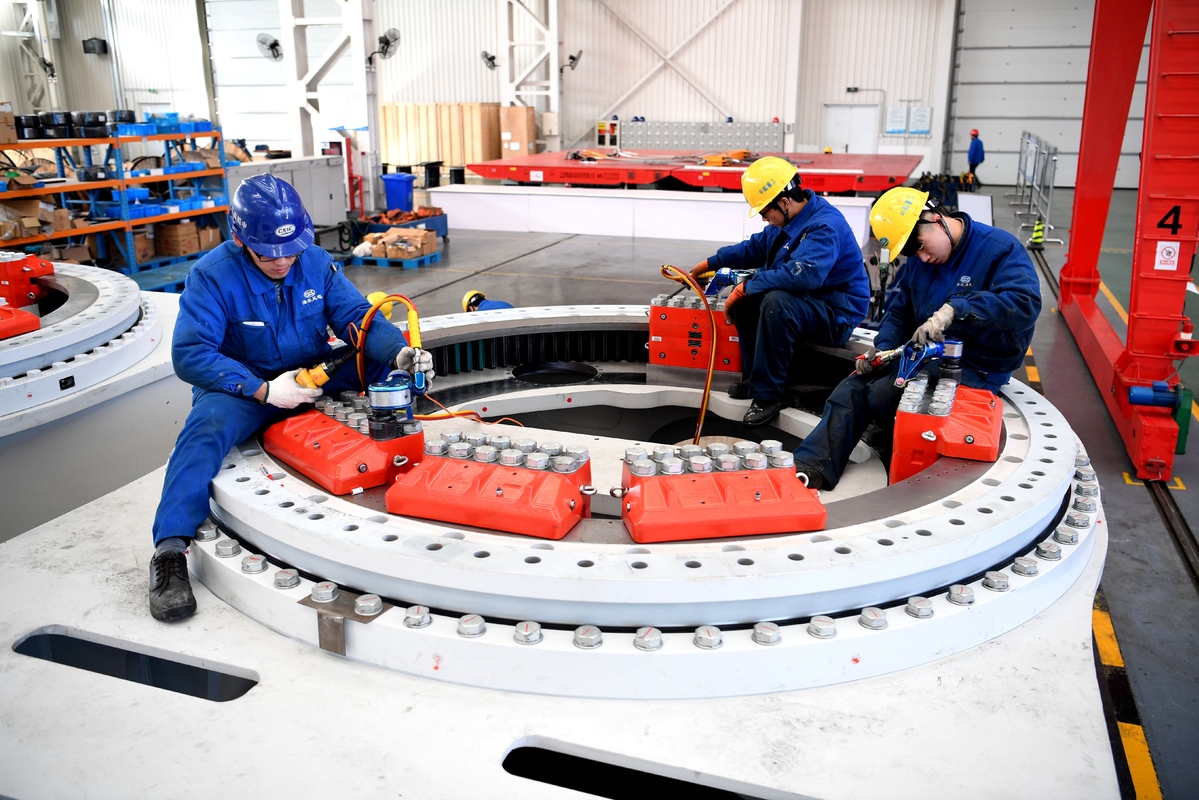
The measures taken to reform State-owned enterprises have produced significant results in the past three years, leading to some fundamental modifications in the SOEs and State-owned assets. Now that China is on the path to achieve modernization, the SOEs should improve their core competitiveness and functions, which is important to China's high-quality development.
Only a detailed study of the health and productivity of the SOEs can help promote marketization based on rule of law in the reform process. First, there is a need to build a modern corporate governance system with Chinese characteristics, and improve corporate governance through statutory and transparent governance mechanisms.
While the power of the business leadership should be fully transferred to the board of directors through market-oriented means, making it the top decision-making body for market operations, the pre-discussion and research into significant business management issues should be optimized, enhancing the performance of external directors and deepening the three institutional reforms to strengthen modern corporate governance mechanisms.
This should be followed by the implementation of a tenure system and contract mechanism for management officials, which will improve the market-oriented salary system and flexibly introduce various medium- and long-term incentives.
Second, the State-owned asset management system should shift to capital management, which is different from the past management system, as it focuses on assets, personnel and management. The State-owned Assets Supervision and Administration Commission of the State Council, China's Cabinet, was established in 2003, which, together with the State-owned assets supervision and management departments at different levels, adopted a three-pronged approach to assets, personnel and management.
Besides, market-oriented operation mechanisms were basically formed and the SOEs became perfect market entities during the 12th Five-Year Plan (2011-15) and 13th Five-Year Plan (2016-20) periods. And to facilitate reform and development, State-owned asset management has shifted from the three-pronged approach to focus on capital management.
The asset supervision departments have gradually transferred the management and operation rights of State-owned assets to the SOEs, giving them the management right and some control rights over State-owned capital. This allows the SOEs to operate and manage State-owned assets through a modern corporate governance system in a market-oriented manner, and, to some extent, decide the direction of State-owned capital investment, which is more conducive to strengthening the quality, efficiency and scale of State-owned capital and SOEs.
Third, the market-oriented approach to promote the integration and restructuring of the SOEs should focus on a single node or collaborative nodes of the industry, value and supply chains through market-oriented and law-based means.
The integration and restructuring should be carried out to earn "three benefits" (preservation and appreciation of State-owned assets, improvement of the SOEs' competitiveness, and expansion of State-owned capital's functions), and be based on "one profit and five ratios" (total profit, as well as return on net assets, operating cash ratio, asset-liability ratio, R&D investment intensity, and labor productivity).
Also, the authorities should promote diversification of equity, attract more strategic investors and industrial investors, and prudently encourage mixed ownership. The focus of the new round of integration and restructuring is on operating State-owned assets and resource-based State-owned assets. For high-quality construction of a modern industrial system that efficiently allocates resources and focuses on the functional positioning of the SOEs, market-oriented means should be used to facilitate professional integration and industrial integration.
While the authorities should promote professional integration in central and local SOEs and horizontal integration of corresponding industries to concentrate enterprises of one kind in one place and thus raise the level of intensive management, they should take measures to facilitate industrial integration based on the development of strategic emerging industries in central and local SOEs, as well as achieve breakthroughs in existing areas and open up various types of enterprises, in order to further develop a modern industrial system.
And fourth, with the new round of technological revolution and industrial transformation and the comprehensive upgrading of modern corporate governance, the SOEs, especially central SOEs, should strengthen their strategic management, corporate governance and control, and improve their operations and leadership to upgrade themselves to the level of world-class companies.
Furthermore, the SOEs should focus on sharpening their competitive edge in the international markets, strengthen their talent management capability, promote innovations, enhance their brand management and digital operation capabilities, and improve their merger and acquisition management. And like leading world-class companies, they should increase their industrial scale and system, and strengthen their risk-prevention and sustainable operation capabilities.
In short, the SOEs, particularly central SOEs, have to shoulder more responsibilities, develop new technologies and promote innovations, and become the vanguard of Chinese-style modernization.
The author is a researcher at the National Academy of Governance. The views don't necessarily represent those of China Daily.
If you have a specific expertise, or would like to share your thought about our stories, then send us your writings at opinion@chinadaily.com.cn, and comment@chinadaily.com.cn.