RCEP steers wheel toward recovery, stability









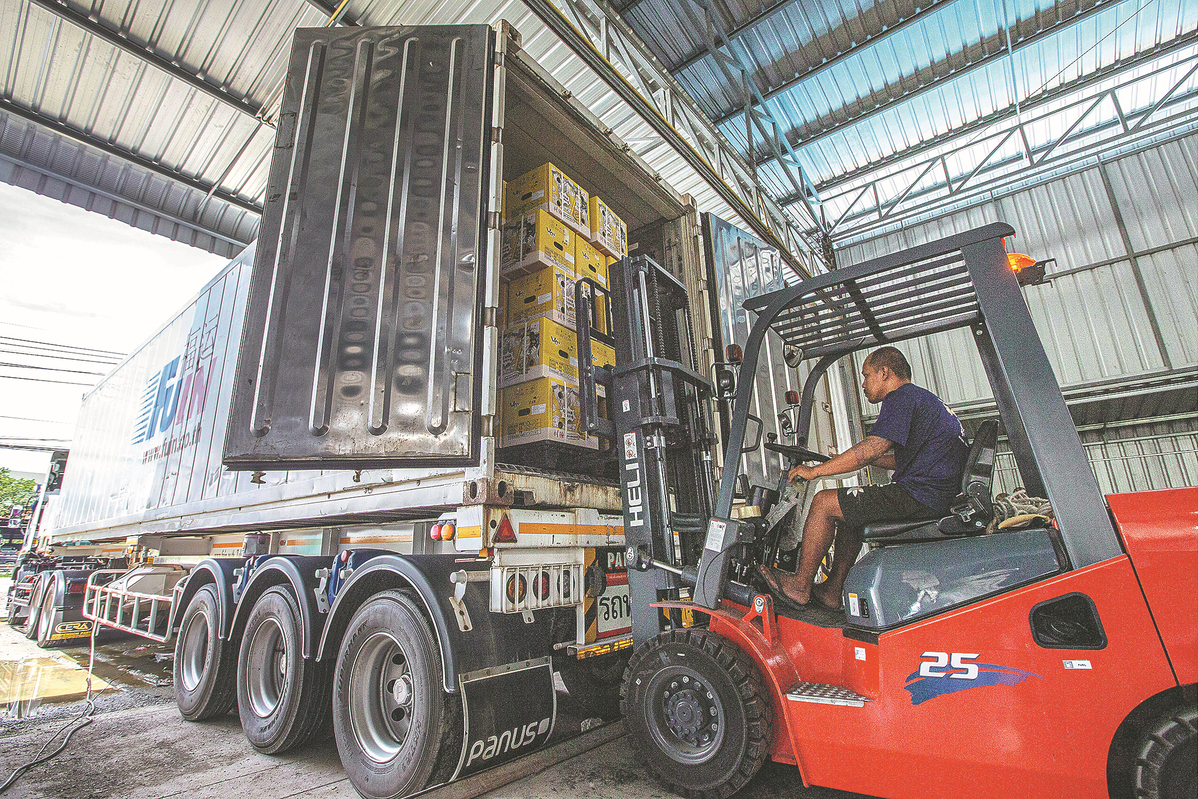
As the world emerges from the pandemic, the Regional Comprehensive Economic Partnership is poised to further facilitate trade flows and inject much-needed vitality into the global economy, which has been disrupted by uncertainties during past years, experts say.
The RCEP is an important institutional arrangement for regional economic integration in the Asia-Pacific region, offering a new paradigm for broader cooperation, they say.
The partnership was signed in November 2020 by 10 member countries of the Association of Southeast Asian Nations and Australia, China, Japan, New Zealand and South Korea.
Since the agreement came into effect for 10 of these countries on Jan 1, 2022, it has catalyzed intraregional trade and spurred economic development, observers say.
"The RCEP forges tighter economic bonds between the economies and integrates ASEAN 10+5 free trade agreement arrangements," said Li Siqi, an associate professor at the China Institute for WTO Studies at the University of International Business and Economics in Beijing.
The RCEP covers 2.3 billion people, $25.8 trillion of global GDP, $12.7 trillion of global trade in goods and services and 31 percent of global foreign direct investment inflows, according to the World Bank.
"Amid economic uncertainties and persistent downward pressure, the RCEP stands as a beacon of stability, offering member countries relatively predictable and secure trade expectations," said Zhang Miao, an associate professor of the School of International Relations/Research School for Southeast Asian Studies at Xiamen University.
As certain countries, amid global geopolitical risks, are initiating trade wars and pursuing decoupling, "the RCEP fosters mutual trust and serves as a stabilizer in navigating international uncertainties", Li said.
Buoyed by its commitment to further opening-up, China has emerged as a driving force in the global economic recovery by spearheading trade liberalization, experts say.
In 2022, China's imports and exports to the other 14 RCEP members reached 12.95 trillion yuan ($1.76 trillion), up 7.5 percent year-on-year, accounting for 30.8 percent of its total imports and exports, China's General Administration of Customs said. The figure reached 6.1 trillion yuan in the first half of this year, up 1.5 percent year-on-year.
"China's substantial economic scale serves as a vital source of reassurance," Zhang said. "It will have a positive effect on the global value chains and supply chains.
"Given the deeply intertwined interests among the countries, it can be said that the members' destinies are closely linked and stand to gain and lose together. This is what we can call 'economies of a shared future'."
'Inclusive' pact
Li hails the RCEP as "inclusive "because of members' different levels of socioeconomic development and because the pact involves not only developed economies such as Singapore and Australia, but also less-developed countries such as Laos and Cambodia.
Zhang said the agreement is like "a double-edged sword" for the less-developed countries because it presents both opportunities and challenges.
On one hand, these countries, by taking part in the pact, take on the "fast trajectory" of free trade; on the other hand, it elevates governance standards within them, she said.
The RCEP incorporates innovative policies applicable across diverse economies, she said. "The principle of cumulative rules of origin stands out as the most important institutional innovation of the RCEP as it is the embodiment of the multilateralism that China has long championed."
By setting a time frame for reducing tariffs, the RCEP focuses on reducing tariff barriers among member countries and on promoting the circulation of goods and services within the region, Li said. "The enhanced regional market cooperation not only alleviates disruptions in the global supply chains, but also mitigates risks from so-called decoupling."
Zhang said such an arrangement provides "a cushion period" for some of the participating countries.
"It enables the less-developed countries to safeguard their industries, and at the same time to reap benefits from the pact," Zhang said.
Penn Sovicheat, secretary of state of Cambodia's Commerce Ministry, said the RCEP has been a key driving force for Cambodia's export growth and has become a magnet for attracting more foreign direct investment inflows into the country.
Cambodia exported $7.21 billion worth of products to RCEP member countries in the first 11 months of 2023, up 27 percent from the corresponding period last year, said a ministry report published this month.
The Philippines was the last country to ratify the deal in February, which became fully effective for all 15 signatory countries on June 2.
Allan Gepty, the nation's lead negotiator in RCEP talks, hailed the entry as "a milestone for the Philippines".
According to the Asian Development Bank, the RCEP could increase the Philippines' exports by 3.7 percent by 2030, an addition of $7 billion.
"The RCEP introduces new ideas and solutions for global economic governance, that is, to jointly build a universally beneficial and inclusive economic governance system and promote economic cooperation," Li said. "It is believed that the RCEP will inject fresh momentum to the Asia-Pacific economic development."
Zhang said: "The RCEP reflects the commitment of a responsible major country toward further opening-up and providing a necessary international public good. The RCEP will deliver benefits for member countries and contribute to post-pandemic global economic recovery."