Intercultural dimensions of Spring Festival









About 9 billion passenger trips are expected to be made during the Spring Festival travel season this year, from Jan 26 to March 5. Not for nothing is the Lunar New Year the biggest festival of China.
Spring Festival sees by far the largest internal migration of people in the world — and it takes place every year. Hundreds of millions of workers travel back to their hometown every year to celebrate Spring Festival with their family. People in most other countries have no idea how much sacrifice these workers have to make in order to secure their livelihoods. And for many, this is the only opportunity to meet their family in one year.
Many cultural practices, rituals and customs contribute to the charm and appeal of Spring Festival. As a matter of fact, the Lunar New Year is also celebrated in countries such as Vietnam, Japan, the Democratic People's Republic of Korea, the Republic of Korea, Thailand, Indonesia, Singapore and Malaysia, as well as by overseas Chinese across the world.
There are many legends behind Spring Festival and many versions of those legends, with the most popular being about the monster "Nian". Nian, as the legend goes, used to emerge from his den in the dark sea on the eve of every Lunar New Year to invade the village and gorge on human and livestock flesh. So before every Lunar New Year's Eve, all the villagers would flee to the remote mountains to escape Nian's attack.
But before one Lunar New Year, an elderly man appeared in the village. He was offered some food by the villagers but asked to flee the village to escape Nian's jaws. But he refused to do so. Instead, he asked an elderly woman to let him stay in her home, and requested the villagers to not flee to the mountains.
The elderly man, who knew what Nian feared, pasted red paper on all the doors and windows of the old woman's home and kept them open, instead of closing them out of fear. He also lit bright lamps in and around the house. When the monster, curious to see why so many lamps were lit in one house, approached the house, the bright red color and the dazzling lights made him tremble.
Irritated, the monster stomped to the front door. But as soon he reached there, the elderly man and some of the villagers began beating drums, tolling bells and bursting firecrackers. The radiant red color, the blinding lights and the deafening noise of the firecrackers and drums were too much for Nian to take, and he fled the place never to return again.
The elderly man's knowledge and courage made the villagers realize that red color, bright lights and bursting firecrackers are the magic keys to scare away the monster.
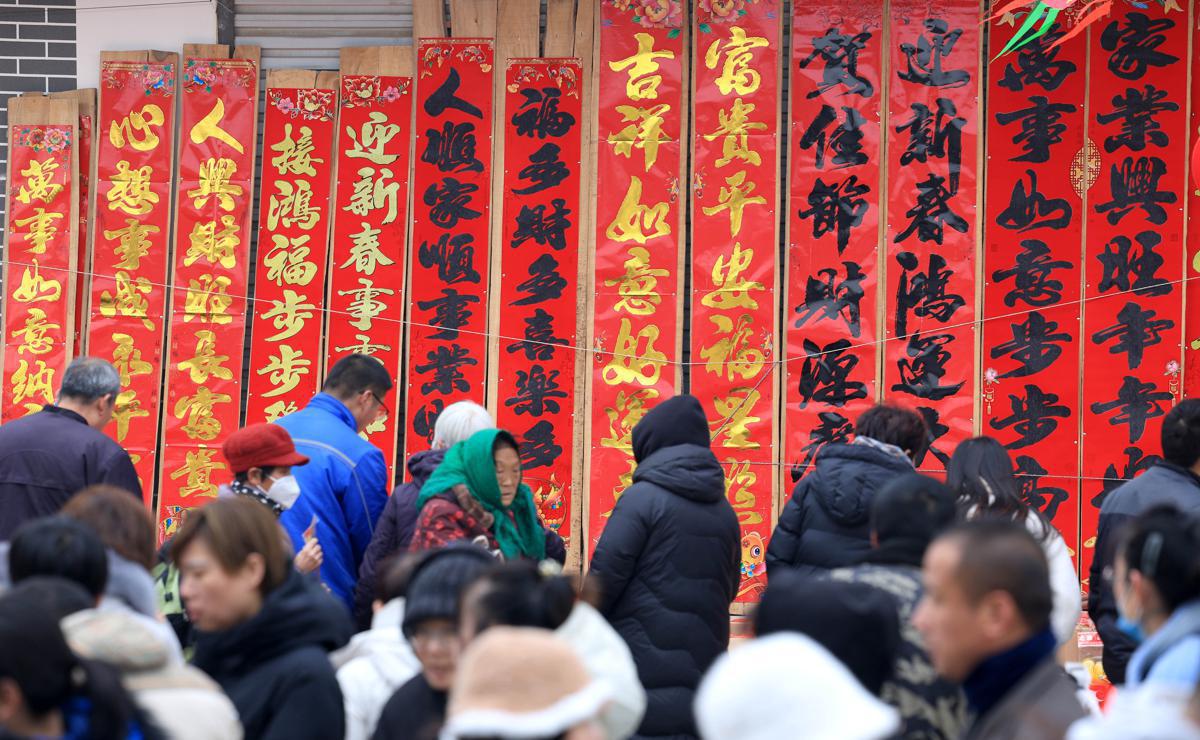
Till today, the Chinese people decorate their homes with red paper cuttings and lamps, light bright lights, and burst firecrackers as a symbolic ritual to dispel misfortune, and welcome prosperity and happiness. This is a classic case of acculturation and integration of identity elements from a source culture.
The intercultural mediation process is crucial and can be seen in the physical presence of the Chinese people in other countries, either in individual capacity or through institutions such as the Confucius Institutes, Chinese cultural centers or Chinese enterprises.
Spring Festival brings out the traditional Chinese cultural elements in all the Chinese people, whether they be in China or other countries. This collective behavior is observed wherever Spring Festival is celebrated.
However, Spring Festival is subject to certain rituals, conventions and customs that are manifested during a particular time of the year. It is a time for family reunion, meeting with friends and relatives, and welcoming a new year in the hope it will bring prosperity, happiness and social harmony.
Why do we love and celebrate festivals? Celebrating festivals provides a certain kind of relief, an escape from the humdrum of everyday life, a respite from worries. It is deviation from norms. In many respects, festivals and everyday life are interdependent. A festival is unthinkable without this difference.
Spring Festival is first and foremost a celebration of the family, and even if one celebrates it alone, the family is always present. Festivals, including Spring Festival, always strengthen an individual's involvement in the family as a social group, and by extension the wider community.
Festivals are occasions for celebration, and even if the myths, legends sagas and fairy tales of ancient times are used to heighten their appeal and value, they are always geared toward a certain meaning. The greetings on New Year, a birthday or a wedding are an assurance of a fulfilling existence.
Today, festivals, especially those celebrated in the West, are no longer associated with the unity of people, or with gods as in Ancient Greece or Ancient Rome. Yet they still have a transcendental aspect. In China, the transcendental aspect is manifested primarily through showing respect to ancestors. Spring Festival injects a new life into everyday life and ushers in a new year of hope, health and harmony. May this come true this year.
Xin nian kuai le!
The author is a professor at Hainan College of Foreign Studies.
The views don't necessarily reflect those of China Daily.
If you have a specific expertise, or would like to share your thought about our stories, then send us your writings at opinion@chinadaily.com.cn, and comment@chinadaily.com.cn.