Manila should settle disputes through talks









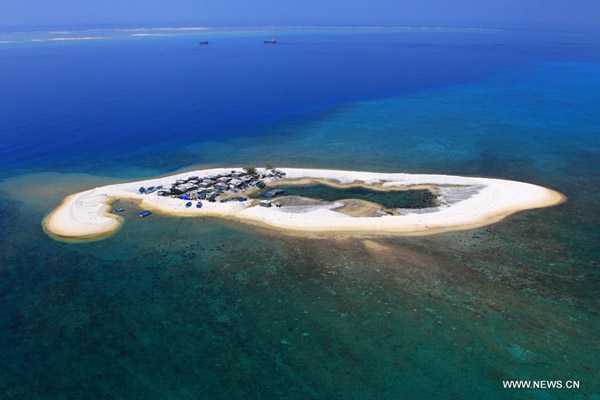
Philippine President Ferdinand Marcos Jr. delivered a speech at the 2024 Shangri-La Dialogue in Singapore on May 31, claiming that some international legal procedures are the expression of "good faith", reiterating the validity of the 2016 South China Sea arbitration awards, and saying that Manila has enacted domestic legislation in accordance with the South China Sea arbitration awards.
According to Marcos Jr., the South China Sea arbitration procedure conformed to the principle of good faith. But this implication is groundless. The reality is that Manila has neither fulfilled its international obligations nor interpreted or applied the United Nations Convention on the Law of the Sea in good faith.
First, the claim by the Philippines is devoid of any factual or legal basis, and thus violates the principle of good faith. Due to the Philippines' claim, the dispute was fragmented into various discrete pieces and brought under the jurisdiction of the Arbitral Tribunal by camouflaging them as mere disputes over maritime entitlements or activities at sea.
The territorial and maritime delimitation disputes are directly or indirectly related to the historical rights enjoyed by China, which is respected by, but not regulated under, UNCLOS. The claim of arbitration under UNCLOS, on the basis of provisions beyond the convention, is a violation of Article 300 of UNCLOS. The Philippines' claim is neither based on the interpretation or application of the provisions of UNCLOS nor the interpretation or application of an international agreement related to the purposes of the convention, and these violate Articles 279 and 288 respectively of UNCLOS.
Second, the Philippines' unilateral initiation of arbitration infringed upon China's right as a state party to UNCLOS to choose on its own will the procedures and means for dispute settlement. In 2006, China excluded itself from the compulsory dispute settlement procedures of UNCLOS concerning, among other things, maritime delimitation, historical bays or titles, or military or law enforcement activities according to Article 298 of UNCLOS.
However, the Philippines deliberately packaged these disputes as simple disputes over maritime entitlements or activities at sea, which brought the disputes under the compulsory dispute settlement procedures under Annex VII of UNCLOS.
Third, the Philippines failed to meet the precondition for friendly consultations and negotiations, and initiated the South China Sea arbitration without admissibility. According to Article 280 and Article 281 of UNCLOS, the content of the consensus of bilateral and multilateral agreements reached on full consultation is binding on the Philippines.
More important, the Declaration on the Conduct of Parties in the South China Sea is an agreement between the parties to the disputes. The Philippines has violated the consensus of the DOC that requires parties to settle disputes through friendly consultations and negotiations. It has also failed to fulfill its obligation under Article 283 of UNCLOS to exchange views with China on the settlement of the disputes.
Fourth, the entity awards in the South China Sea arbitration lack factual or legal basis. Above all, the Arbitral Tribunal wrongly dealt with the relationship between UNCLOS and the historical rights, and mistakenly denied China's historical rights in the South China Sea.
Furthermore, the tribunal improperly divided and isolated the legal status of the islands and reefs of China's Nansha Islands and Zhongsha Islands, and erroneously interpreted and applied laws, especially Article 121 of UNCLOS.
And fifth, the tribunal wrongly denied the legitimacy of China's activities in the South China Sea and unfairly concluded that China's activities had "aggravated or expanded (the) disputes". Hence, the tribunal erred in terms of fact-finding, and interpretation and application of law. And the tribunal's awards on certain important issues failed to "state the reasons on which they were based".
Therefore, it is wrong on the part of Marcos Jr. to imply in his speech that the proceedings in the South China Sea arbitration conform to the principle of good faith. The South China Sea arbitration exceeded its jurisdiction and misinterpreted the laws, which makes the arbitration awards invalid.
Hopefully, the Philippines will honor its commitments, confine its activities to maritime territory demarcated by international treaties, fully and effectively implement the DOC, and try to settle maritime disputes and differences through dialogue and consultations. China is ready to continue to work with the members of the Association of Southeast Asian Nations, including the Philippines, to maintain stability and peace in the South China Sea, and ensure it remains a sea of peace, friendship and cooperation.
The author is a senior researcher at the Institute of Chinese Path to Modernization at Nankai University, Tianjin, and a professor at the School of Law of the same university.
The views don't necessarily reflect those of China Daily.
If you have a specific expertise, or would like to share your thought about our stories, then send us your writings at opinion@chinadaily.com.cn, and comment@chinadaily.com.cn.