



Scientists work together to protect transnational species









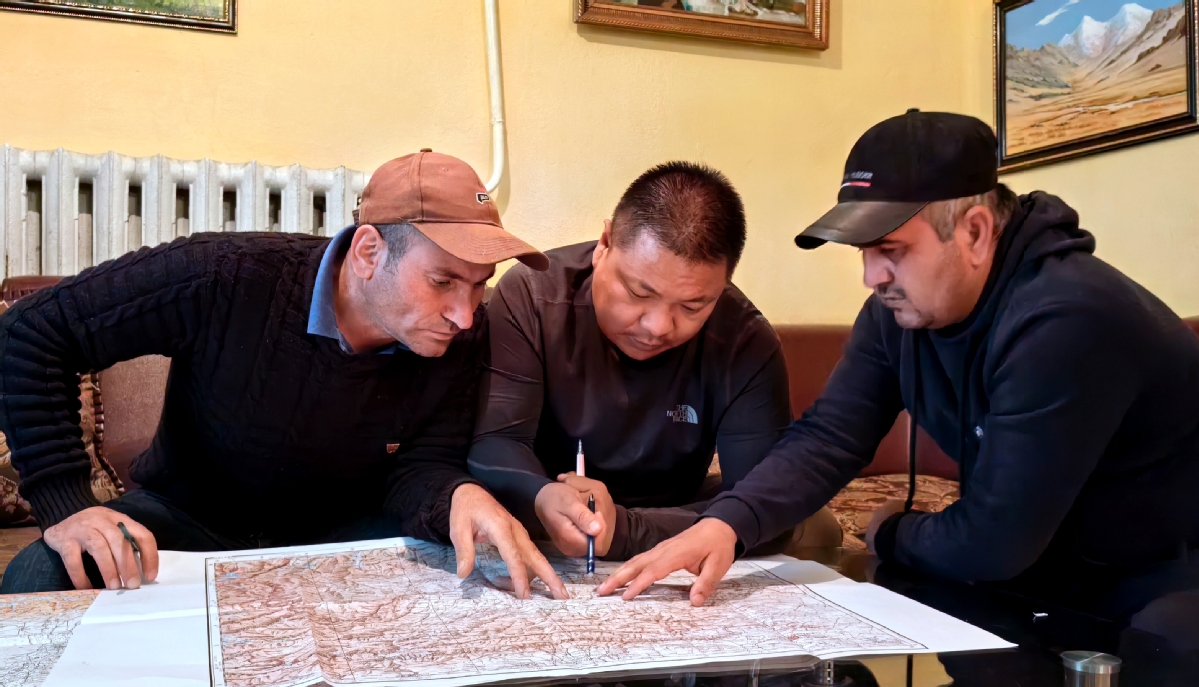
The survival of wild animals knows no borders, and the research and protection of transnational species have always been key concerns for international scientists. Organized by Chinese scientists, scientists from Central Asian countries such as Tajikistan have embarked on a two-year joint research effort, venturing into the wilderness together to search for the transboundary Marco Polo sheep in the Pamir Plateau.
"Through joint surveys, we have found that the core habitat of the Marco Polo sheep in the Pamirs is already fragmented. We need to establish ecological corridors to link these habitats together, ensuring their genetic exchange, in order to protect this species, because if genetic exchange is impeded, this species will decline," said Yang Weikang, a researcher at the Sino-Tajikistan Joint Laboratory for Conservation and Utilization of Biological Resources.
Yang, deputy director of the Conservation and Research center for Biodiversity of Arid Land at the Xinjiang Institute of Ecology and Geography, Chinese Academy of Sciences, and his team brought validated population research methods for wild animals from China to Tajikistan. Through methods such as geotagging, based on a decade of observational data, they have determined the global survival status, distribution and migration routes of the endangered species, the Marco Polo sheep.
"The Marco Polo sheep will move according to seasonal changes in search of water and grass, and will migrate to certain locations for birthing, mainly traversing between China, Tajikistan, Afghanistan and Pakistan," said Yang.
The Sino-Tajikistan Joint Laboratory for Conservation and Utilization of Biological Resources is a platform for biodiversity research and talent development jointly established by the Xinjiang Institute of Ecology and Geography, Chinese Academy of Sciences and relative research institutions of Tajikistan.
The laboratory also collaborates with research institutions in Central Asian countries such as Kyrgyzstan, Uzbekistan and Kazakhstan, conducting surveys of wild animals and plants as one of its important tasks.
"In the past, scientists studying the Marco Polo sheep from various countries did not communicate. However, transboundary species require cooperation from various countries for effective protection," Yang said.
The Sino-Tajikistan Joint Laboratory, since its establishment in March 2022, has organized scientists to communicate and conduct field research together, jointly apply for international cooperation projects, organize international conferences, and collaborate in training master's and doctoral students.
"Understanding which national borders they cross during migration, when they cross, the population distribution, habitat fragmentation, and the survival crises they face all require international exchange and cooperation," Yang said.
The Marco Polo sheep is an endemic species of the Pamir Plateau, also known as Pamir argali sheep, and is listed as near threatened on the IUCN Red List. Currently, there are only around 30,000 Marco Polo sheep, with over 20,000 in Tajikistan, and several thousands in countries such as China and Kyrgyzstan.
In May, the laboratory submitted a consulting report to the Tajikistan government, hoping that Central Asian countries could work together to protect the Marco Polo sheep, especially by renovating border fences to facilitate the migration and genetic exchange of populations.
Due to national security considerations, some Central Asian countries have erected wire fences between them, with a total length exceeding 20,000 kilometers, which has a significant impact on migrating species. Some populations have been fragmented into small groups, with around 400 individuals in Afghanistan and around 100 in Pakistan.
"Based on the migratory corridors of wild animals, we suggest that relevant border management departments of each country improve the scientific management of border fences, and even consider modifying them, to ensure smooth migration between countries during the migration season," he said.
Yang mentioned that during the years of research in the Pamir Plateau, they received a lot of help from local residents, leading to a deeper cultural understanding among each other.
"When conducting research in the plateau, we often stay in nearby villages, where villagers provide us with rooms and food, and scientists from various countries sleep together on a large kang (a big, hard bed)," Yang said.
The Marco Polo sheep is not only a flagship and umbrella species on the plateau but also a sacred animal in the minds of local people.
"Through the exchange of protection for the Marco Polo sheep in the Pamir Plateau, local governments and people understand and trust us more, and have become more supportive and actively involved in the Belt and Road Initiative," Yang said.
He emphasized that China's Belt and Road Initiative involves not only economic development and infrastructure construction in countries along the route but also cultural exchanges and people-to-people bonds, with biodiversity conservation being a crucial component.


- Several hurt as bus carrying S. Korean tourists collides with car in Hunan
- Switzerland Tourism releases creative video ahead of Chinese New Year
- Doubling down on cooperation offers better payout for APEC economies: China Daily editorial
- Hong Kong's stability safeguarded by law: China Daily editorial
- Taiwan’s frontline weapon deployment plan sparks strong criticism
- Taicang hosts spring symposiums for foreign-funded and private enterprises













