



Lessons for India in China's governance model









The most distinctive feature of the resolution of the recent third plenary session of the 20th Central Committee of the Communist Party of China is that it is comprehensive and reform-oriented, and its objective is to realize Chinese modernization.
India, like China, is also striving to achieve rapid modernization. As in China, all patriotic and thoughtful Indians think that India should not imitate the Western modernization model. Like Chinese modernization, Indians want it to be quintessentially "Indian modernization".
And like China, India is also marching ahead on a path of reform with success and shortcomings. I have always wondered why India should not learn from the Chinese experience and China should not learn from the Indian experience.
My answer is in the affirmative. India and China are both ancient civilizations that are modernizing simultaneously, and seeking to realize national rejuvenation. That's why Indian politicians, policymakers and intellectuals should seriously study the political discourse in China. By doing so, they will realize that, despite significant and deep differences in the two countries' political and governance systems, India can benefit from China's efforts and vice versa.
The comprehensive nature of China's reforms is one major lesson for India, where reform is often narrowly understood as only economic reforms. The resolution of the third plenum shows the Party's resolve to deepen reform in every area of development and governance.
To begin with, in response to the current slowdown of the Chinese economy, the resolution does not offer quick-fix solutions just to meet the expectations of foreign investors. Instead, it takes a holistic view of China's economy by emphasizing the importance of the integrated development of the socialist market economy with equal and complementary scope for the public and non-public sectors. Its stress is on high-quality development, not on quantitative growth, so as to enable China to achieve common prosperity and balanced development across regions.
China has prioritized the creation of jobs by, for example, focusing on new types of employment including flexible employment through the development of new quality productive forces — a concept that seeks to "integrate the real and digital economies" and upgrade the agricultural and other traditional industries through the use of AI, robotics and other technological breakthroughs that bring unprecedented efficiencies and productivity gains.
This task necessitates maximum self-reliance in scientific research and technological innovation in strategic areas to overcome the constraints imposed by Western sanctions and to produce world-class outcomes. To achieve this, the resolution calls for major reforms in the education sector and high-tech enterprises, and advocates for flexible management of universities and institutions engaged in research.
China is also advancing "whole process people's democracy" to strengthen rule-based governance and deepen "democracy at the primary level". It is making huge investments in the cultural sector. The third plenum has called for reforming the cultural sector in order to promote "cultural-ethical progress" and "enhance China's cultural soft power".
Each of these reforms has relevance for India. But India should also pay attention to what China is attempting in the field of "new and sustainable urbanization" and "rural vitalization "with emphasis on "urban-rural integration". India faces huge challenges in urban and rural modernization, which make it difficult to provide good housing, supply water and sanitation, improve transportation, protect the environment, and create parks and recreational amenities for all citizens. China too faces problems despite making remarkable achievements on these fronts. Therefore, the need for mutual learning in these fields is self-evident.
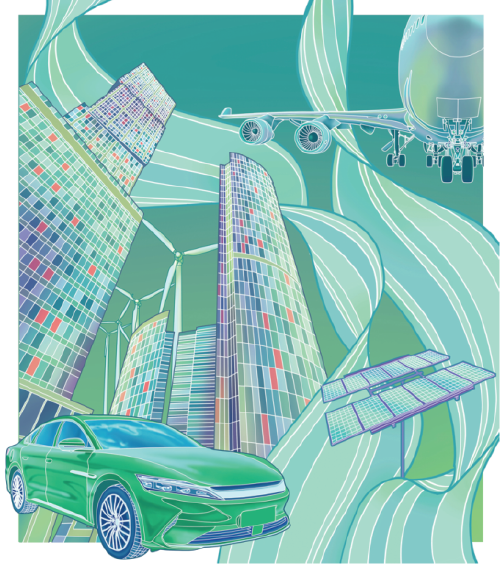
Another obvious area of India-China cooperation is "green and low-carbon development", to which the resolution devotes a large section. China aims to not only realize its two climate goals of peaking emissions before 2030 and realizing carbon neutrality before 2060, but also to promote "ecological civilization" and "man-nature harmony".
Indian Prime Minister Narendra Modi has recently declared that "green energy" and "green mobility" are India's developmental priorities. Therefore, India should forge close ties with China in green development because the latter is a global leader in renewable energy, and electric vehicles (EVs) and batteries.
Furthermore, almost all major Indian business houses seem interested in building long-term collaborations with Chinese companies in these and other fields, especially in manufacturing and infrastructure development where China's successes are spectacular. In a welcome development, the Indian government recently decided to relax the self-hurting policy of denying visas to Chinese technicians and engineers. Its latest Economic Survey says India must plug itself into China's supply chains and attract Chinese foreign direct investments.
Any Indian politician who studies the third plenum's resolution will find another useful lesson. The plenum not only expounded on what reforms are needed, but also on how to implement those reforms. Hence, one of the most important sections in the resolution focuses on reforms in the functioning of the Party. Here, we see a major new point of emphasis in the Party's political discourse: the need to constantly improve systems and institutions across the board to modernize China's national governance system and governance capacity.
More important, the "reform tasks laid out in this resolution shall be completed by the time the People's Republic of China celebrates its 80th anniversary in 2029." India, too, needs such a time-bound implementation plan along with necessary institutional reforms.
The resolutions passed by Indian political parties are rarely studied in-depth by its leaders and members. As a result, the responsibility of implementing the policies and programs rests entirely on the non-political bureaucracy. In contrast, the third plenum's resolution, along with the detailed action plan prepared by the State Council, China's Cabinet, will be rigorously studied and implemented by Party officials and members at every level, from provincial to city and county levels.
At the plenum, the Chinese top leader Xi Jinping, emphasizing the significance of strengthening the Party's overall leadership in the implementation of reforms, said: "Leadership by the Party provides a fundamental guarantee for further deepening reform comprehensively to advance Chinese modernization."
He also said, "We will refine the mechanisms through which major decisions and plans of the Central Committee are implemented; further reform the management system for officials and personnel and firmly follow the right approach to selecting and appointing officials… refine the systems and mechanisms for preventing and tackling pointless formalities and bureaucratism, and adopt more measures to effectively prevent and control new and disguised forms of corruption."
India, too, needs wide-ranging political reforms, in which dialogue and engagement with China might help.
The author, a close aide to India's former Prime Minister Atal Bihari Vajpayee, is active in promoting friendship and cooperation between India and China.
The views don't necessarily reflect those of China Daily.
If you have a specific expertise, or would like to share your thought about our stories, then send us your writings at opinion@chinadaily.com.cn, and comment@chinadaily.com.cn.





