Shaking the foundations









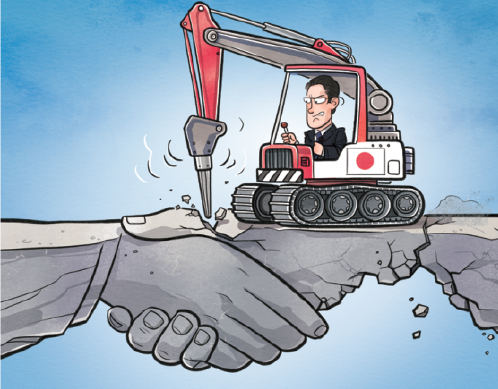
Japan's changing position on the Taiwan question bodes ill for regional peace and stability
Recently, some Japanese senior official expressed views that deviate from its stance on Taiwan question since 1972 on many occasions. This will inevitably exacerbate regional tensions in the Asia-Pacific and impact regional security.
In 1972, when China and Japan established diplomatic relations, Japan made a solemn commitment in the joint communique: "The government of Japan recognizes that the government of the People's Republic of China as the sole legal government of China" and "The government of the People's Republic of China reiterates that Taiwan is an inalienable part of the territory of the People's Republic of China. The government of Japan fully understands and respects this stance of the government of the People's Republic of China, and it firmly maintains its stand under Article 8 of the Potsdam Proclamation."
Article 8 of the Potsdam Proclamation states that "the terms of the Cairo Declaration shall be carried out", which refers to the statement in the Cairo Declaration that all the territories Japan had stolen from China, including Taiwan, should be restored to it.
Japan has always accepted the Potsdam Proclamation and the Cairo Declaration, as reflected in Emperor Hirohito's Imperial Rescript on the Termination of the War released on Aug 15, 1945, and the Instrument of Surrender signed by Japanese representatives on Sept 2, 1945.
Japan's stance on Taiwan has been reaffirmed many times in subsequent political documents and statements by Japanese leaders. In the China-Japan Joint Declaration of 1998, Japan explicitly expressed its position on one China.
The document reaffirms the connotations of "one China" set forth in the joint communique, and clarifies that engagement between Japan and Taiwan should only be limited to "people-to-people and regional exchanges".
On Dec 28, 2007 when meeting then Chinese premier Wen Jiabao in Beijing, then Japanese prime minister Yasuo Fukuda further clarified Japan's position on Taiwan, saying that Japan would not support "two Chinas" or "one China, one Taiwan"; and would not support "Taiwan independence"; would not support Taiwan's participation in the United Nations; and would not support any referendum on this matter by the Taiwan authorities.
In 2010, China surpassed Japan to become the world's second-largest economy. With the shift in power balance between the two countries, structural contradictions began to surface. In 2017, Donald Trump initiated a trade war against China, and the prolonged strategic competition between China and the United States also had a negative impact on Japan's China policy.
As Japan loses its competitive advantages, the Taiwan question has become one of a few "strategic cards" left for it to play. As a result, Japan's stance on Taiwan has dramatically regressed and it is increasingly intervening in Taiwan-related matters. Since 2021, Japan has engaged in "2+2" talks with Taiwan under the guise of "ruling party exchanges", a far cry from its promise to maintain only "people-to-people and regional exchanges".
After the outbreak of the Russia-Ukraine conflict in 2022, Japan has deliberately confused the Ukraine issue with the Taiwan question, despite them being completely different in nature. Japan has been hyping up the idea that "a Taiwan contingency is a Japan contingency" and using the pretext of preventing a "Taiwan contingency" to strengthen its military capabilities on the "southwestern islands". In May 2024, several Japanese politicians visited Taiwan to attend Lai Ching-te's "inauguration ceremony".
There are two reasons for the regression in Japan's Taiwan stance. The first is Japan's strategic entanglement with the US. On May 28, China Times, a leading newspaper in Taiwan, revealed that when then Japanese prime minister Eisaku Sato visited the US in November 1969, the US offered to "return" administrative rights over Okinawa in exchange for Japan's agreement to allow US forces to launch military operations from Japanese mainland and Okinawa to the Democratic People's Republic of Korea or Taiwan, if there was a "contingency". The two sides also signed a secret clause on "joint defense of Taiwan", in which Japan pledged that, in the event of a war in the Taiwan Strait, it would allow US forces to establish forward operating bases in Japan.
The second reason is Japan's desire to be perceived as a "normal country". Japan is in the middle of the most significant strategic transformation since World War II, with strengthening military and security capabilities being a key element, but it needs an external excuse to make its transformation appear "reasonable". Meanwhile, Japan's domestic politics underwent significant changes after the Cold War. Pro-Taiwan forces that were previously scattered across different parties began to come together, further driving Japan's policy regression.
Japan's changing position on Taiwan will undoubtedly undermine the political foundation of China-Japan relations and severely damage political trust between the two countries. The Taiwan question is a core interest of China. The one-China principle was the political precondition for the normalization of diplomatic relations between China and Japan in 1972, as well as being a crucial cornerstone for maintaining the stable development of bilateral relations. Political mistrust will inevitably affect economic and cultural exchanges and cooperation, ultimately harming the fundamental interests of both countries.
Japan's actions will also impact the regional security landscape and heighten divisions over the post-war international order. In the Asia-Pacific region, there have always been deep-seated differences and conflicts over the regional order and its legal basis since World War II. Japan and the US advocate that the 1951 Treaty of San Francisco is the legal foundation of the regional order, while China and Russia uphold the Cairo Declaration and the Potsdam Proclamation. China did not sign the Treaty of San Francisco and has never recognized its legitimacy.
In this sense, the one-China principle that was established in the China-Japan joint communique and was repeatedly reaffirmed later has a profound meaning beyond the bilateral relations between China and Japan. It not only forms the political foundation and legal framework of contemporary China-Japan relations, but also marks China and Japan's mutual confirmation of the legal basis of the postwar Asia-Pacific order.
The author is the director of the Institute of Japanese Studies at the Chinese Academy of Social Sciences. The author contributed this article to China Watch, a think tank powered by China Daily.
The views do not necessarily reflect those of China Daily.
Contact the editor at editor@chinawatch.cn.