Satellite mission finds mysterious celestial object









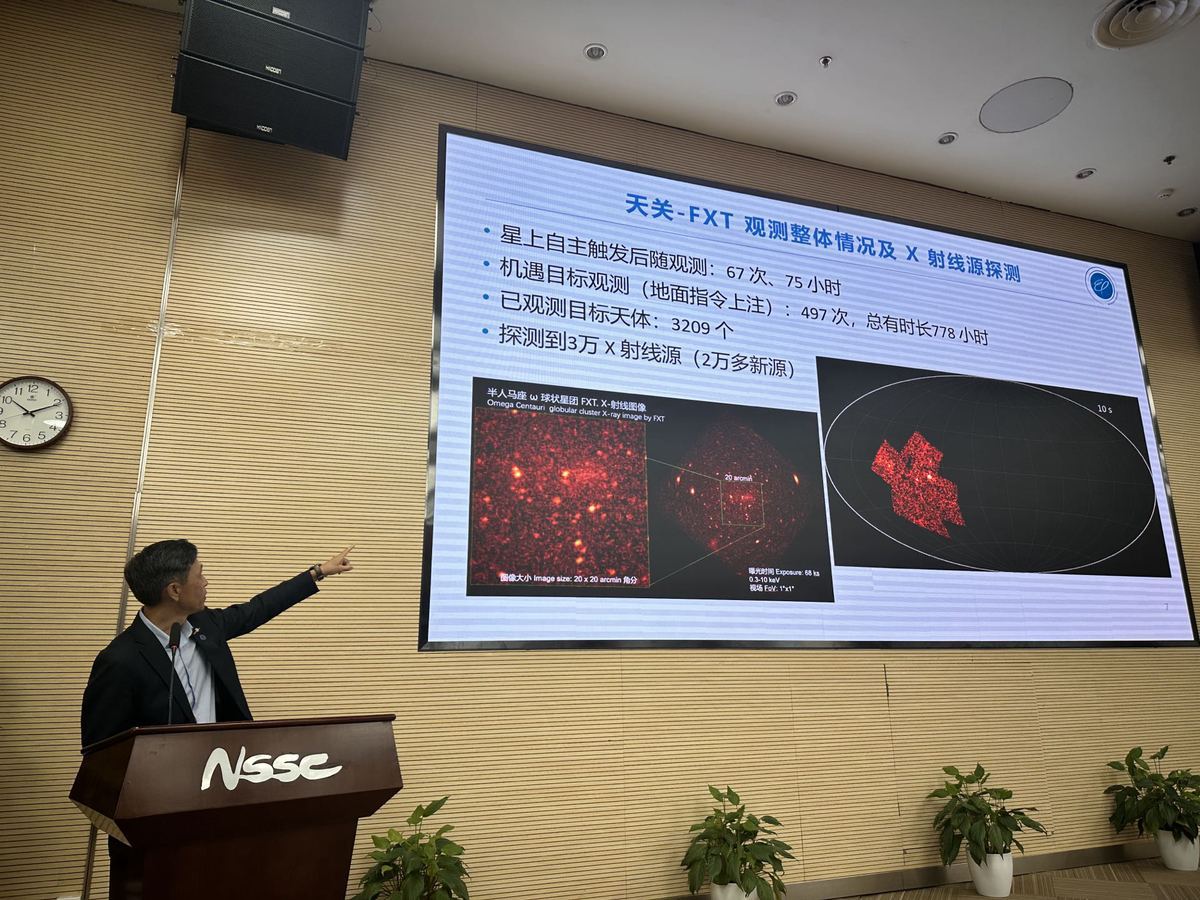
A Chinese-led satellite mission has detected a mysterious, transient celestial object in a discovery scientists say could represent a previously unknown category of cosmic phenomena.
Known as EP240408a, the object was first spotted in April by China's Einstein Probe satellite after it experienced a massive X-ray outburst. During the event, the object grew 300 times brighter but faded within seconds and disappeared roughly 10 days later.
The Einstein Probe, developed by the National Space Science Center of the Chinese Academy of Sciences, is designed to monitor transient and eruptive celestial bodies. The mission's first formal study on the object was published Wednesday in the Science China Physics, Mechanics & Astronomy journal.
"The characteristics of this object don't fit any known models, suggesting it may belong to an entirely new class of transient celestial phenomena," said Yuan Weimin, principal investigator of the EP mission and a researcher at the National Astronomical Observatories of the CAS.
The EP's advanced Wide-field X-ray Telescope and Follow-up X-ray Telescope enable it to detect X-rays from faint, transient sources that other observatory tools often miss. Yuan noted that the EP's field of view and detection capabilities offer sensitivity and spatial resolution that is 10 times better than existing international equipment.
Operating 590 kilometers above the Earth's surface, the EP focuses on X-ray sources that could shed light on black holes, gravitational waves and other cosmic events predicted by Albert Einstein's theories. It has identified 60 confirmed transient bodies and cosmic phenomena since its launch in January, including white dwarfs, neutron stars, black holes, gamma-ray bursts and more than 480 stellar flares.
"These findings illustrate EP's major impact on science," said Paul O'Brien, a professor of physics and astronomy at the University of Leicester in the United Kingdom.
The satellite also observed a distant gamma-ray burst, capturing its early soft X-ray emissions and offering new insights into the universe's poorly understood reionization era, a period in the early days of the universe during which neutral hydrogen atoms were reionized by intense radiation.
The EP Science Center, together with the EP science team, has issued over 100 alerts to the global astronomy community, prompting follow-up studies.
In addition to detecting individual events, the EP has conducted repeated sky surveys, successfully generating China's first all-sky X-ray map. The EP science team comprises about 300 scientists, about three quarters of whom are from Chinese institutions and one-quarter from Europe.
The EP team annually solicits research proposals from Chinese scientists and provides data access to international researchers one year after acquisition.
China's recorded interest in transient phenomena dates back to the Han Dynasty (206 BC-AD 220). In 1054, astronomers from the Song Dynasty (960-1279) documented the "Guest Star of Tian Guan," later known as the Chinese Nova, a supernova explosion considered among the most significant astronomical observations in history.
Yuan said the Einstein Probe, known as Tian Guan in Chinese, honors this legacy and seeks to inspire future contributions to world astronomy.





- China records 697 million border crossings nationwide in 2025
- Think tank forum between KMT and CPC to be held on Feb 3: spokeswoman
- Senior CPC official urges high-quality Party building to support 15th Five-Year Plan start
- China revises drug administration regulations to spur innovation, tighten oversight
- China's humanoid robot connects to satellite in pioneering trial
- Chinese premier urges integrity, anti-corruption efforts in government work