Brewing rich legacy of tea culture
Time-tested traditions backed by 10 centuries of expertise









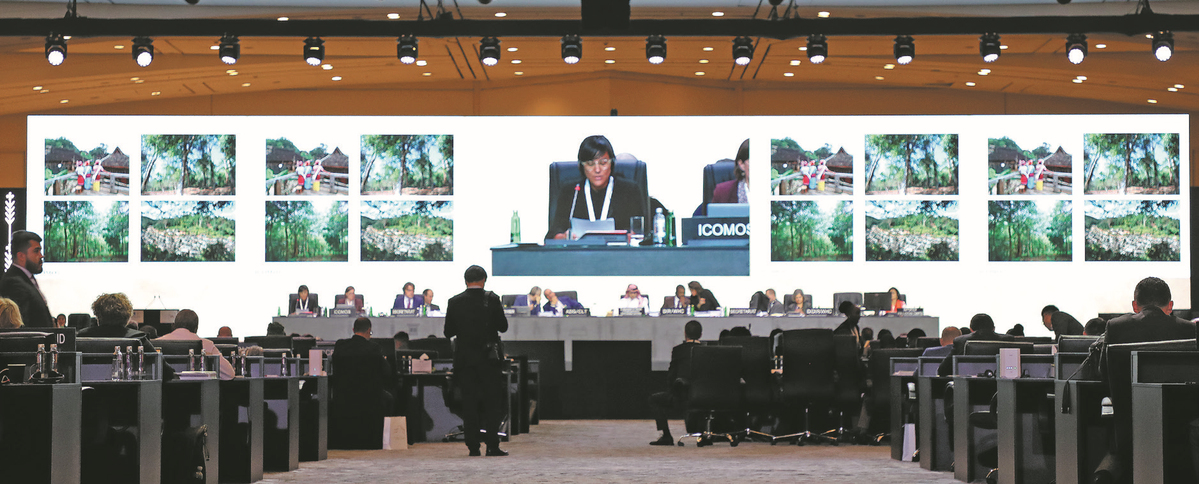
Among the mind-boggling array of tea plantations in Southwest China's Yunnan province, the old tea forests of Jingmai Mountain in Pu'er city can claim a singular distinction: At the 45th session of the UNESCO World Heritage Committee in Riyadh, Saudi Arabia in 2023, the Cultural Landscape of Old Tea Forests of the Jingmai Mountain in Pu'er was designated as the world's first tea culture World Heritage Site.
Residents of Jingmai Mountain have time-tested traditions in applying ecological wisdom in cultivating tea trees, embodying a special interaction between people and nature in a "natural tea tree museum". With an average elevation of 1,400 meters, Jingmai Mountain consists of five ancient tea forests, nine ancient villages and three separated shelter forests. For more than 10 centuries, ethnic groups like the Blang and Dai have utilized the ecosystem to cultivate a three-dimensional community structure of tall trees at the top, tea trees and shrubs in the middle and herbaceous plants at ground level.
Harmonious coexistence
"The Jingmai Mountain ancient tea forests are a typical representation of well-preserved, large-scale and time-honored ancient tea forests, with a history of more than 1,000 years and a concentrated area of 1,200 hectares of tea planting areas," said Zhou Tianhong, deputy director of the Pu'er Jingmai Mountain ancient tea forest protection bureau. "There are more than 3 million tea trees aged over 50 years, including more than 1 million aged over 100 years. A handful have reached up to 600 years old."
A 50-meter banyan known as "bee king tree" in Mangjing village hosts a spectacular sight on the mountain. More than 60 honeycombs hang from its branches, but out of respect for nature, residents don't disturb them. Instead, the villagers set up their own hives nearby — underlying the harmonious coexistence of humans and nature. "Bees have very strict requirements for their living environment and these hives are evidence of Jingmai Mountain's excellent ecological environment," said Zhang Pisheng, secretary of the Lancang county committee of the Communist Party of China.
Walking through the forest, one can see taller growth providing dappled light for the tea trees, while groundlevel herbaceous plants nurture the soil, continuously providing nourishment. The three-dimensional community structure creates ideal conditions for the growth of tea trees in terms of light, temperature and humidity.
According to statistics from the Xishuangbanna Tropical Botanical Garden of the Chinese Academy of Sciences, the Jingmai Mountain ancient tea forests are home to 943 species of seed plants, 187 species of terrestrial vertebrates and 134 bird species, all playing crucial roles in pollination, nutrient cycling and pest control in the ancient tea forests.
Su Guowen, an 80-year-old Blang elder in Mangjing village, said that compared to the world-famous terraced and farm-style plateau tea gardens, the ancient tea forests of Jingmai Mountain have a longer history and possess distinctive characteristics. "Long before the widespread adoption of modern tea garden planting techniques, the ancestors on Jingmai Mountain were already utilizing limited under-story cultivation to create ideal lighting conditions for tea tree growth," said Su. "Moreover, a well-preserved forest ecosystem has its own mechanisms to grow high-quality organic tea without the use of pesticides and fertilizers. For example, by preserving or planting osmanthus, camphor and other trees in the ancient tea forests, their fragrances can be imparted to the tea leaves, giving the tea a natural aroma and also helping suppress certain pests and diseases."


- Intl students showcasing global business acumen in Shanghai
- CPC expels former senior official of Guangxi
- Shanghai university unveils sustainable, efficient water treatment system
- Fire at auto business park in Jiangsu claims one life
- Magnitude 6.0 earthquake strikes Akqi county in Xinjiang
- Shenzhou XXI team to carry out first spacewalk