Live up to its name
Friendship with China would be the highest form of security assurance for Japan, which calls itself a 'peaceful nation'










There is a deep-rooted sense of pride across Japanese society in being a "peaceful nation" that has renounced war. On the other hand, neighboring countries' vigilance toward Japanese militarization plans has not disappeared but increased in recent years.
One of the reasons for this is Japan's continuous political measures that deny the history of its aggressive wars and revise a series of laws and regulations that reflect on those wars. At the same time, Japan has constantly strengthened its security cooperation with the United States, the world's leading military power, which is another significant factor that cannot be ignored. Although the Japanese Self-Defense Forces possess one of the most formidable military strengths in the world, the Japanese government has been pushing forward with policies that would invalidate the nation's pacifist Constitution.
The Japanese public is opposed to tax increases and a significant increase in the defense budget. However, due to the widespread belief in society that Japan is a "peaceful nation" and that neighboring countries are implementing expansionist policies, there is a lack of large-scale and active opposition to Japan's military build-up.
The US-Japan Treaty of Mutual Cooperation and Security was signed in 1960, and 2025 marks its 65th anniversary. When the old security treaty between Japan and the US was signed in September 1951, Japan was still under occupation following its defeat in its war of aggression, and it was concluded under the leadership of former prime minister Shigeru Yoshida without substantial public support.
With the scars of war still fresh and the Cold War intensifying conflicts in East Asia, the revision of the security treaty in 1960 triggered massive protests across Japan, driven by a common desire to "avoid being dragged into war again". To sign the new security treaty, then Japanese prime minister Nobusuke Kishi had to resign in exchange for the revision. During that period, Japan's postwar identity as a "peaceful nation" was incompatible with the US-Japan Treaty of Mutual Cooperation and Security.
So, what is the situation like 65 years later? The term "Japan-US alliance", once cautiously avoided, is now ubiquitous in both political and public discourse. Even though the term evokes the image of a military alliance, people no longer seriously consider its contradiction with Japan's pacifist Constitution and its identity as a "peaceful nation".
Given that during its aggressive wars, Japan's military actions were also carried out under the guise of "defense" and "liberation", neighboring countries' concerns about the resurgence of an imperial Japan are not unfounded.
Such a dangerous situation is caused by the fact that, apart from the "Japan-US alliance", Japan lacks any other conceptual framework for its national security.
Sixty-five years ago, even among conservatives, there was a notion that the Japan-US security arrangement was a temporary measure, and that Japan would eventually break free from its subordinate position to the US and pursue an independent foreign policy.
Today, however, both Japan's left- and right-wing forces unabashedly declare that "Japan-US alliance is the cornerstone" of the country's security, based on the traditional deterrence theory, which posits that a country's national security can be achieved by maintaining military superiority over other nations. This reveals that postwar Japan, while keeping the identity of a "peaceful nation", has continued to be a militaristic country, just like in the prewar period.
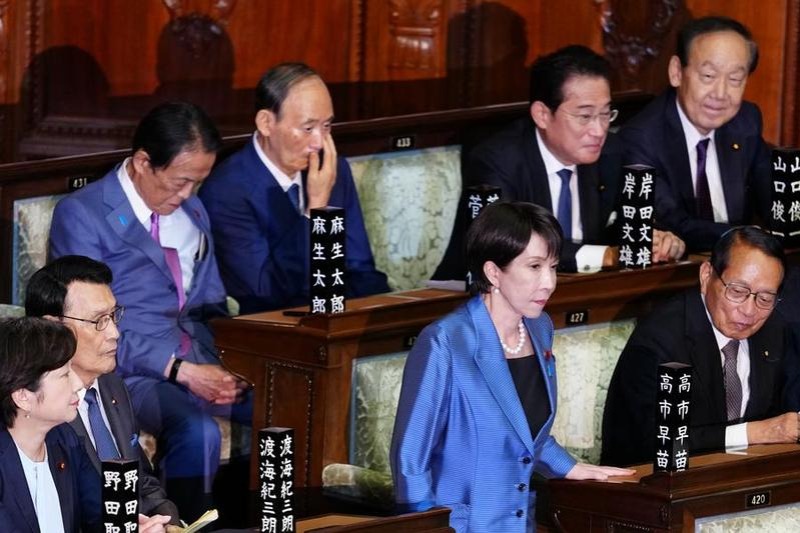
In recent years, using the "China threat" as a pretext, the Japanese government has continuously revised laws, not only lifting restrictions on military spending but also enabling the exercise of collective self-defense and even preemptive strikes against enemy bases.
In contrast, China's military expenditure growth has always remained in a range commensurate with the country's economic growth. It is worth noting that postwar Japan has long been increasing its military strength. Now, despite three decades of economic stagnation, Japan's military spending has doubled. In the context of its declining birthrate, rapidly aging population and decreasing average income, the Japanese public is burdened with heavy taxes and social security costs. The Japanese government unilaterally strengthening the Japan-US alliance under the pretext of a so-called security threat that doesn't even exist will only undermine Japanese people's wellbeing and escalate tensions in Japan's surrounding regions.
So, are there ways for Japan to guarantee its national security other than via a military build-up?
In the postwar period, Japan refused to recognize the newly established People's Republic of China during the Cold War, leading to the birth of unofficial diplomacy that sought to promote reconciliation and friendly relations with the People's Republic of China through grassroots efforts, which makes the country a true "peaceful nation".
In recent years, the advocates of the friendship movement have aged, and with the overall rightward shift in Japanese society, the peace and friendship movement has been shrinking.
Nevertheless, there still exist groups and citizens who steadfastly reflect on the country's history of aggression and strive to build trust. Among them is Hirokazu Yamahashi in Osaka, who has always been at the forefront of the labor movement. Yamahashi actively advocates that "Sino-Japanese friendship is the highest form of security assurance". He believes that if the government does not pursue military expansion that contradicts the essence of a "peaceful nation", the majority of the population, who are workers, will have the conditions to live a humane life. He believes that the Japan-US security system primarily targets a fictional "threat" — China. Therefore, Yamahashi calls on the public and workers to transcend national borders and develop friendship with the Chinese people, initiating and practicing Sino-Japanese friendship from the grassroots level, thereby gradually eliminating the conditions that necessitate the Japan-US security system.
Such awareness and activities, in today's Japanese society where the "China threat theory" is a uniform clamor regardless of the political stances, might even be criticized as utopian or impractical.
However, ensuring security through Sino-Japanese friendship is precisely the spirit of the Sino-Japanese Treaty of Peace and Friendship, an attempt to elevate the postwar settlement between the two countries to a principle of peaceful coexistence between nations.
In the 1970s, both Japan and China shared and contributed to the world the wisdom of transforming the history of aggression into a future of peace and friendship. If we adhere to the treaty, there would be no need for costly military expansion, and such bilateral relations would not only benefit the two peoples but also be welcomed and trusted by neighboring countries; the "peaceful nation" would live up to its name, and Japanese Self-Defense Forces, which is aimed at defense, would also be better understood.
Furthermore, joining the Belt and Road Initiative and pursuing development with a broader range of countries could create more development opportunities for the struggling Japanese economy. Therefore, the path of peace and friendship is a realistic, reliable and long-term guarantee for Japan's security.

The author is an associate researcher at the School of Humanities at Shanghai Jiaotong University. The author contributed this article to China Watch, a think tank powered by China Daily. The views don't necessarily represent those of China Daily.
Contact the editor at editor@chinawatch.cn.