



Data, accountability and growth: a blue map for climate action









The Global South, home to the majority of the world's population, faces a dual challenge: achieving economic growth to reduce poverty while addressing the severe impacts of environmental degradation and climate change.
Industrial progress has often come at the cost of clean air, water and land. China is no exception. But what is lesser known to many is how China has leveraged data to foster multistakeholder participation, resulting in large-scale emissions reductions and rapid environmental improvements.
The Institute of Public and Environmental Affairs, or IPE, has played a key role in this process. When we began our work in 2006, 28 percent of State-monitored rivers and lakes reported water quality worse than Category V, meaning the water was unable to be used. At that time, about 300 million rural residents lacked sufficient safe drinking water.
In 2011, key regions experienced heavy smog, which led to a decline in air quality. This affected air travel and reduced visibility in Beijing, raising public health concerns for many residents.
Like many developing countries, we faced challenges ranging from limited resources to constrained capacities in addressing pollution issues. Years of research have taught me that tackling challenges of this magnitude requires widespread public participation, which begins with ensuring access to information.
In 2006, IPE began compiling violation records but initially gathered fewer than 2,000. Through a decadelong multistakeholder effort, we have seen historic progress in environmental monitoring and transparency. Over 3 million violation records and penalty fines have now been issued, and tens of thousands of major emitters are now required to report their online monitoring data every one or two hours, a first-of-its-kind initiative in the world.
Access to environmental data has mobilised public supervision, strengthened government enforcement and enabled market-based solutions. To make this data accessible, IPE created Blue Map, an app that collects publicly available air and water quality data. As smartphones became widespread in China and concerns about air and water quality grew, the app attracted 3.8 million users over time. People could access emission records and easily share violator records on social media.
Progress in China's environmental monitoring and information disclosure has enabled platforms like IPE to track the performance of millions of companies. This dynamic data has become a unique resource for green supply chain management. Some of the largest multinational and local brands have incorporated it into sourcing standards, encouraging over 31,000 suppliers to address their violations and/or measure and disclose their emissions. In the past four years, major banks have also used Blue Map data to conduct green banking due diligence on 3 million corporations.
Through extensive multistakeholder clean air and clean water initiatives, significant reductions in air and water pollution were achieved over approximately a decade. Key atmospheric pollutant PM2.5 concentrations in Beijing dropped from 89.5 micrograms in 2013 to 30.5 in 2024, and by more than 50 percent across major regions. Additionally, the proportion of monitored rivers and lakes with water quality worse than Category V fell to below 1 percent in 2023.
In 2020, IPE launched Blue Map for Zero Carbon, a data-driven initiative that assesses the peak carbon and neutrality trends of provinces and cities, as well as the climate action performance of 2,000 brands and listed companies. Leveraging information technology, IPE developed digital carbon accounting and product carbon footprint disclosure solutions, helping suppliers measure tens of millions of tons of carbon emissions.
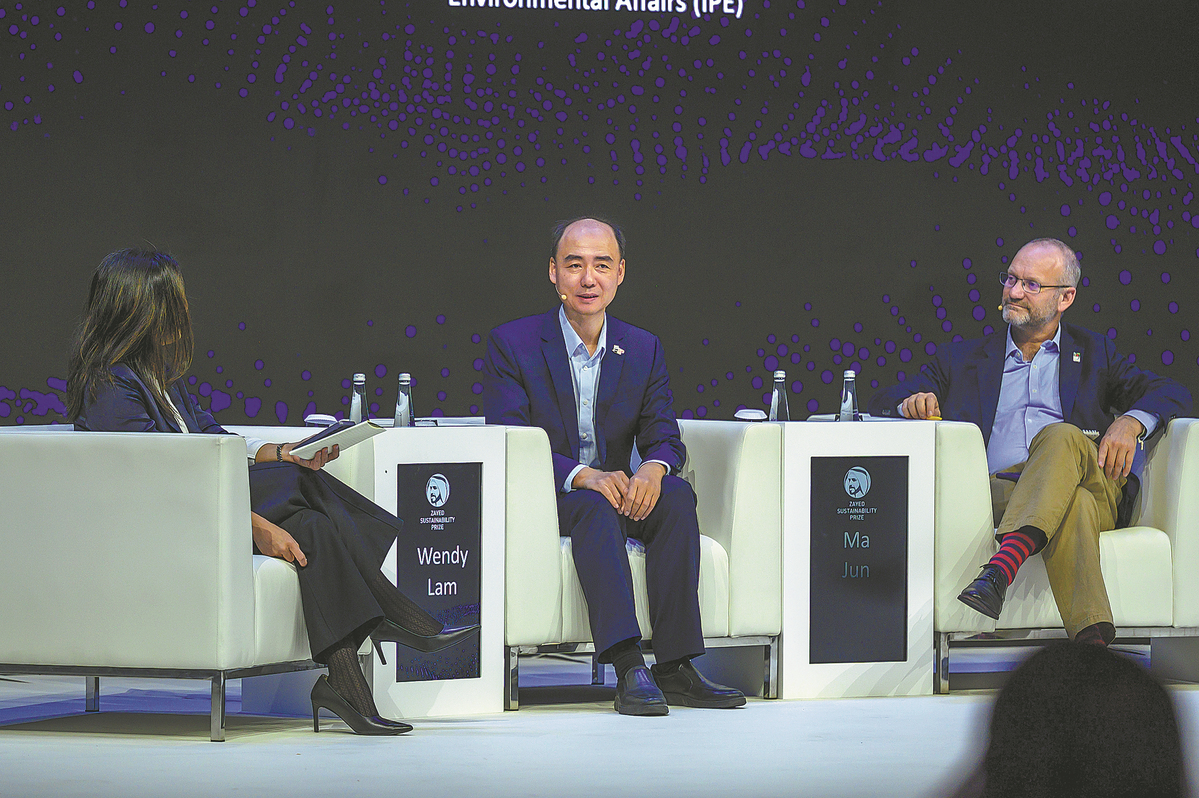
At the Zayed Sustainability Prize Forum held in Abu Dhabi in January, I shared insights on how innovation and inclusivity can drive environmental and economic progress. The Zayed Sustainability Prize, the United Arab Emirates' pioneering award for solutions to global challenges, has recognized remarkable innovations worldwide, including those from China. For example, in 2024, Beijing No 35 High School won in the Global High Schools category for inventing transparent solar photovoltaic films for windows to reduce energy consumption. Additionally, in 2016, BYD Auto won for pioneering the largest fleet of electric vehicles in the world and developing energy-efficient rechargeable batteries.
By spotlighting practical innovations that address urgent global issues — from clean energy to sustainable mobility — the Prize underscores the importance of linking local solutions to global impact, a theme central to my work in making environmental data accessible and actionable.
At the Forum, the focus was on scaling solutions like these to address global challenges. Our experience shows that the key to balancing progress and sustainability lies in greater accountability and making environmental information accessible to everyone. By promoting data accessibility, leveraging technology, and mobilizing communities, we can create a framework for sustainable progress that benefits everyone.
Sustainability is a collective journey. The same tools that enable economic growth can also safeguard our environment, provided we prioritize accountability and inclusivity. The Global South, with its unique challenges and opportunities, stands at the forefront of this effort. Together, we can ensure that progress does not come at the cost of our planet.
Let us commit to a future where transparency, innovation, and community empowerment drive both resilience and prosperity — one solution, one partnership, and one informed citizen at a time.
The Zayed Sustainability Prize is now accepting submissions from organisations and high schools across the categories of Health, Food, Energy, Water, Climate Action and Global High Schools.
The author is founding director at the Institute of Public and Environmental Affairs. Xu Xin from IPE contributed to the story.


- China's Tianguan satellite likely captures black hole devouring white dwarf: study
- Hong Kong's new year fairs bloom with festive spirit
- Battle Beats | When duty calls
- China expects over 2.05 million daily cross-border trips during Spring Festival holiday
- Xinjiang through my eyes: Maierdan's cafe of memory
- Chinese researchers build quantum key distribution chip network covering 3,700 km











