US tariff wars have global fallout, united fight needed









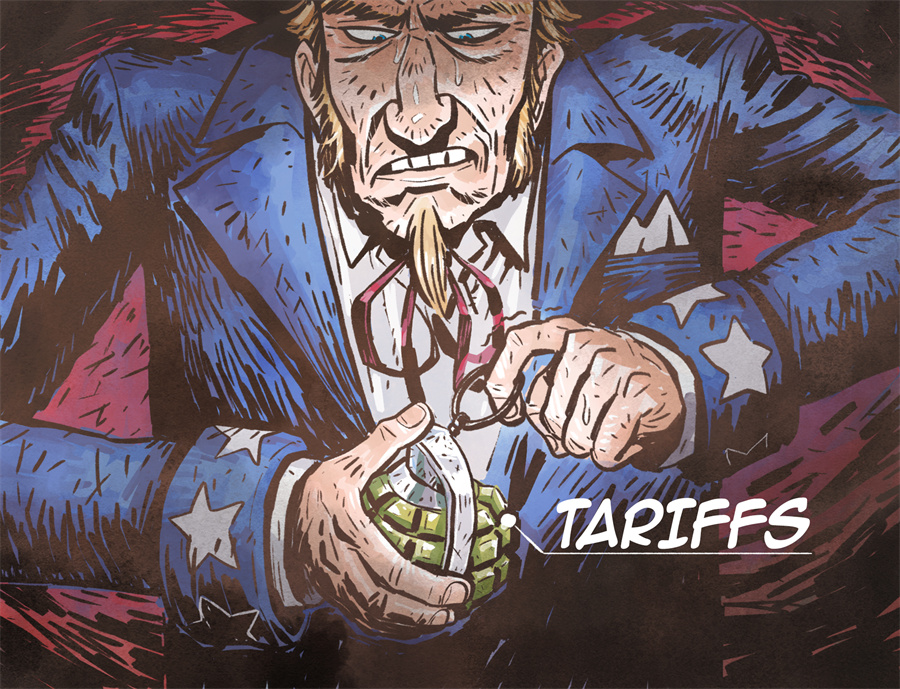
Less than a month into his second term, US President Donald Trump launched a new round of trade wars, using tariffs as a weapon to advance the United States' interests. On Feb 1, Trump signed an executive order, imposing 10 percent tariffs on Chinese goods and 25 percent tariffs on Canadian and Mexican goods. And on Feb 10, the Trump administration levied 25 percent tariffs on all steel and aluminum imports, without exceptions or exemptions.
The US administration's aggressive trade policy to push forward the "America First" strategy represents a massive increase in the US' protectionist policies, violating the fundamental principles of global trade.
But trade conflicts are not new to Washington. During his first term in office, Trump imposed a barrage of tariffs on Chinese goods on the pretext of safeguarding the US' economic security, which included 25 percent duty on $50 billion worth of Chinese goods — and later an additional $200 billion worth of Chinese goods. The two sides agreed to a temporary détente in January 2020 after the signing of the "Phase One" trade agreement. But amid the shifting political tides in Washington, the administration quickly sidelined those commitments. Now, the US' renewed assault on global trade threatens to undermine years of multilateral economic cooperation.
In an era of economic interdependence, free and open trade has fueled global prosperity. Yet Washington has resorted to economic nationalism in a bid to revitalize manufacturing in the US. The US is one of the world's largest consumers of steel and aluminum, which are required by industries, ranging from automobiles and aerospace to infrastructure. But rather than embracing the efficient global supply chains, the US leadership views import of goods as an economic liability. The previous round of tariffs saw a 27 percent drop in US steel imports and a marginal increase in domestic production — a policy outcome now being repackaged as a job-saving strategy.
Beyond economic calculations, political calculus is at play in the US' strategy. The Rust Belt states — home to the US' declining industrial base — hold the key to winning presidential elections. By branding the imposition of tariffs as a battle for US jobs, the administration seeks to consolidate its support base in those politically crucial swing states. In reality, however, it is marketing protectionism as a populist panacea.
But tariffs are rarely about just economics; they are about leverage, too. The latest round of trade restrictions is a strategic attempt by the US to reshape the distribution of benefits among key trading partners. The administration claims it is correcting the trade imbalance, arguing that past trade policies left the US in a disadvantageous position while its trade partners reaped disproportionate benefits. Unsurprisingly, Beijing remains the main target. In 2024, the US' total goods and services trade deficit was $918.4 billion, with both the Chinese mainland and China's Taiwan island, the European Union, Mexico, and Vietnam accounting for the majority of the deficit.
Although recent steel and aluminum tariffs did not explicitly single out China, the intent is clear.
Also, the US' underlying strategy extends beyond trade. By targeting China's manufacturing and high-tech industries, the US aims to weaken its global competitiveness. The US uses tariffs both as economic punishment and strategic deterrence. Yet history shows such pressure tactics often backfire. In China's case, tariffs have prompted the country to expedite its industrial upgrading and become more economically resilient. Rather than capitulating to the US, China will double down on innovation-driven economic development, expand its domestic market and pursue a more self-reliant development model.
The repercussions of the US' protectionist crusade will be felt beyond China. Canada and Mexico, integral to North America's supply chains, are also in the US' crosshair. Canada supplies nearly 25 percent of the US' steel and 79 percent of raw aluminum imports while Mexico is a crucial supplier of aluminum alloy and scrap metals. So using tariffs as leverage, the US may seek concessions in border control, energy policy and alignment of regulations.
The European Union, another US tariff target, has been warned that it has to pay higher tariffs on its auto exports — a looming transatlantic trade war is threatening to weaken the US' alliances and dampen global economic prospects.
The international community cannot endure this wave of protectionism. As such, international institutions, trade blocs and individual countries should uphold free trade not just to shield their economies against US tariffs but also to safeguard the fundamental rules of global trade and ensure the international economic order is not dismantled by nationalist impulses.
For China, the escalating trade conflicts present both challenges and opportunities. While rising tariffs increase short-term pressure, they also accelerate long-needed structural shifts toward high-value manufacturing and greater economic self-sufficiency. By promoting industrial innovation, enhancing domestic consumption and strengthening regional trade ties, China can become not only more resilient but also stronger.
The world has reached a crossroad. Will global trade continue to be conducted based on the principles of cooperation, mutual benefit and shared growth? Or will it succumb to zero-sum games dictated by blind nationalism? The answer lies in fighting the US tariff menace with collective resolve. As Washington raises its tariff walls, the rest of the world must work together to keep the doors of global trade open.
The author is dean of the School of International Studies at Nanjing University.
The views don't necessarily reflect those China Daily.
If you have a specific expertise, or would like to share your thought about our stories, then send us your writings at opinion@chinadaily.com.cn, and comment@chinadaily.com.cn.