Boost China-EU trade to nullify US tariffs









Published in 1776, Adam Smith's seminal work, The Wealth of Nations, laid the foundation for modern economic theory, advocating for the division of labor and free trade. Smith argued that specialization increases productivity and efficiency, leading to greater wealth for all. Free trade between countries follows the same principle: countries focus on producing what they do best and exchange goods and services freely, benefiting consumers with lower prices and better quality. Barriers such as tariffs disrupt this system, leading to inefficiency and economic losses.
Despite these well-respected insights, US President Donald Trump asserts that tariffs will "Make America Great Again". He is once again pursuing a "reciprocal tariff" policy, imposing duties on imports from countries that have tariffs on US goods, claiming this will protect US industries and jobs while generating revenue.
However, economic realities contradict this view. Tariffs function as a tax on consumers and businesses, leading to higher prices and inflation. As import costs rise, manufacturers relying on foreign raw materials face increased production costs, often passing these costs on to consumers. Also, retaliatory tariffs by other countries harm US exporters, reducing market access and causing job losses in affected industries. The economic disruptions triggered by tariffs far outweigh any short-term revenue gains.
Reports indicate that the US' reciprocal tariff policy disproportionately impacts major trade partners such as the European Union, Brazil and India. Among them, the EU may emerge as the "biggest loser", as US tariffs target crucial sectors such as automobiles, where the EU holds a competitive edge. The EU's auto industry, already facing challenges from electrification and regulatory pressures, could face more problems if its access to the US market is reduced.
However, the impact extends beyond automobiles. The machinery, pharmaceutical and aerospace industries are also vulnerable to trade barriers. Given that these sectors contribute significantly to the EU's GDP and employment, prolonged tariff conflicts could lead to economic slowdown, job losses, and reduced investment.
At the same time, Chinese manufacturers have made significant progress in electric vehicle production and innovation, a challenge EU automakers are struggling to address.
Adding to the pressure, Trump is also pushing large EU companies to move production to the United States, arguing that it would create jobs and strengthen the US economy. Trump claims the EU exploits the US economically, but the fact is: while the US has a trade deficit with the EU in goods, the EU has a trade deficit with the US in services.
The US also benefits significantly from high-skilled immigration, including professionals from Europe and elsewhere in the world who contribute to US innovation and industry. Many of the most groundbreaking companies in Silicon Valley have been founded or led by immigrants, and numerous Nobel Prize winners in science and economics have come from abroad. For example, Elon Musk, founder of Tesla and SpaceX, grew up in South Africa, got his university education in Canada, and later built his business empire in the US.
A critical factor to consider is that the US threat to impose tariffs may be part of a strategic game to force the EU into making concessions, buying more US products, or increase imports of US oil and gas. The EU has several potential responses to the US' trade pressures. It could use counter-tariff measures, making US goods more expensive in the EU markets.
But such measures risk escalating the trade conflict, eventually harming both economies. A more strategic response would be to diversify trade relations away from the US. The EU has already been pursuing trade agreements with Latin America, Canada and India, aiming to expand market access and reduce dependence on any single trading partner.
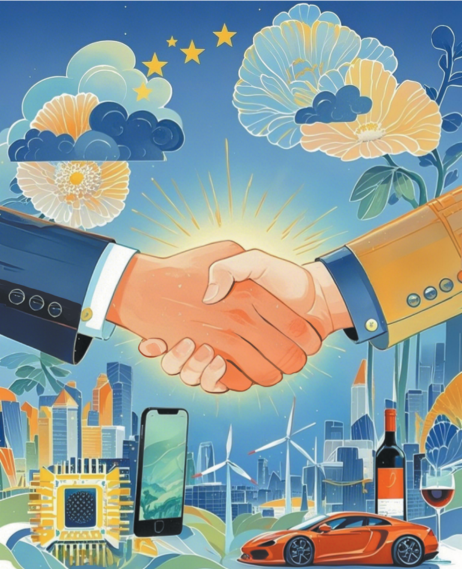
The EU and the four Mercosur (Southern Common Market) countries — Argentina, Brazil, Paraguay and Uruguay — recently reached a political agreement to develop a deep partnership. The EU is already Mercosur's most important trade and investment partner. By deepening trade relations with China, the EU could further access a vast market for its exports, particularly in high-value industries such as automotive, luxury goods and pharmaceuticals. China, facing its own trade challenges with the US, is likely to welcome closer economic cooperation with the EU, potentially offering investment opportunities and reduced trade barriers.
In addition, European Commission President Ursula von der Leyen, during her recent visit to India with a high-profile delegation, held detailed discussions on a free trade agreement with the country. The EU and India aim to sign the agreement by the end of the year, making it the largest trade deal of its kind anywhere in the world. The EU hopes to gain greater access to the Indian market for its cars and spirits, despite India's traditionally high tariffs on these goods, and is pushing for a broader investment agreement.
However, negotiations on agriculture remain difficult, with both sides struggling to find common ground.
While the US seeks to exert economic pressure through tariffs, it is unlikely that the EU will be the biggest victim of these policies. The EU remains an economic powerhouse with a large internal market, and a strong and diversified export orientation. Unlike smaller economies that struggle to absorb trade shocks, the EU is resilient enough to adjust its trade strategy and mitigate the effects of US tariffs, while its commitment to multilateral trade agreements reinforces its ability to navigate economic challenges. Given these strengths, the US will find it difficult to effectively execute its tariff policy without facing significant domestic backlash.
As a result of these developments, the EU is likely to pursue greater strategic independence in economic and other foreign policy matters, including military issues. The shift away from its reliance on US trade could extend to defense cooperation and diplomatic alignment. Strengthening China-EU ties may again emerge as a strategic priority, with economic collaboration forming the basis of broader geopolitical engagement.
While recent discussions have focused on reducing dependence on China in key supply chains, the practical need for stable trade relations may override decoupling efforts. As the EU seeks to hedge long-term risks, China will have an opportunity to enhance its standing and influence within the region. Additionally, the EU may develop a long-term strategy to attract and retain high-skilled migrants, ensuring that its own innovation ecosystem remains competitive compared with that of the US.
Ultimately, the US' reciprocal tariff policy may backfire, not only weakening its own economy but also accelerating the EU's shift toward a more diversified and independent global strategy. The EU's response will shape the future of international trade, highlighting the importance of strategic partnerships and economic resilience in an increasingly uncertain global landscape.
The author is a professor at the Free University of Berlin and president of the Global Labor Organization, a Germany-based worldwide network of researchers investigating the path of globalization. The views don't necessarily reflect those of China Daily.
If you have a specific expertise, or would like to share your thought about our stories, then send us your writings at opinion@chinadaily.com.cn, and comment@chinadaily.com.cn.