United States tariff policies inevitable to fail









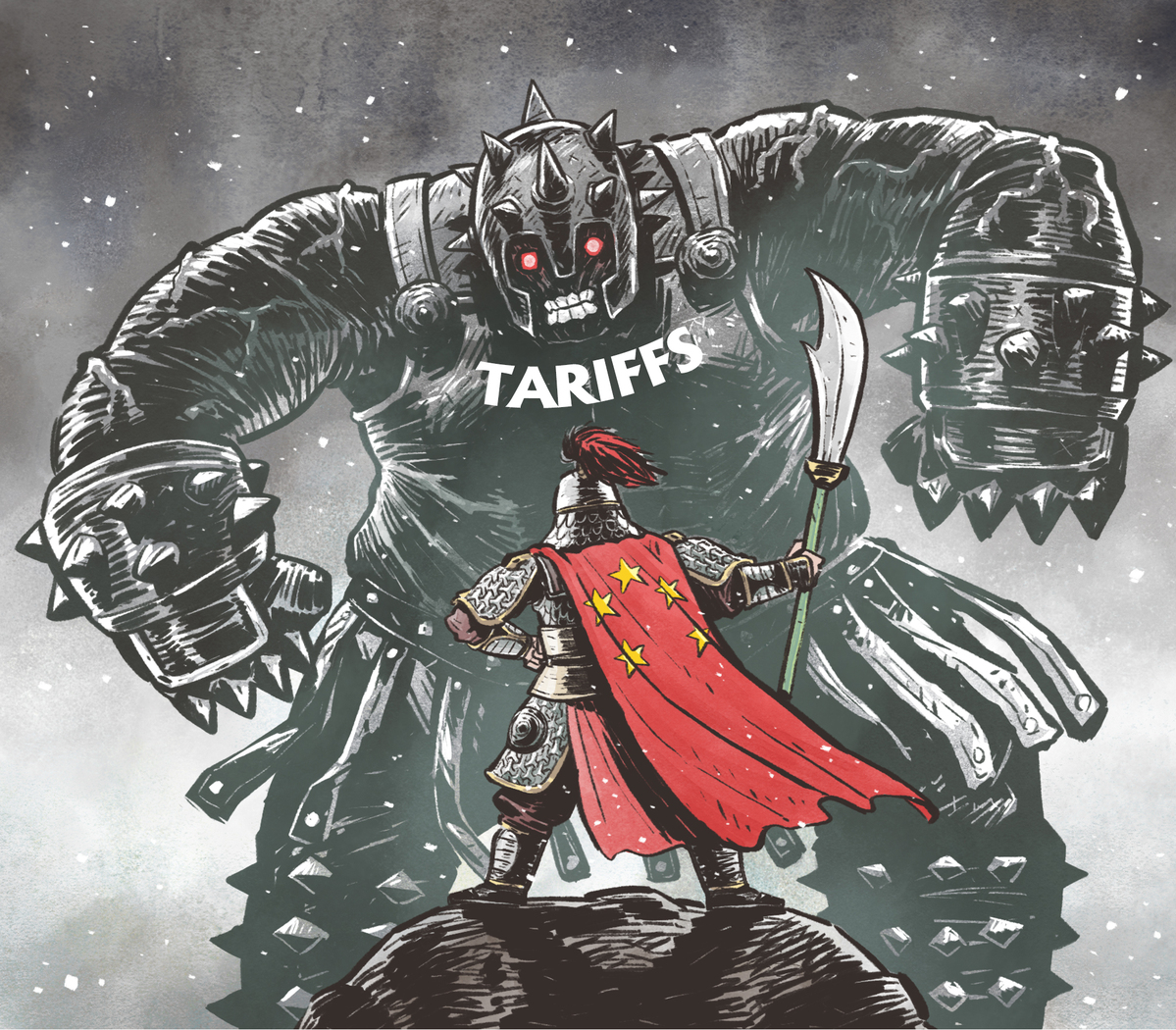
The United States has been imposing tariffs without regard for international trade rules or established practices. However, countries around the world are now pushing back against US President Donald Trump's disruptive high-tariff policies, indicating the inevitable failure of his approach.
While China faces challenges due to the tariff hikes, the sky is not falling. China has maintained a steady growth trajectory over the past few decades, with its massive economic scale serving as a powerful buffer against external pressure.
By placing domestic demand at the forefront, China can create a more stable and self-sustaining economic growth model that is less vulnerable to the volatility of global trade vagaries.
Moreover, last year, the two-way trade volume between China and the US still reached $688.2 billion. Even under Trump's first term which began in 2017, the lowest bilateral trade volume stood at about $688.5 billion, which shows that all the tariff hikes ultimately amounted to little more than a Pyrrhic victory.
The fact that the trade volume has maintained the same level as it was eight years ago is a clear testament to the resilience of the China-US economic relationship. Imposing tariffs cannot completely sever the deep-rooted trade and economic connections between the two countries.
The Trump administration's relentless pursuit of imposing high tariffs on trading partners, particularly China, was driven by the single-minded goal of "making America great again".
Washington's strategy involved levying high tariffs on imports, while simultaneously implementing significant tax cuts domestically, with the belief that this would create a powerful economic advantage for the US to "lure" companies and manufacturing industries to "return" to the country.
This misguided belief that the White House could simply use tariffs to eliminate trade deficits and weaken the manufacturing capabilities of other countries, such as China, demonstrates a profound lack of understanding of the modern global economy.
It is absolutely certain that the US will not be able to achieve its intended objectives. The Peterson Institute for International Economics, a US think tank, has conducted a very thorough analysis of the Trump 1.0 tariffs on China, and found that 92.3 percent of the burden was shouldered by US businesses and consumers.
This means that the previous tariff war against China had backfired. Now the Trump administration has picked up the failed weapon again and has even increased its intensity, which will only lead the US further down the path of error.
The US inflation rate, which had previously been at low levels, has now surged past 2.8 percent. The continuation of Trump's blanket approach of tariff hikes targeting friends and foes alike could quickly send the US inflation rate spiraling back upward.
During the Biden administration (2021-25), the US inflation rate reached as high as 9.1 percent at its peak. If Trump's "contributions" were to have a greater impact, there is a real possibility that the US inflation rate could even surpass double digits in the future.
The increasing anticipation of a high level of inflation might leave the US Federal Reserve few choices but to aggressively raise interest rates, which in turn would likely exacerbate the fiscal deficit and debt burden of the US government.
In addition to the growing debt burden, the combination of high inflation and low growth projections for the US economy further exacerbates the risks of a potential recession during the Trump administration.
Goldman Sachs economists have already revised the US growth rate in 2025 down to 1.7 percent. The latest United Nations forecast puts US economic growth at just 1.9 percent, a significant drop from the previous expectations of around 2.8 percent.
These downward adjustments underscore the potential for Trump's tariffs and shocks to trigger a recession, rather than the promised economic boom.
Going forward, it's imperative for Beijing to not only resolve China's problems from China's perspective, but also take a global stance to address the world's problems.
Efforts should be made to safeguard the authority of the World Trade Organization, a platform that can provide a rules-based framework for resolving trade disputes, despite the US refusal to recognize its legitimacy. It's important to build a global consensus against trade wars, forming a united front of countries opposed to Trump's disruptive tactics.
China should strengthen communication and coordination with other economies deeply affected by the trade tensions — such as Canada, Mexico and the European Union — to adopt different countermeasures tailored to their unique circumstances.
For Chinese products and materials that are especially crucial to the US, such as core components, key raw materials and rare earth resources, China can follow the examples of countries like Canada and impose tariffs as high as 250 percent to 390 percent.
When the US is hit by the backlash of its own tariff weapon, it may find its days are not going to be easy.
China should continue to support enterprises to expand their global presence, leveraging their industrial strengths and global operational capabilities to reconfigure global industrial and supply networks. This is not only a strategy to counter trade tensions, but also a higher level of openness and engagement with the global economy.
It is not entirely impossible for Beijing and Washington to reach an equal trade agreement, but the US must demonstrate sincerity and willingness to engage on the basis of parity, fairness and mutual benefit.
In January 2020, China and the US reached the first phase of a trade agreement, which Trump at the time signed. Building upon this foundation to negotiate a second-stage trade deal is a viable option.
However, any evaluation of the phase-one trade agreement must exclude three crucial factors that have dramatically altered the context — the impact of the three-year pandemic on the agreement's implementation, the US government's sweeping bans on high-tech exports to China, and the effects of the Biden administration's "small yard, high fence" strategy and the subsequent withdrawal of US tech giants, which have disrupted China's supply chains and trade volumes.
The world's two largest economies should serve as role models for the principle of equal trade, rather than the US adopting a condescending attitude and using coercive tactics in its negotiations with China.
Such an approach, rooted in mutual respect and a commitment to win-win outcomes, is the only path forward to achieving a truly comprehensive and beneficial trade agreement between China and the US.
The writer is former chief economist at the China Center for International Economic Exchanges.
The views do not necessarily reflect those of China Daily.