



AI sparking a global health revolution









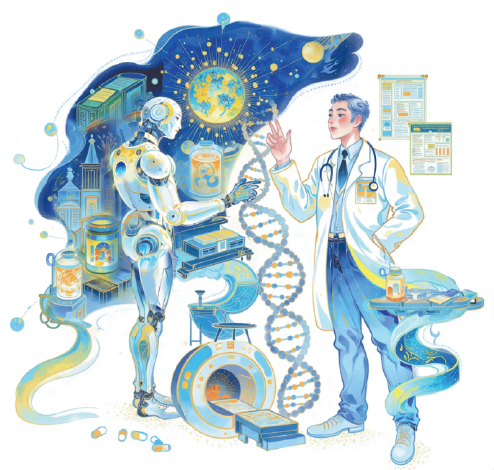
Imagine a world where diseases are spotted before they strike, health is monitored by a digital guardian and treatments are perfectly tailored. This is no longer a distant dream but an emerging reality supercharged by artificial intelligence, big data and digital health. These technologies are rewriting global public health, offering a more reliable way to better predict illnesses, closely monitor people's well-being, treat them with pinpoint accuracy, and make healthcare fairer and faster. To achieve this, we need a strong, equitable worldwide healthcare system.
Think of AI and big data as health super-sleuths. They sift through mountains of health data, spotting patterns humans might miss, making disease prediction sharper. The large language model of DeepSeek shows promise in understanding medical conversations and helping doctors read scans for early signs of trouble, which means quicker help and access to fairer medical knowhow.
AI analysis of electronic health records can flag risks which can lead to hundreds of diseases later in life and years before the onset of the disease. This is vital for spotting individuals vulnerable to diseases during health scares. A simple, cheap AI-read eye scan could soon predict the risks for many conditions including type 2 diabetes, making large-scale, cost-effective early disease detection feasible.
AI-powered wearables and health apps are becoming personal health coaches, tracking body signals, lifestyle and the environment to warn of risks and offer tailored advice. AI analysis of our unique chemical signature readily obtained from a single blood draw can predict multi-disease risk and track health in detail. This proactive approach is key to chronic disease control and boosting health literacy.
AI also personalizes treatment. By crunching patient data and medical studies, AI can help understand diseases, find new drug targets and predict treatment responses. It can spot patient subgroups who will respond best to specific therapies and help expedite the discovery of new medicines and testing methods, making access to life-saving drugs faster.
AI, big data and digital health technologies are transforming healthcare, making it more efficient, accessible and equitable. By automating administrative tasks, optimizing hospital work-flows, and supporting faster, more accurate diagnoses, AI reduces the burden on medical workers and shortens patients' wait time. Advanced large language models such as DeepSeek can provide expert-level medical support for remote and underserved regions, helping bridge the gap in access to quality medical care.
These innovations play a vital role in addressing global healthcare disparities. Low-cost AI-powered health apps and virtual consultations extend high-quality medical services to communities with limited resources. When trained on diverse medical data, AI systems offer accurate predictions for a wide range of population groups, including those historically underrepresented. Affordable diagnostic tools, such as AI-analyzed retinal scans and chemical signature tests, further democratize access to vital health information, paving the way for more inclusive and proactive healthcare worldwide.
While the promise of AI in healthcare is immense, ensuring its safe, ethical and equitable use requires thoughtful regulation. Regulations for AI in healthcare markedly differs across the European Union, the United States and China. The EU leads with its comprehensive AI Act, classifying health-related AI as high-risk, and requiring strict oversight and compliance. Its General Data Protection Regulation enforces rigorous data privacy, emphasizing individual rights and explicit consent.
The US lacks a unified AI law, relying on the FDA for case-by-case regulation for AI in healthcare, and the Health Insurance Portability and Accountability Act for data privacy, which is less stringent than the EU's GDPR.
China, on the other hand, has adopted a strategic, State-guided approach, embedding AI governance within broader national frameworks. While it has no standalone AI law, it issues detailed ethical guidelines and uses the Personal Information Protection Law to regulate health data, emphasizing consent and data localization.
These different models — the EU's rights-based, the US' innovation-driven, and China's State-coordinated — reflect distinct policy priorities and cultural values shaping the global landscape of AI in healthcare. Given China's rapid pace of AI innovation and strong State coordination, the country is well positioned to accelerate the use of AI-driven healthcare solutions from urban centers to remote rural areas.
In doing so, China can serve as a global role model by demonstrating how digital health technologies can promote equity and transform public health at scale. We are entering a new era of data-driven, AI-enabled public health. To seize the opportunities offered by this advancement, we need global cooperation, interdisciplinary research and shared ethical principles. By embracing these technologies responsibly and inclusively, we can build a smarter, fairer and healthier world for all.


The views don't necessarily reflect those of China Daily.
If you have a specific expertise, or would like to share your thought about our stories, then send us your writings at opinion@chinadaily.com.cn, and comment@chinadaily.com.cn.





