



ROK ought to boost trilateral coordination









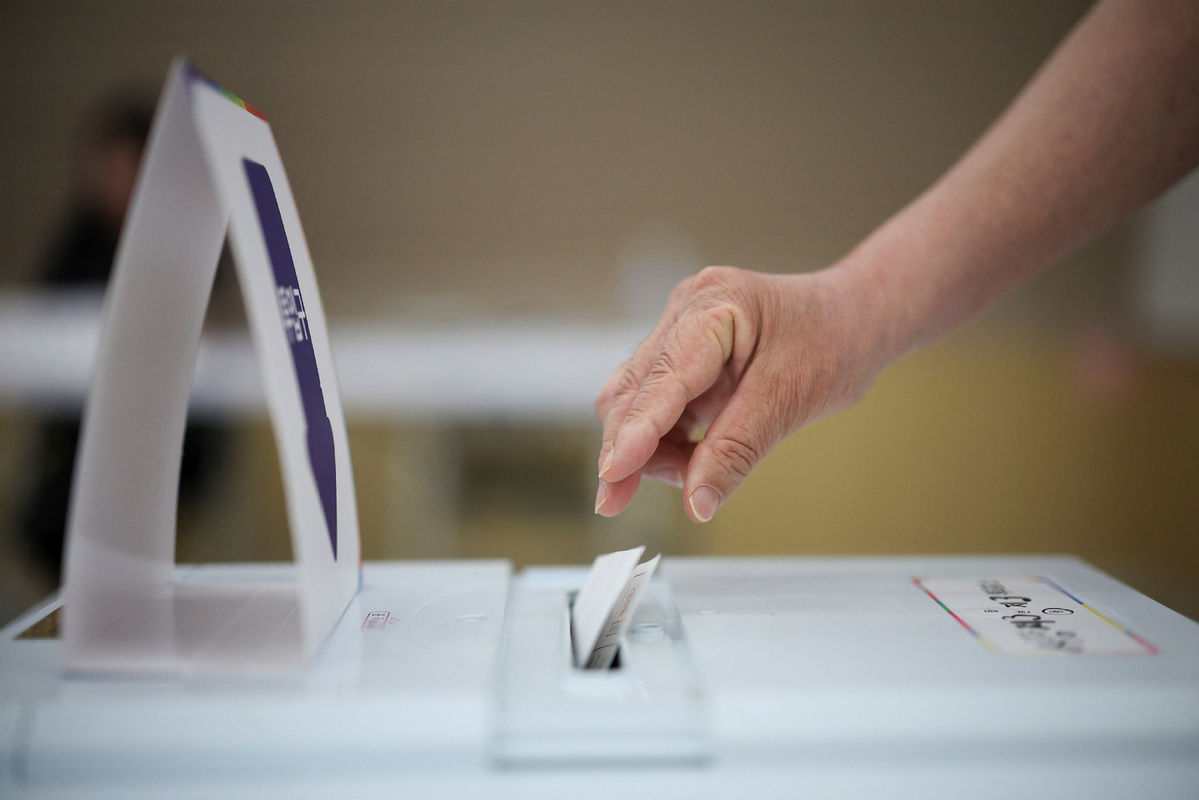
The Republic of Korea is scheduled to elect a new president on June 3. Although both leading presidential candidates — the liberal Democratic Party of Korea candidate Lee Jae-myung and the conservative People Power Party's candidate Kim Moon-soo — will likely prioritize the US-ROK alliance after the winning the election, and the difference would be in how they deal with Japan and China respectively.
The Democratic Party may not be blindly pro-China and anti-Japan. Instead, its policy toward China and Japan may be somewhere between the policies of the liberal Moon Jae-in administration and the conservative Yoon Suk-yeol administration. However, the conservatives, despite remaining pro-Japan, would adjust the ROK's relations with China as needed. Even during the Yoon administration, there were no fundamental changes in China-ROK ties. Yet at the tactical level, bilateral relations improved, albeit through the China-Japan-ROK trilateral relationship.
In the context of deepening trilateral cooperation, the new ROK government's efforts to withdraw from trilateral cooperation would give the US leverage and Japan the opportunity to blame the ROK for souring relations. Hence, it would be more beneficial for Seoul to apply the US-ROK-Japan mini-lateral format of diplomacy to the ROK-China-Japan relationship in order to have more diplomatic options at its disposal.
In short, the mini-lateral framework would be useful for Seoul's diplomacy, as it would help mitigate the risk of US-China competition in Northeast Asia, and manage ROK-Japan and ROK-China relations under the trilateral cooperation framework.
If bilateral relations are burdensome, a trilateral framework can lessen sensitivity. This is also true for China and Japan, and is in the interest of all three countries.
The core of trilateral cooperation has remained economic cooperation, but the three sides have not been able to realize its full potential due to the lack of institutionalization. The core of trilateral cooperation is the trilateral free trade agreement, negotiations on which are yet to be held on a full scale. Due to this lack of institutionalization, China and the ROK have a low-level FTA, while the ROK and Japan, and China and Japan have none.
Additionally, geopolitical risks are very high, with the United States pressuring the ROK and Japan for "decoupling" or "de-risking" from China, and its protectionist measures are threatening trilateral cooperation.
Nevertheless, China-ROK-Japan relations still hold promise. To translate that promise into concrete results, the three sides need to institutionalize economic and trade cooperation, accelerate free trade agreement negotiations, and build resilient supply chains. Based on their respective national interests, the three sides should promote sustainable economic growth, while deepening cooperation in the high-tech sector and facilitating cooperation among their enterprises.
The three sides also have to promote the industrial division of labor based on their respective strength in advanced technologies, and address common challenges such as declining birthrates, aging populations and demographic changes. They need to increase people-to-people exchanges, including student exchanges, too, while reducing people's negative perceptions of each other.
Furthermore, the three countries need to boost mutual political trust and increase strategic communication, while jointly devising cooperation models that go beyond zero-sum games and contribute to the public good.
They also need to adhere to the philosophy of "addition", not subtraction, and promote the "three-in-one" spirit. Trilateral cooperation is, after all, an investment in the constructive future of Northeast Asia. And we hope the three countries will steer the future in a positive direction.

The views don't necessarily reflect those of China Daily.
If you have a specific expertise, or would like to share your thought about our stories, then send us your writings at opinion@chinadaily.com.cn, and comment@chinadaily.com.cn.





