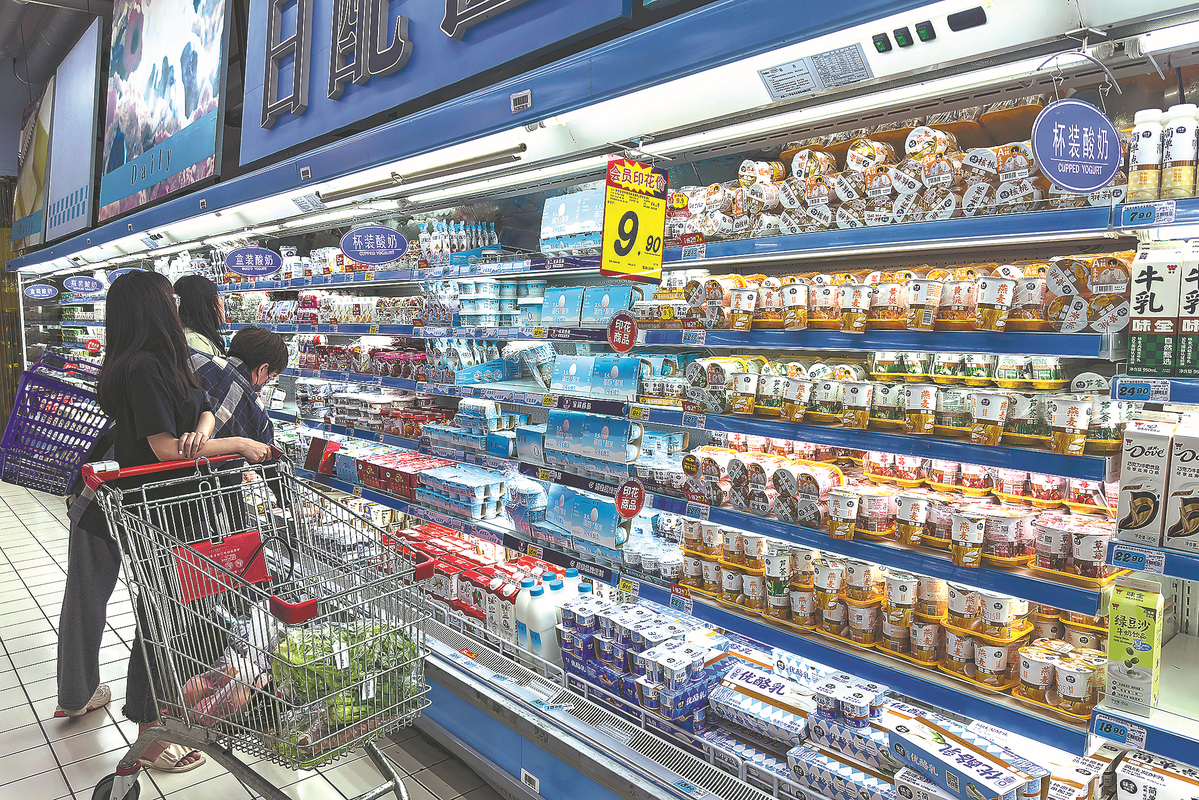
Oarmilk to expand product line beyond Greek yogurt
Company reported 500 million yuan in revenue for 2024 and is confident it will reach profitability this year










As China's chilled yogurt market undergoes a health-focused shift, Oarmilk Greek Yogurt has stood out for its high-protein positioning, targeting mid-income families who are health-conscious and experiencing double-digit growth on a yearly basis.
Founder and CEO Wang Weijian said at the 2025 Food and Beverage Innovation Forum in Shanghai that the brand will "reshape the high-end yogurt market" leveraging differentiated products and precise marketing.
The Beijing-based company has invested more than 420 million yuan ($58.5 million) in building a modern dairy production hub. Its second-phase facility, launched in 2020, spans over 81 hectares and includes ultra-clean, fully automated lines capable of processing 800 metric tons of fresh milk daily.
The vertically integrated operation covers deep processing and R&D to cold-chain logistics and nationwide sales.
"We've been laser-focused on the high-end segment since day one, targeting middle-income consumers in first- and second-tier cities," Wang said in an interview. Early marketing efforts centered around upscale malls and fitness centers and helped the brand build a loyal base. Oarmilk now covers around 60 cities across China and is seeing increased traction even in lower-tier markets.
Despite headwinds in the broader yogurt sector, Oarmilk has maintained double-digit growth. As of April, the brand had already achieved over one-third of its annual sales target.
"We've doubled annual revenue year-on-year for several consecutive years, and we're confident we'll reach profitability in 2025," Wang said.
The company reported 500 million yuan in revenue for 2024 and is setting its sights beyond yogurt.
Plans are underway to expand into clean-label, high-protein dairy categories including cheese, milk and ice cream. Oarmilk is also preparing to launch in Southeast Asia as part of a broader push to become an internationally competitive premium dairy brand.
"Our products have been shown to progress in China's premium market. Now we're confident in our ability to compete globally, especially in markets where Greek yogurt is already well established," Wang said.
Globally, Greek yogurt covers a significant share of chilled dairy. In mature markets like the United States, it accounts for as much as 80 percent of low-temperature yogurt sales, said Wang. But in China, the segment remains small — just 5 percent of the country's 300-400 billion yuan yogurt market in 2024, according to Wang.
That leaves room for rapid growth. Wang said Oarmilk now leads domestic low-temperature Greek yogurt in capacity, output and sales. Strong consumer retention is helping to sustain momentum and its online repurchase rate is more than double the category average.
"Greek yogurt remains a niche and we intend to stay focused," Wang said. "By deepening our category expertise and serving our core audience, we're confident of unlocking long-term growth."
Oarmilk is an example of the shift in the low-temperature yogurt market in China. After years of stagnation, China's low-temperature yogurt market is showing signs of revival, driven by a rising consumer focus on health and nutrition, according to an industry report.
The number of buyers has grown steadily since mid-2024, boosting both sales volumes and revenue, according to Kantar Worldpanel China.
The surge is largely powered by a new wave of yogurt products marketed with visible wellness benefits, from probiotics to sugar-free and high-protein claims.
To sustain momentum, yogurt producers are investing heavily in health-centric innovation. According to Kantar, the path to long-term growth lies in three key areas: clarity of health benefits, targeting specific consumption scenarios, and localization through traditional Chinese health culture.
While front-of-pack claims such as "low-fat", "probiotic", or "sugar-free" remain widespread, Chinese consumers are becoming increasingly skeptical of vague health promises.
Nearly half (46 percent) of shoppers now regularly read ingredient lists and nutrition labels before buying, according to the 2024 Consumer Index report "Who Cares? Who Does?", which is also conducted by Kantar.
Brands that communicate functional benefits, backed by credible certifications or data, stand to win consumer trust.
As the yogurt category becomes more specialized, brands are aligning product design with specific usage scenarios such as fitness, digestion or sugar control. Kantar data show that scenario-based solutions — products tailored to context-specific health needs — are unlocking incremental growth.
For example, in the weight management category: Classykiss' "anti-sugar lifestyle" product leverages its "0 sucrose, 0 sugar substitutes + low GI" positioning to cater to calorie-conscious consumers. The product line has posted double-digit annual growth.
In the digestive health category, Simple Love's "Body Knows" yogurt features acid-resistant probiotics that survive digestion, drawing a 30 percent year-on-year increase in customers.
In the fitness nutrition category, Lepur's Greek-style yogurt, with up to 9.5g of protein per 100g, is finding traction among fitness enthusiasts as a convenient post-workout option.
Building such scenario-based product portfolios requires deep consumer insight, including understanding how purchasing decisions vary by occasion, lifestyle and nutritional priority. Brands that can translate these insights into tailored offerings are better positioned to capture high-value demand, according to Kantar.
Beyond Western nutrition science, local cultural concepts are gaining ground. Once overlooked ingredients from traditional Chinese medicine — like red dates, goji berries and lingzhi mushrooms — are making a comeback as health-conscious millennials embrace the philosophy of "food as medicine".
Mengniu Dairy, one of China's largest dairy companies, has reformulated its red date and goji berry series, replacing jams with concentrated juices to elevate both taste and perceived health value. The move lifted annual penetration rates by 2.3 percentage points.
Other brands are going further, mixing lesser-known ingredients such as tangerine peel and lotus seeds into yogurt aimed at children. These products promise digestive support and immunity benefits aligned with traditional wellness beliefs.
Despite growing health interest, the yogurt market in the country is still under pressure from changing consumption habits and category competition. Euromonitor International expects retail volumes to decline in coming years as consumers shift to "less, but better" daily habits.
"Sugar control will continue to dominate health claims in yogurt," said Elisa Lin, food and nutrition consultant at Euromonitor. "Most new launches are either low-sugar or sugar-free and increasingly paired with clean-label positions like additive-free."
Consumers may be eating less yogurt overall, but they're spending more on quality, according to Euromonitor. Middle to high-end chilled products and freshly made yogurt drinks from premium street stalls are gaining favor — even at higher price points. For manufacturers, that means quality, transparency and differentiated functionality will be crucial to sustaining value growth in a contracting market, said Euromonitor.