Shift in student visa stance encouraging









United States Secretary of State Marco Rubio on May 28 announced plans to revoke visas of Chinese students linked to the Communist Party of China or in "critical fields", heightening scrutiny on applications from China and the Hong Kong Special Administrative Region. US President Donald Trump initially supported this move but later softened his stance, stating in a May 30 interview that the visa issue would be resolved.
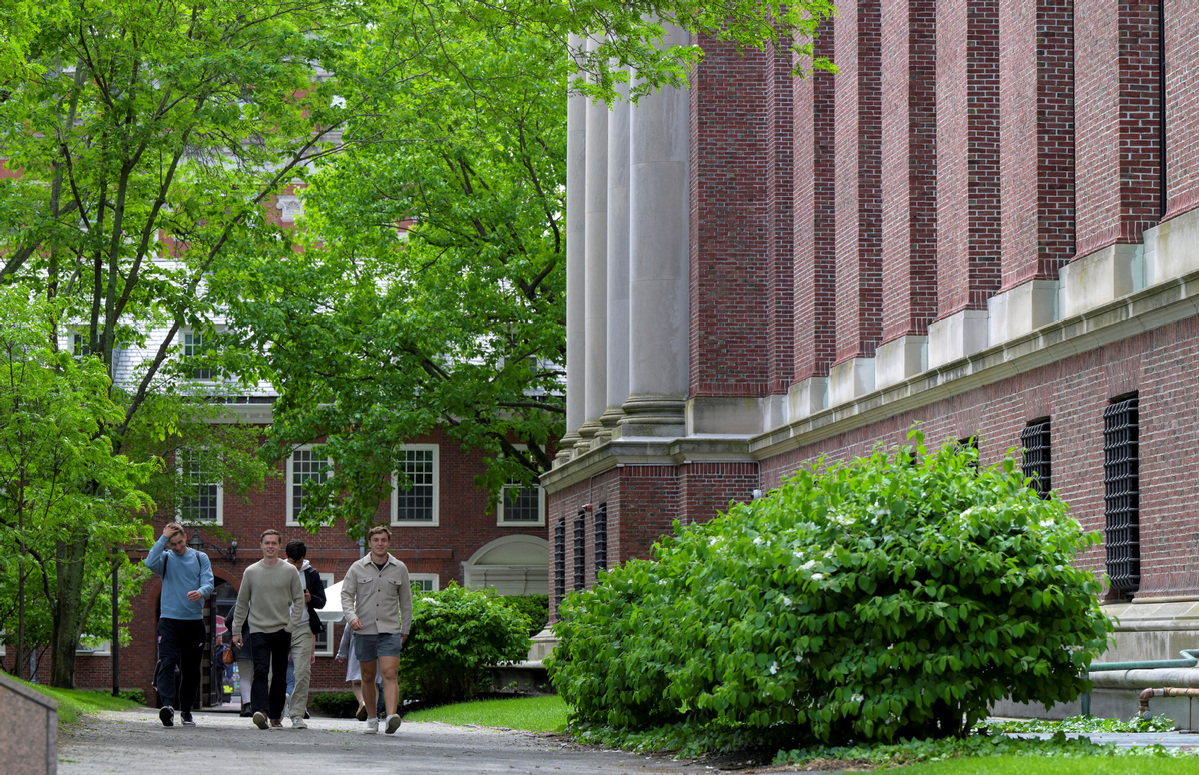
After a June 5 call with Chinese President Xi Jinping, Trump said, "Chinese students are coming. No problem. It's our honor to have them. We want to have foreign students, but we want them to be checked." On June 11, Trump said on social media that allowing Chinese students to attend US institutions "has always been good", suggesting a commitment to educational exchanges with targeted vetting.
On Wednesday, the US State Department announced it is restarting the stalled process for foreigners applying for student visas, but all applicants will now be required to unlock their social media accounts for government review.
While the current shift is encouraging, Rubio's directive, framed as a national security measure, is not, as it risks escalating US-China educational tensions, which can undermine US leadership in research, including scientific discovery and commercialization of innovation.
The importance of US-China educational exchanges remains undiminished, as these ties have historically driven innovation and cultural bridge-building critical to both nations. Chinese students are among the largest group of international students in the US. In 2023-24, more than 270,000 Chinese students were enrolled at US colleges and universities, comprising about 30 percent of all international students. A large share of Chinese students are in graduate-level STEM (science, technology, engineering, mathematics) programs — fields where the US faces chronic talent shortages.
According to the National Science Foundation, more than 50 percent of doctoral students in engineering and computer sciences in the US are foreign-born, and many are Chinese.
These students play central roles in research teams working on artificial intelligence, quantum computing, semiconductors, climate tech and biomedicine. Rubio's announcement threatens to dismantle this talent base, with long-term damage to both US academic institutions and the industries that rely on their output.
Many Chinese students are now looking to other countries. The chilling effect is already evident, with university leaders warning of irreversible harm to their academic ecosystems.
Beyond intellectual contributions, Chinese students also bring substantial economic value. The US Department of Commerce estimates that they inject over $15 billion annually into the US economy through tuition, housing and local spending.
At the University of California, nearly 18,000 Chinese students contribute an estimated $750 million each year. At the University of Illinois Urbana-Champaign, Chinese nationals account for over 15 percent of total tuition revenue.
Rubio's directive puts such financial flows at risk. But the academic costs may be even higher. Labs at institutions such as Massachusetts Institute of Technology, Georgia Institute of Technology and Stanford University depend heavily on Chinese graduate students and postdocs. Abrupt removals could derail federally funded projects, disrupt private sector collaborations and cripple scientific productivity. In the short term, there are few viable replacements for this talent pool.
The effects ripple far beyond academia. Chinese-born engineers and scientists are integral to the US tech sector. According to the Silicon Valley Leadership Group, around 25 percent of STEM workers in Silicon Valley are of Chinese origin.
Revoking visas sends an unmistakable message: Chinese nationals, regardless of their contributions or time in the US, are no longer welcome. This could accelerate a "reverse brain drain", as top talent opts for friendlier environments.
China and many other countries such as India, Canada and Germany are investing heavily to attract global researchers and returnees. The US risks isolating itself in a global competition it once dominated.
For over a century, the US has been the top destination for the world's best students. That reputation is now in jeopardy. Rubio's policy signals unpredictability, arbitrary enforcement and suspicion based on nationality rather than evidence.
Legal experts and university counsel have voiced concern that this approach violates principles of due process and opens the door to discriminatory profiling.
Chinese students, understandably, are reconsidering their options. Application figures for the 2025-26 cycle are expected to decline by 20 percent or more. Alternatives such as joint-venture universities within China — such as Duke Kunshan University in Suzhou, Jiangsu province, and NYU Shanghai — are becoming more attractive, offering global curricula without the fear of deportation or policy whiplash. However, even that option may have become tenuous when two weeks ago a select committee strongly suggested that Duke withdraw from its DKU partnership because of national security concerns about Wuhan University, its joint venture partner.
Rubio's announcement evokes uncomfortable echoes of past US overreactions: the 1882 Chinese Exclusion Act, the internment of Japanese Americans during World War II and Cold War-era purges of foreign-born scientists. In each case, national security concerns were used to justify broad-based discrimination — with deep moral and strategic consequences.
A 2021 survey by the Asian American Scholar Forum found that 42 percent of Chinese or Chinese American scientists in the US feared being racially profiled. This new directive deepens that unease.
Chinese students are being advised to secure legal counsel, avoid international travel and safeguard all visa documentation. Universities are developing legal aid frameworks, lobbying efforts and emergency support systems. But such measures are stopgaps, not solutions.
Some institutions are considering shifting recruitment efforts toward India, Southeast Asia and Latin America. While such efforts are sensible, no region offers a substitute for the scale and quality of Chinese STEM talent — at least not in the short term.
If the objective of Rubio's visa directive is to strengthen US national security, the policy is dangerously counterproductive. It weakens the institutions that drive US innovation. It endangers academic freedom and global collaboration. And it damages the image of the United States as a meritocratic, welcoming hub for the world's best and brightest.
Rather than casting suspicion on thousands of students who have made good-faith contributions to US' life and learning, the US should focus on targeted, evidence-based policies. Blanket suspicion and political theater will only erode the foundations of US' scientific and technological preeminence.
At a time when global leadership in innovation is more critical than ever, the US must recommit to openness, fairness and excellence. Rubio's announcement was a strategic misstep — one the nation can ill afford.
The author is a nonresident fellow at the Quincy Institute for Responsible Statecraft, a think tank based in Washington, DC.