Growth driver










Shanghai Cooperation Organization members unlock potentials for joint development and prosperity
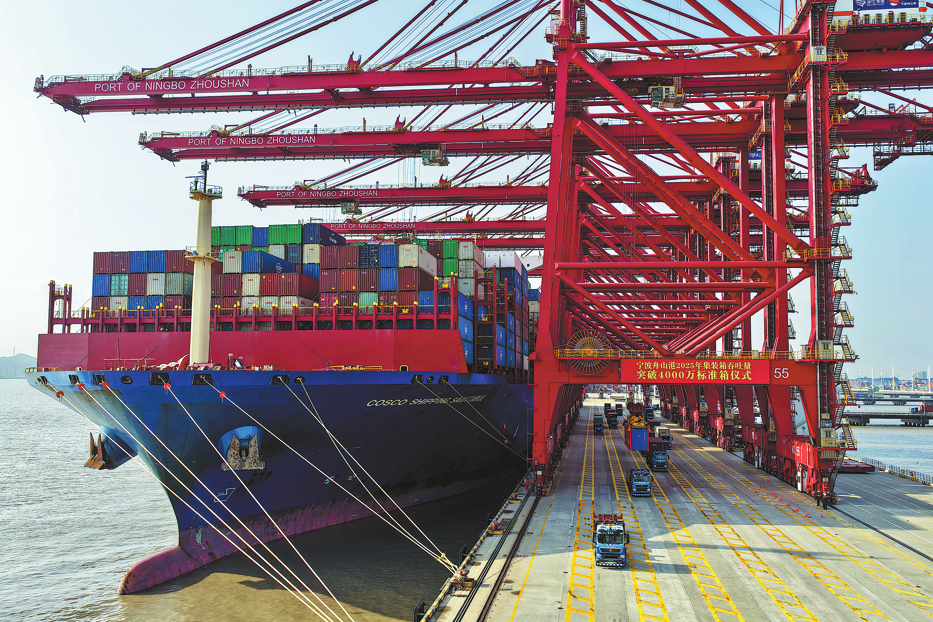
Economic and trade cooperation has consistently served as a key engine for the Shanghai Cooperation Organization's development. In recent years, deepening regional collaboration has fostered increasingly robust trade among SCO member states. In 2024, China's trade with SCO member states, observer states and dialogue partners amounted to approximately $890.3 billion, accounting for 14.4 percent of China's total foreign trade. The SCO has made notable headway in the development of energy, investment, finance, cross-border transportation and other sectors, injecting robust momentum into the regional economy.
Against the backdrop of evolving global economic dynamics and accelerating regional integration, economic and trade cooperation among the SCO members has encountered unprecedented opportunities, unlocking vast new prospects for synergistic regional economic advancement.
First, each SCO member state has crafted its own development strategy targeting national and regional economic growth. Key examples include Kazakhstan's Bright Path economic policy, Russia's Greater Eurasian Partnership and China's Belt and Road Initiative. The strategic alignment and coordination of these initiatives offer substantial potential. Within the SCO framework, member states can advance this effort by establishing coordination mechanisms and working groups to dismantle policy barriers.
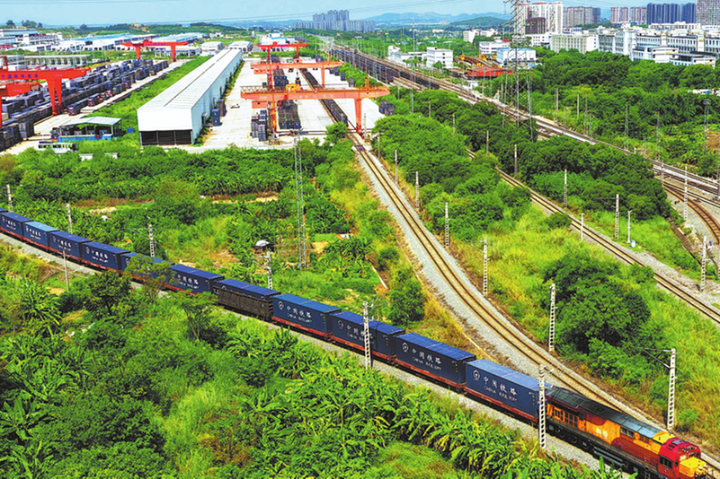
Second, spanning Eurasia and covering South Asia, the SCO has seen its infrastructure networks gradually take shape over years of unremitting efforts. In 2024, the China-Europe Railway Express operated over 19,000 trains, marking a 10.7-percent year-on-year increase. With the total surpassing 100,000 cumulative trips, the variety of goods transported has expanded to encompass over 50,000 items across 53 major categories. Member states are also actively exploring innovative multimodal transport solutions. As more infrastructure projects come to fruition, the region will establish transportation corridors characterized by "East-West coordination and North-South connectivity". This will significantly reduce logistics costs and promote the growth of regional trade.
Third, following Belarus's accession in 2024, the SCO has expanded to 10 members representing 3.6 billion people — approximately 47 percent of the global population. This consolidation creates a super-sized consumer market. Countries such as India, Pakistan and Uzbekistan continue to capitalize on their demographic dividends. Notably, 68 percent of the SCO's combined population is within the 15-64 working-age bracket, consolidating the SCO's position as a super-sized production base.
Fourth, technological innovations — particularly in artificial intelligence and the digital economy — are reshaping regional cooperation frameworks. The China-SCO Big Data Cooperation Center has spearheaded the implementation of 120 digital projects. China's investments in cross-border digital infrastructure, including the China-Kyrgyzstan-Uzbekistan optical cable and China-Russia international data corridors, have slashed regional network latency by a substantial 40 percent. In 2024, China's digital services trade with SCO members reached $32 billion, with emerging sectors such as short-video platforms and online education propelling a 35-percent increase.
Designated as the SCO's Year of Sustainable Development, 2025 arrives at a time when global consensus on tackling climate change has solidified. Member states possess substantial potential for collaboration in energy transition, ecological protection, and the green economy. Nevertheless, significant obstacles and challenges persist, impeding higher-level regional economic cooperation.
First, the SCO faces dual pressures from the accelerated restructuring of global industrial chains. On the one hand, developed countries are pursuing "friend-shoring "and "near-shoring", relocating industries manufacturing electromechanical goods and automotive components to countries such as Mexico and Vietnam. On the other hand, insufficient synergy plagues regional supply chains. Central Asian nations remain predominantly dependent on exporting primary commodities — agricultural products, energy and minerals — a pattern indicative of "low-end lock".
Second, the economic development of member states varies widely. In 2024, China's per capita GDP reached $13,500, while Tajikistan's was only $1,400 — representing a tenfold difference. These economic disparities have led to divergent interests among SCO member states. Moreover, regional trade structures remain rigid, with low trade interdependence between members, and the region collectively occupies the middle and lower tiers of the global value chain.
Third, trade and investment facilitation must be improved. Cumbersome customs procedures, inefficient operations and inconsistent trade rules are certainly not facilitating trade. The factors deterring investment include complex red tape, insufficient policy transparency and inadequate intellectual property protection.
Fourth, financial cooperation encounters persistent bottlenecks across three key dimensions. First, the US dollar hegemony continues to impact member economies. The 2024 Fed rate hikes triggered an average 15 percent depreciation of Central Asian currencies, substantially increasing debt servicing pressure. The second is that adoption of local currency settlements between member states remains limited. Despite 92 percent of China-Russia bilateral trade being settled in local currency, smaller members face low currency internationalization and persistent overreliance on US dollar clearing. Third, delayed establishment of the SCO Development Bank has left most projects dependent on Chinese policy bank loans, while sanctions cripple Russia's and Iran's international financing access, and Central Asia confronts massive infrastructure funding gaps.
Fifth, the SCO is grappling with structural talent shortages across its member states, particularly in high-skill sectors. This is evidenced by 70 percent of mid-level management roles in Chinese-funded projects requiring Chinese deployment and substantial workforce training investments necessitated by local technical expertise gaps.
As the rotating presidency of the SCO, China upholds the principle of "extensive consultation, joint contribution and shared benefits", actively advancing policy coordination and planning for sustainable growth within the SCO framework.
In transportation infrastructure, China has participated in constructing numerous notable landmark projects, including the Qamchiq Tunnel on the Angren-Pap Railway line in Uzbekistan, the Bishkek-Osh highway in Kyrgyzstan and the China-Russia Heilongjiang railway bridge. These initiatives have significantly improved transportation in the host countries, boosted local business, tourism and economic growth, and also enhanced regional connectivity.
In renewable energy, Chinese companies have invested in projects such as the Zhanatas wind farm, the Turgusun hydropower station and the Akmola Region wind farm in Kazakhstan. In Uzbekistan, Chinese investment facilitated the construction of a 1 gigawatt photovoltaic project. Once operational, this project will generate 2.4 billion kilowatt-hours of electricity annually, reducing carbon dioxide emissions by 2.4 million metric tons per year. It will meet the electricity needs of 4 million residents, provide 1,600 local jobs during construction and operation, and generate $140 million in tax revenue.
China empowers SCO member states to achieve sustained development through technology sharing and capacity building. For instance, the widespread adoption of Chinese water-saving irrigation technology in Uzbekistan has substantially boosted agricultural productivity and conserved water resources. Kazakhstan also seeks to introduce China's afforestation techniques to implement a tree-planting plan on the dried-up seabed of the Aral Sea, addressing this critical environmental crisis.
As of May 2025, the SCO Demonstration Base for Agricultural Technology Exchange and Training in Shaanxi's Yangling has cultivated 2,400 professionals from various countries, established 10 overseas sci-tech parks, and promoted the implementation of over 110 Chinese farming technologies abroad. In poverty alleviation, China enhances the capabilities of SCO member states through specialized training workshops and expert team deployments.
Guo Xiaoqiong is a research fellow at the Institute of Russian, Eastern European and Central Asian Studies at the Chinese Academy of Social Sciences. Cai Zhen is an associate research fellow at the Institute of Finance and Banking at the Chinese Academy of Social Sciences. The authors contributed this article to China Watch, a think tank powered by China Daily.
Contact the editor at editor@chinawatch.cn.