


Astronomy teams up with art to illuminate cosmos at exhibition










At an exhibition in the heart of China's capital, Beijing, cosmic data becomes tangible art.
Navigating through 10 billion light years with the slide of a finger, confronting the dense, tangled web of space debris now circling the Earth, and listening to music made from data collected by satellites orbiting in space, are all options at the exhibition Cosmos Archaeology: Explorations in Time and Space, which opened to the public on July 3 in the National Museum of China. Here, visitors can discover and explore new gateways to the universe.
Jointly hosted by the museum, the Embassy of Switzerland in China, and the Swiss Federal Institute of Technology Lausanne, or EPFL, the exhibition is one of a series of events to celebrate the 75th anniversary of the establishment of diplomatic relations between China and Switzerland.
The show, which will run for three months, features many pieces created from real observational data and transforms abstract cosmic phenomena into immersive encounters.
"Ordinary people often feel distant from the vast datasets of fundamental science," says the exhibition's cocurator Long Xingru.
"Art is an excellent vehicle for telling scientific stories. It enriches our expression of science," Long adds.
Her vision materializes through installations in the exhibition.
An installation, developed by EPFL's labs to present the dynamic cosmos, employs a custom graphics rendering engine to construct an interactive 3D universe model — allowing visitors to traverse cosmic scales spanning 27 orders of magnitude.
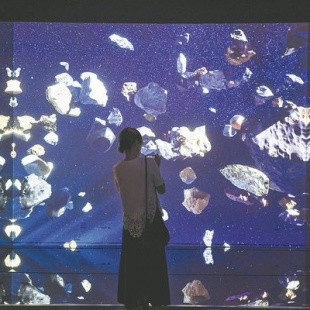
Another exhibit nearby, which is an interactive astrophysical visualization system, projects approximately 500 NASA deep-space images onto a domed environment. Optical enhancement modules then transform telescope data into shimmering nebulae and spiraling, colliding galaxies.
Notably, this exhibition connects millennia of cosmic inquiry. A prized artifact from the host museum's own collection, a Southern Song Dynasty (1127-1279) stele rubbing, reveals early Chinese astronomical mastery.
Its star map documents 1,434 precisely charted stars, along with the Milky Way boundary, ecliptic path and 28 lunar constellations — exceeding the systematic accuracy of contemporaneous European charts.
Modern astronomers confirm that its stellar positions align remarkably well with contemporary catalogs.

Yet, alongside historical wonder lie stark warnings about the future.
With an increasing number of satellites and spacecraft being launched, space debris continues to accumulate. An EPFL lab has managed to create an interactive data visualization device that dynamically presents tens of thousands of satellites and pieces of space debris.
Visually, it suggests that the Earth is now ensnared by numerous webs made up of a dense layer of space junk.
"This is forcing us to rethink how we will explore and manage space resources in the future," says Gao Lu, a curator and associate researcher at the National Museum of China.
Beyond visualizing the distant cosmos, the exhibition also probes humanity's place within it.
The exhibition features a series of works designed by faculty members and students from Tsinghua University's Academy of Arts and Design, a coorganizer of the exhibition, envisioning future planetary journeys.
"Science and art part ways at the mountain's base but reunite at its summit," says Shi Danqing, an associate professor at the academy.
"We need students equipped with both scientific thinking and experimental design creativity — merging technology with exploration. This ability will become crucial in the AI era," he says.