China ready to drive smart vehicle brain









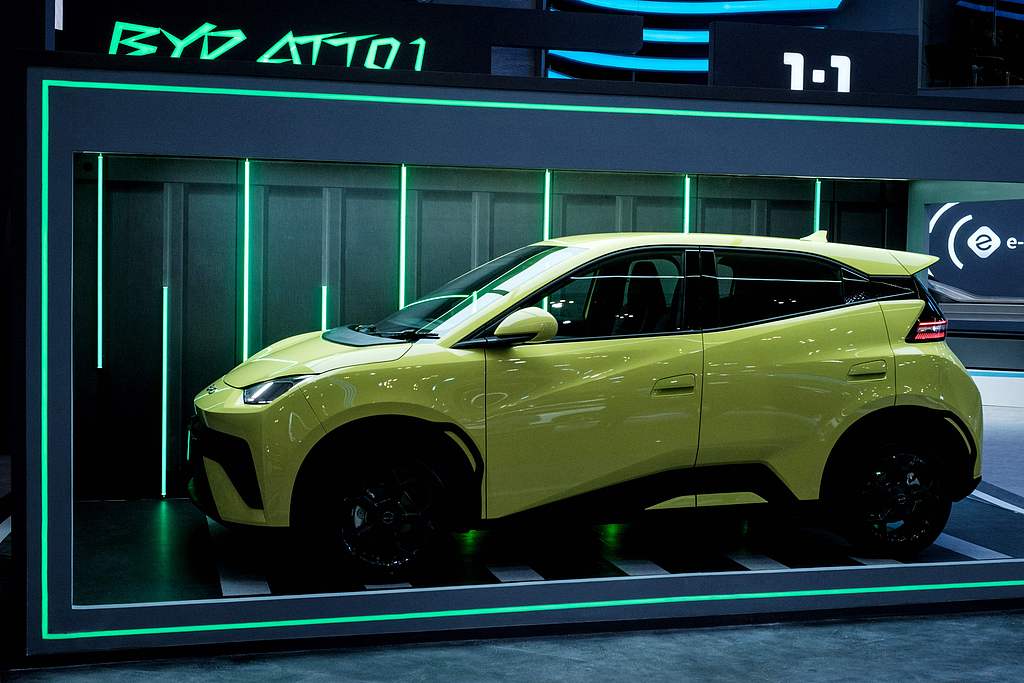
BYD Atto 1 is displayed during the Gaikindo Indonesia International Auto Show in Tangerang, Indonesia, on July 23, 2025. [Photo/VCG]
As global supply chains fragment because of rising geopolitical tensions, China is doubling down on a long-term strategy to achieve technological self-reliance in the automotive sector. Central to this ambition is the rapid localization of high-value components, particularly semiconductors, sensors and software, which form the "smart brain" of next-generation vehicles. What began as a defensive move to reduce dependence on foreign suppliers is now evolving into a bold industrial upgrade with global implications.
The Chinese auto industry is not merely catching up; it is redefining the game.
At Automobility, we have long argued that the auto industry is shifting from a hardware-centric model built on mechanical differentiation to a software-defined architecture rooted in intelligence, connectivity, and user experience. The car is no longer just a machine; it is becoming a smart device on wheels.
This shift elevates the role of semiconductors, sensors and domain controllers — from supporting components to the central nervous system of the vehicle. In this software-defined era, control over these intelligent systems is not only a source of competitive advantage but also a matter of strategic autonomy.
This brings us to the rise of the "Smart Vehicle Brain" — Made in China?
Historically, global automakers relied on tier-1 suppliers, many of them based in Europe, Japan or the United States, for electronics and chips. China's early-stage domestic brands imported much of this technology. But over the past five years, the roles are gradually changing: Chinese EV makers are increasingly seen as technology leaders. Leading Chinese electric vehicle makers such as BYD, NIO, Li Auto and XPeng have moved aggressively to internalize core intelligent systems, from advanced driver assistance to computing platforms and battery management.
Now, the next wave of innovation is coming from a new class of domestic suppliers focused on chips and sensors that enable autonomous and AI-assisted driving. Companies like Horizon Robotics, Black Sesame, and Hesai Technology are gaining traction domestically and starting to explore international opportunities.
These enterprises are not simply imitating Western technology; they are optimizing performance to meet the specific demands of Chinese roads, users and digital ecosystems. The result: homegrown systems that are leaner, cheaper, and faster to iterate.
The price war that now marks China's auto market is not a race to the bottom; instead, it's a test of industrial efficiency and technological self-sufficiency. As vehicle prices fall below 100,000 yuan ($13,800), cost structure becomes destiny.
Here's where localization delivers strategic leverage. A domestically sourced sensor suite or AI chip may be significantly more affordable than its imported equivalent. More importantly, integration cycles are faster when engineering teams work in the same time zone, speak the same language, and respond to market changes in real time.
This virtuous loop of cost, speed and scale is difficult for foreign suppliers to replicate, let alone improve, and this allows Chinese brands to embed intelligence in vehicles at a price point that rivals cannot match.
What does this mean for the global auto industry?
First, foreign original equipment manufacturers operating in China must now integrate with a rising tier of domestic tech suppliers or risk losing relevance. Legacy Tier-1s can no longer assume that their brand, scale or engineering history will win the day. Increasingly, it's about software, speed, and local customization.
Second, Chinese brands are exporting not just cars, but entire technology stacks. As companies like BYD, Geely and SAIC expand globally, they bring with them smart cockpit systems, autonomous driving platforms, and localized compute modules — all designed and manufactured in China. The export of complete "intelligent mobility solutions" may well become one of China's most powerful soft power tools.
Finally, global automakers must grapple with a new reality: the innovation frontier is no longer confined to Silicon Valley or Stuttgart. Shenzhen, Shanghai and Beijing are now equally powerful nodes in the global mobility innovation network.
The question is no longer whether China will build the smart vehicle brain. The question is how soon it will become the global leader in doing so. With policy support, massive domestic demand, and a deep pool of tech-savvy talent, China is well positioned to lead the next wave of automotive intelligence.
But success is not guaranteed. Sustained leadership will depend on creating globally competitive standards, navigating data governance challenges and ensuring interoperability with international ecosystems. If those hurdles can be crossed, China could move from being a fast follower to an innovation leader in the most strategically critical layer of the future mobility stack.
As the auto industry rewires itself around intelligence, connectivity and autonomy, China's vision is clear: not just to make cars, but to redefine what a car is. In doing so, it may also define what the global car of tomorrow will look like, and who builds its brain.
The author is founder and CEO of Automobility Ltd.
The views don't necessarily reflect those of China Daily.