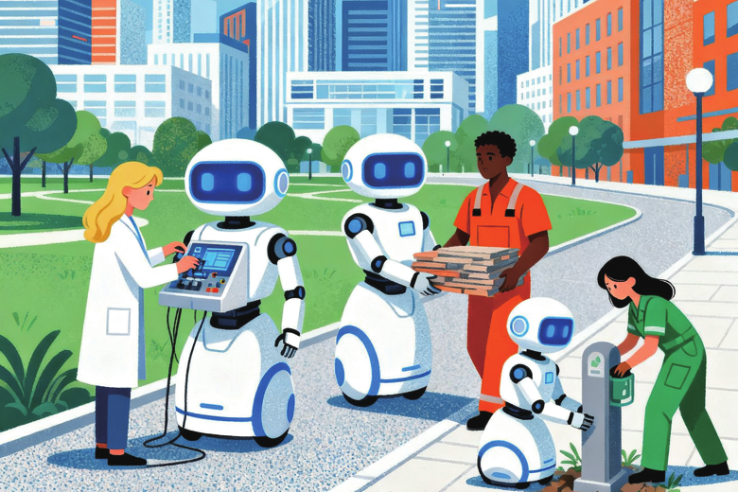
Beijing's initiative promotes global AI governance










It is said, not without merit, that artificial intelligence will change the world more than any other technology since the Industrial Revolution. The fever-pitch race for AI supremacy, both between companies and between countries, threatens to imperil humanity in multiple ways, including widening the knowledge-divide between developed and developing countries (and thus widening global inequality), making workers suddenly redundant and unemployed, altering human psychology and development in unpredictable ways, and, potentially, posing a grave threat to humankind as a whole.
Technologically, the competition seems a toss-up. True, the United States is ahead in AI software. But China is catching up rapidly. China's DeepSeek, a homegrown start-up, has developed highly advanced large language models (LLMs), comparable to those developed by American AI giants, at a fraction of their cost. And DeepSeek's design requires fewer resources for both training and deployment.
More recently, Beijing-based Moonshot AI released the weights for Kimi K2, an LLM with 1 trillion total parameters, in the range of the leading US LLMs.
The US and some of its allies are global leaders in computational hardware, the specialized chips that empower AI to create "magic", but China has made self-sufficiency in advanced chips one of its top national priorities. China's open-source approach to AI facilitates rapid development, as diverse, even competing, groups can learn from one another.
The US has not only restricted the export of advanced chips to China on the grounds of safeguarding national security, but also is promoting an "America first" policy. In contrast, China presents itself as the champion of global inclusiveness.
China's vision is set forth in its initiative, the "World Artificial Intelligence Cooperation Organization", with a mandate to address all the issues that AI has created for the international community. For example, by helping less-developed countries to boost their economic development and optimally use AI, as well as by promoting open-source AI as opposed to proprietary AI, China states that its initiative works toward building a more equal world. Only multinational cooperation, China says, can ensure AI benefits humankind both in the short term and long term.
Following President Xi Jinping's vision for global cooperation, China established the WAICO at the World Artificial Intelligence Conference, which was held in Shanghai from July 26 to 28, in order to achieve critical goals. Its first goal is to build a platform for connecting supply and demand, promoting practical cooperation in AI between China and other countries, as well as among various countries, thereby unlocking the potential of AI and achieving common development. A second goal is to help countries in the Global South strengthen capacity-building so they can benefit equally in the coming tsunami of AI-enabled systems and activities. Another goal is to enhance coordinated governance to ensure AI is used for the good of humankind.
China says it is relying on the WAICO to align and coordinate different countries' AI development policies and governance rules, so as to form a global governance framework and set standards for AI, as well as to ensure AI development advances the progress of human civilization.
A key factor in China's global vision is its adoption of open-source AI, which will enable broader access to state-of-the-art technologies, unencumbered by proprietary, profit-maximizing boundaries. The downside, some AI safety experts warn, is that reduced protection could prompt those with malicious intent to modify advanced AI models to create AI systems that could cause harm to others.
WAICO officials stress China's commitment to AI safety, keeping a watchful eye on companies that might shirk safeguards to gain commercial advantage. In fact, former Google CEO Eric Schmidt has called for US-China cooperation on AI safety, warning that AI-generated existential risks could affect us all.
China's move to promote AI as a multinational public good, announced by Premier Li Qiang at the World Artificial Intelligence Conference, was unsurprisingly interpreted as distinguishing China's approach from that of the US, which just a few days earlier had set forth its "AI Action Plan" that is clearly intended to sustain and perpetuate the US' dominance in AI.
It would be stretching the boundaries of na?veté to imagine the US would even agree to China's vision of establishing a global AI coordination center in China. Needless to say, the US and its allies in the developed world see the WAICO as a vehicle for China to set the agenda for AI and to control the global narrative.
A new factor in the US leader's approach to AI and to China comes in the form of his new best-buddy technology entrepreneur, Jensen Huang, CEO of Nvidia, the world's most valuable company with its market capitalization exceeding $4 trillion. Although promoting his own company's interests, as he should, Huang is widely recognized as being thoughtful, as well as innovative and dynamic.
Good wishes aside, all we know for sure, right now, is that AI is the future, and that to control AI is to control the future.
The author is chairman of The Kuhn Foundation, creator/host of Closer to Truth, a digital-media nonprofit TV series on science and philosophy, and a recipient of the China Reform Friendship Medal. The views don't necessarily represent those of China Daily.
If you have a specific expertise, or would like to share your thought about our stories, then send us your writings at opinion@chinadaily.com.cn, and comment@chinadaily.com.cn.