Xi: Grottoes are treasures of civilization
Preserving cave temples with great historical, cultural value emphasized









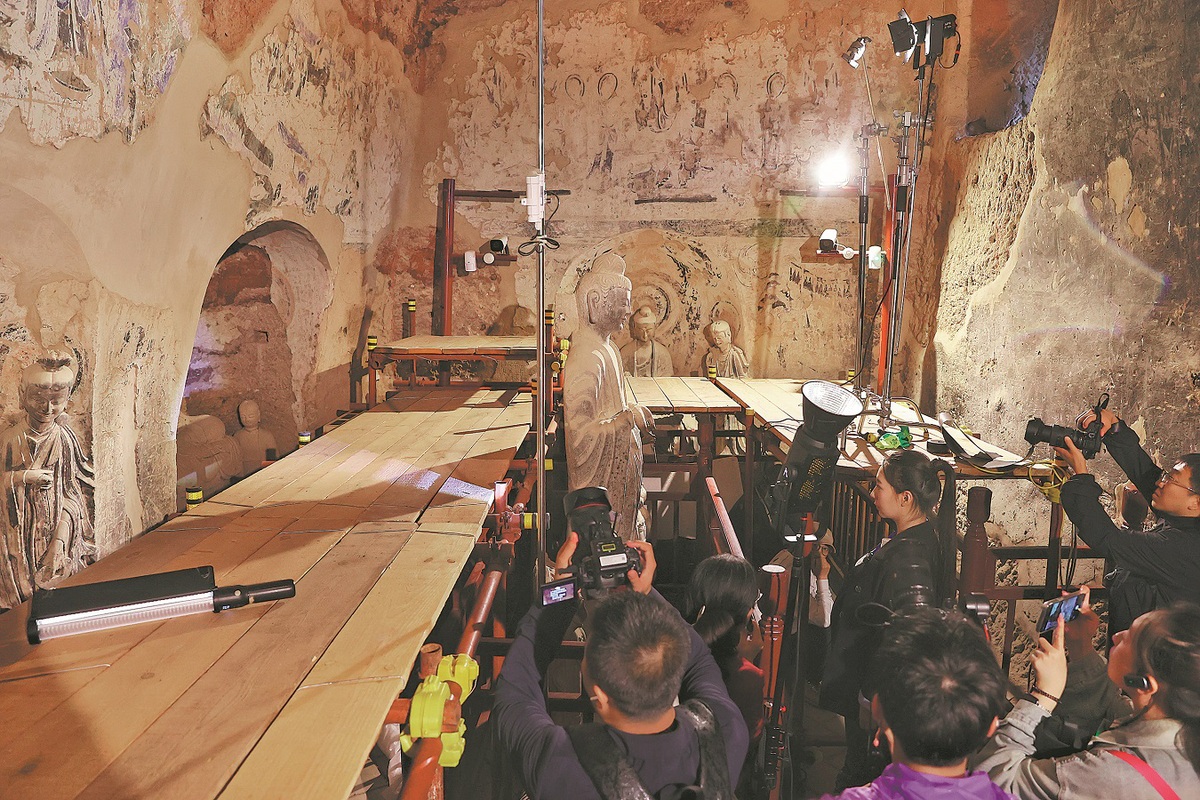
When night fell and the lights turned on, the statue of Lushena Buddha, originally built in the Tang Dynasty (618-907) as part of the Longmen Grottoes in Luoyang, Henan province, seemed draped in a golden cassock.
Against the backdrop of the night sky, the statue, whose name is the Chinese translation of the Sanskrit word "vairocana", meaning "illuminator", looked more solemn and serene, inspiring awe for the ancient piety and artistry that brought it to life.
The night tour around Longmen, an artistic trove comprising more than 2,300 caves and niches carved into steep limestone cliffs over a one-kilometer-long stretch mainly from the fifth to the 10th centuries, gained popularity this summer.
Since July, the site has received an average of 5,000 to 6,000 visits daily from 5 pm to 9 pm, with peak days exceeding 10,000, according to Yu Jie, Party secretary of the Longmen Grottoes Academy.
President Xi Jinping's continuous attention to cave temples has significantly contributed to this popularity. Xi, who is also general secretary of the Communist Party of China Central Committee, has visited all four major cave temples in China and made many instructions about their significance and conservation since 2019.
The four grottoes are all treasures of Chinese civilization with significant historical and cultural value, Xi said when he visited the Maijishan Grottoes in Tianshui, Gansu province, on Sept 11 last year.
Besides Longmen and Maijishan, the four sites also include the Mogao Caves in Dunhuang, Gansu, and the Yungang Grottoes in Datong, Shanxi province, all UNESCO World Heritage sites. They are outstanding examples of Chinese grotto temples, an important Buddhist art form that was introduced to China via the ancient Silk Road during the third century.
In August 2019, Xi arrived in Gansu for an inspection and made the first stop at Dunhuang. Touring the Mogao Caves, he checked the work of cultural relics protection and research, and emphasized the need to preserve the finer features of the nation's culture.
The Mogao Caves site, at the religious and cultural crossroads on the ancient Silk Road, boasts more than 700 Buddhist caves featuring exquisite murals and statues from the fourth to the 14th centuries.
Xi also met Fan Jinshi, honorary director of the Dunhuang Academy, who was born in Beijing and raised in Shanghai, but chose to work in Dunhuang, a remote and arid desert region in Northwest China, for six decades. Xi highlighted the "Mogao spirit", forged by heritage protectors such as Fan, which values insistence, contribution, a sense of responsibility and pioneering.
Change in approach
Experts noted that cave temples, often located in remote mountainous areas and exposed to the natural environment, are difficult to protect and manage, as they frequently face threats such as water damage, earthquakes, unstable rock foundations and weathering, as well as human-induced damage.
"Despite the difficulties, China's efforts to protect its cave temples have endured for eight decades," said Su Bomin, director of the Dunhuang Academy. "We have continuously explored technologies and accumulated experience in restoring the Mogao Caves, developing a comprehensive set of programs that have been applied not only in domestic grottoes but also to sites overseas."
Su said that the approach to protecting China's cave temples is currently experiencing a leap from a "rescue restoration" mindset to one focused on "preventive protection".
Hang Kan, director of the Yungang Research Institute, said that in recent years, professionals have intensified their efforts in the digital collection of information from the caves of the Yungang Grottoes, striving to "seize the information at the moment".
"Grottoes are changing every day, and so is the information they carry. We want to capture every moment to preserve as much information as possible," said Hang. He added that they have collected information from 80 percent of the caves, which will serve as a reference for their long-term protection.
On the other hand, restorers are actively exploring new technologies and materials for cave temple restoration. For example, in the 1970s, epoxy resin was frequently used in restoring cultural relics in caves due to its strong adhesion, excellent versatility and chemical resistance, making it an advanced new material at that time.
However, after decades of use, professionals have discovered that epoxy resin materials are not good enough, as they age and deteriorate under high temperatures. Therefore, they are developing new materials.
Experts from Chongqing University are exploring a way of using microorganisms in the restoration of cultural relics as an alternative to epoxy resin. By introducing specific microbial strains under suitable environmental conditions, bioadhesives can be synthesized, and these can then be applied to reinforce cracked relics, offering benefits such as greater compatibility, non-toxicity, environmental friendliness and stronger weather resistance, according to Hang.
"The protection of cave temples is not a once-and-for-all project. With changes in time and climate, new problems arise, bringing fresh challenges and prompting us to continuously seek new materials, innovative ideas and advanced technological methods for their preservation," he said.
Unwavering commitment
Behind the progress is the persistent dedication of heritage protectors, year after year.
In September last year, Xi, at Maijishan, encouraged cultural heritage professionals to inherit the "Mogao spirit", remain dedicated to safeguarding the nation's treasures and to contribute greater efforts to the preservation and innovation of China's fine traditional culture, as well as the improvement of the influence of Chinese culture.
Cave temples are often located in remote areas, sometimes lacking good environmental conditions. According to Yue Yongqiang, deputy director of the Maijishan Grottoes art research institute, heritage protectors can withstand the loneliness and stay for decades because they are obsessed with the charm of traditional Chinese culture and art, find their research direction there, and are committed to intensive studies of their subjects.
"It's all about insistence, passion and love," said Yue.
He said that predecessors such as Fan have set good examples for them. "They possess ideas and beliefs, love their cause and are not willing to give up their research, forming the precious 'Mogao spirit'," said Yue. "Their spirit has inspired more people to join, reminding us that despite the hardships, our work is very meaningful."
In May, Xi visited the Longmen Grottoes and called for protecting, inheriting and promoting the treasures of Chinese culture well.
Hang, director of the Yungang Research Institute, said: "Although protection is our priority, it's not reasonable to keep the relics sealed. Instead, we aim to strike a balance between protection and utilization, which means that while ensuring their protection, we explore ways to bring them back to life so they can benefit the public."
He said that the institute has organized a series of innovative exhibitions related to Yungang in many cities across the country. In an upcoming exhibition in Shanghai this month, there will be dancing robots based on stone carving figurines from a cave in Yungang.
Such efforts have made significant changes. "We have analyzed the data and found an interesting phenomenon: Every time we organize an exhibition in a city, visitors from that city flock to Yungang afterward. This means that exhibitions are an effective way to promote cave temples. With digital technologies, we will find more ways for such promotion," he said.





- More youngsters going under knife in quest for 'beauty ideal'
- Xi: Grottoes are treasures of civilization
- Huangyan approved as nature reserve
- Hongqiao Intl CBD facilitating companies' global ambitions
- Global Public Security Cooperation Forum to be held in Lianyungang
- Huangyan Island National Nature Reserve gets official go-ahead