Peace requires remembering the cost of war









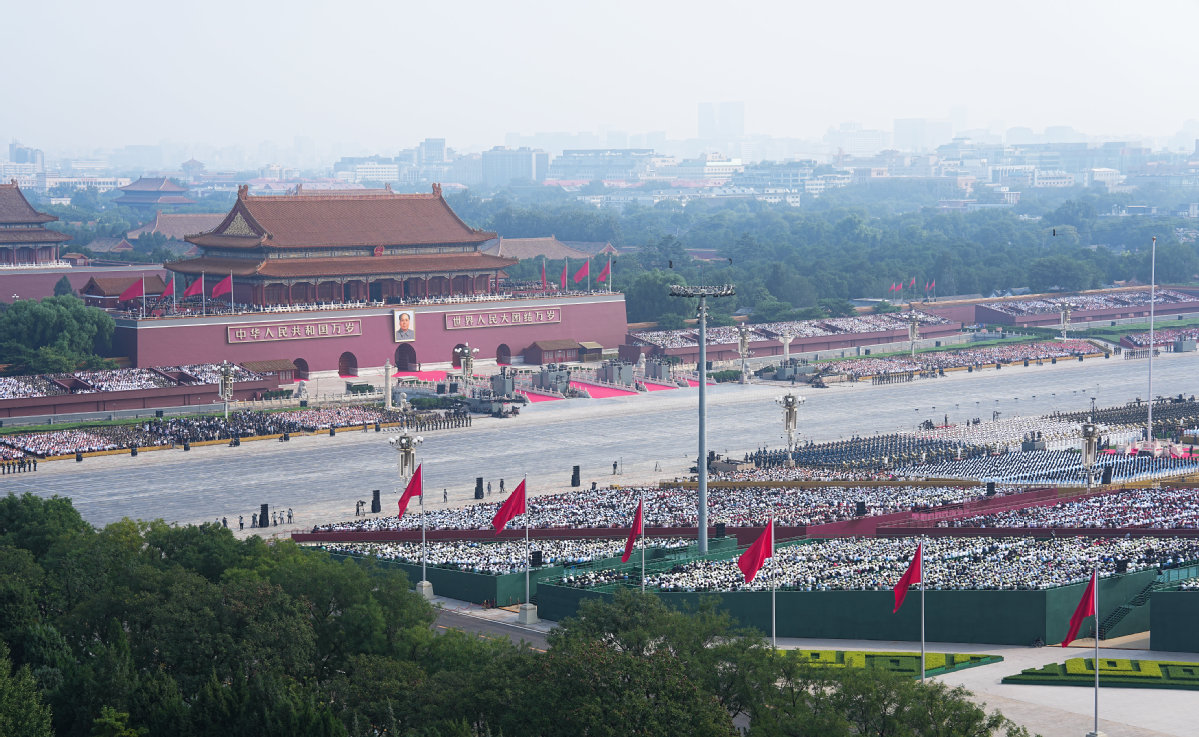
On Sept 3, the skies over Tian'anmen Square in Beijing were filled with 80,000 doves and a mass of balloons. It was not just pageantry, but symbolism — China's message to the world on the 80th anniversary of victory in the Chinese People's War of Resistance Against Japanese Aggression (1931-45) and the World Anti-Fascist War: Peace must be preserved by remembering the cost of war.
Beneath the grandeur of the parade and its geopolitical undertones was a quieter but far more profound historical truth: China was not a peripheral participant in World War II; it was one of the most pivotal battlegrounds and a decisive contributor to the victory against the aggressors.
China's war of resistance against Japanese aggression began not in 1937 but in 1931, with the Japanese invasion of China's northern territories. Over the next 14 years, China endured the longest and most brutal theater of World War II, facing a then technologically superior Japanese military. And yet, it never capitulated.
According to Professor Hu Dekun, an expert on World War II, China's resistance prevented a catastrophic two-front war that could have crushed the Soviet Union, which was then resisting the German Nazi invaders.
By tying down over 1 million Japanese troops — nearly 90 percent of Japan's ground forces at their peak — China diverted pressure away from the Pacific and European fronts. An estimated 1.5 million Japanese soldiers died in China, accounting for 70 percent of Japan's total wartime casualties, despite China's then disadvantages in economic and military resources. That staggering toll not only weakened Japan's imperial capacity, but arguably saved the Allies from strategic disaster.
China's resistance was not a remote battle. It was fought valiantly in the streets of Shanghai, the ruins of Nanjing, and the mountains of Sichuan. It was felt in famine-ravaged provinces, in families torn apart by bombing, and in a resistance powered not just by soldiers, but by civilians, students, women and workers.
The human toll was catastrophic: Over 35 million Chinese were killed or wounded; cities were reduced to ashes; and countless women and children were subjected to systematic atrocities by the Japanese army.
As a descendant of those who lived — and some of whom died — through that resistance, including two granduncles, Dee Hoc Siu and Dee Hoc Khe, in the Philippines, who fell to Japanese forces, and another granduncle, Dee C Chuan, who was chief proponent and served as vice-chairman to Singapore's Tan Kah Kee in the Southeast Asia coalition to support war-ravaged China called the Nanyang Federation of China Relief Fund, I find this anniversary deeply personal and epic in inspiration.
The overseas Chinese diasporas played a vital role. Communities across Southeast Asia, the United States, and beyond organized resistance networks, raised funds, and sent aid.
China's struggle against fascism was global in its impact and collective in its sacrifice.
The 80th anniversary parade in Beijing was thus more than a stunning martial display.
Yes, it showcased China's modern-military prowess — robot dogs, undersea drones, hypersonic missiles — but it also wove together narratives of the past, present and future. As President Xi Jinping said in his speech, China remains committed to learning the lessons of history and dedicating itself to peace.
Critics have called the event a challenge to the Western-led international order. But I believe such views are drawn from a distorted perspective.
For China, commemorating this war is not about "revanchism" — it is about restoration of dignity, of historical recognition, and of sovereignty hard-earned through sacrifice.
The doves released at the end of the parade were not an afterthought. They were the soul of the message: Peace is sacred and invaluable; but it must be defended.
As the respected sinologist Professor BR Deepak notes, China's role in the war was not just heroic — it was decisive.
Its prolonged resistance gave the world time to mobilize. It offered crucial strategic breathing space to the Soviet Union. It ensured Japan could not reinforce the Nazis in the Middle East or reach Australia. Without China's endurance, the war's outcome might have been catastrophically different.
China was also the first to resist fascism — starting eight years ahead of the rest of the world — and one of the last countries still fighting in 1945. Despite being then a semi-colonized, feudal agrarian society, China mounted an epic nationwide resistance that lasted longer than any other major front of World War II. That alone is a unique achievement in the annals of war.
Today, the lessons of that noble resistance are not just historical. They are political and philosophical. The war helped forge modern Chinese nationalism, ended the "century of humiliation", and laid the foundation for China's re-emergence as a peace-loving global economic power.
It also taught a painful truth: Peace is not given; it is defended through unity, sacrifice and strength.
This is why the People's Liberation Army today bears a dual mission — not only to safeguard China's security, but to uphold global peace. Through United Nations peacekeeping missions, humanitarian relief and anti-piracy patrols, China is increasingly positioning itself as a contributor to international stability, not just to its own defense.
To the world, China's message on Sept 3 was clear: We remember not to relive the past, but to ensure it never returns.
As the doves took flight over Tian'anmen, and over the collective memory of a war-weary world, perhaps they carried a timeless truth: Peace born of sacrifice carries the broadest wings.
The author is an economics and politics analyst, an award-winning columnist of the Philippine Star and Abante newspapers, and moderator of the Pandesal Forum.
The views do not necessarily reflect those of China Daily.