Bridging the divide
China is demonstrating how technological innovation can unite the Global South for sustainable growth









Editor's note: The world has undergone many changes and shocks in recent years. Enhanced dialogue between scholars from China and overseas is needed to build mutual understanding on many problems the world faces. For this purpose, the China Watch Institute of China Daily and the National Institute for Global Strategy, Chinese Academy of Social Sciences, jointly present this special column: The Global Strategic Dialogue, in which experts from China and abroad will offer insightful views, analysis and fresh perspectives on long-term strategic issues of global importance.
As China nears the completion of the 14th Five-Year Plan period (2021-25), there are some distinct lessons other Global South countries, such as South Africa, should heed. South Africa is navigating complex development challenges amid shifting global power dynamics. Many of the challenges are structural and systemic. In many ways, South Africa has achieved a great deal, but there are areas that still demand attention.
For example, growth has been relatively static for the last decade. Inequality persists unabated, and unemployment sits uncomfortably high. On reflection, China's economic achievements between 2021 and 2025 offer instructive parallels and cautionary tales for South Africa and, of course, other Global South countries. In particular, the plan's emphasis on high-quality growth, technological self-reliance and common prosperity presents a model that warrants serious examination.
First, it must be acknowledged that the Global South has largely remained fragmented. Developing countries seldom view themselves as being part of a bloc, and this has profound implications. For a long time, the Global South has been dismissed by the West as being on the margins and relegated to a passive role. Now, amid the increasingly uncertain global context, developing countries must come together to learn from each other. The challenges, from infrastructure deficits, youth unemployment, climate vulnerability, technological gaps and the imperative of inclusive growth, are remarkably convergent. These are not isolated national problems but shared development realities that demand collective responses. When one Global South nation charts solutions to these challenges, it creates pathways that can be adapted and refined for others.
China's 14th Five-Year Plan arrived at a critical juncture when many other Global South countries were striving to develop their own paths based on their own needs. For instance, it is imperative that South Africa moves beyond resource-dependent growth models toward innovation-driven economies. China's strategic pivot toward domestic consumption, technological innovation and green development addresses key issues all too familiar to South African policymakers. The Global South is tasked with answering how to create inclusive growth while transitioning to sustainable economic structures in an increasingly fragmented global landscape. Equally, it must be remembered that growth alone is not development. What is transferable is the recognition that inequality itself constrains growth by limiting human capital development and domestic consumption. China's commitment to "common prosperity" reflects a deliberate attempt to narrow social and regional disparities while expanding the middle-income group. Investing in education, vocational training and digital skills must therefore be viewed as an economic strategy. For South Africa and other Global South countries, this represents a powerful counter-narrative to traditional models. The Chinese economy has demonstrated its strong resilience, enormous potential, vast room for manoeuvre and long-term stability. These are the very tenets other economies in the Global South must tap into. The question is how to do it.
Translating these lessons into practical results also requires institutional coherence and governance capacity. China's ability to mobilize resources efficiently has been rooted in long-term planning and a strong developmental State ethos. Perhaps the most pertinent aspect is the consideration around technology. The cornerstone of China's plan has been its emphasis on technological self-sufficiency and industrial upgrading. This has been achieved through investment in semiconductors, artificial intelligence, quantum computing and biotechnology. This has been underpinned by a recognition that technological sovereignty encourages economic security. China's model demonstrates how State coordination, patient capital and clear strategic priorities can accelerate this translation. The establishment of specialized funds, tax incentives for research and development, and coordinated procurement policies have created ecosystems where innovation could flourish. It could be argued that for the Global South collectively, building regional innovation networks and pooling resources for strategic technologies represent a viable pathway forward.
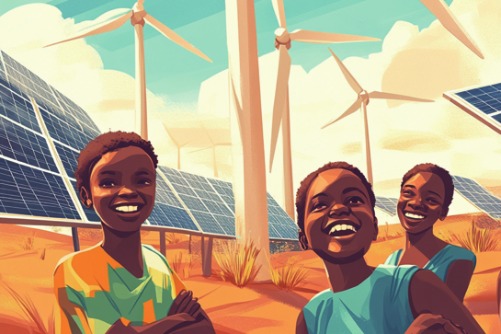
Another dimension that deserves emphasis is the green transition. China's pursuit of carbon neutrality and the expansion of renewable industries demonstrate how climate policy can drive new markets. Impressively, China now leads globally in renewable energy capacity, battery technology and electric vehicle production. South Africa, similarly, stands at an inflection point as it navigates the decline of coal while ensuring energy security and creating new green jobs. By leveraging partnerships within the Global South, particularly in green finance or circular economy practices, climate adaptation becomes an opportunity.
China's economic achievements have broader implications for global stability and the architecture of international cooperation. By demonstrating an alternative development pathway, China has expanded policy space for other Global South nations to chart courses suited to their contexts rather than following prescribed templates. This has contributed to the emergence of a more multipolar world, which is visible in mechanisms and institutions such as BRICS and the New Development Bank. From China, other Global South countries can truly learn how to build stronger economies. And with South-South knowledge transfer, they can become stronger. This requires establishing systematic channels for exchange through arrangements between cities, secondments of civil servants to observe policy implementation, joint research programs between universities, and even digital platforms that enable real-time sharing of developmental experiences. South Africa's experience navigating relationships with both emerging and developed economies allows it to contribute meaningfully to building bridges in this evolving global landscape. It can leverage its experience navigating diverse partnerships to advocate a reformed international economic architecture that accommodates different development models while maintaining cooperation.
The path ahead will not be without friction, but as the Global South learns to speak and act collectively, its shared experiences can evolve into shared strength. Indeed, the next chapter of global development can be written by the Global South. As the often-cited African proverb goes: "If you want to go fast, go alone. If you want to go far, go together." For the Global South, the choice is clear.
The author is the vice-chancellor and the principal of the University of Johannesburg. The author contributed this article to China Watch, a think tank powered by China Daily.
The views do not necessarily reflect those of China Daily. Contact the editor at editor@chinawatch.cn.