Nation's Mars orbiter snaps images of interstellar object









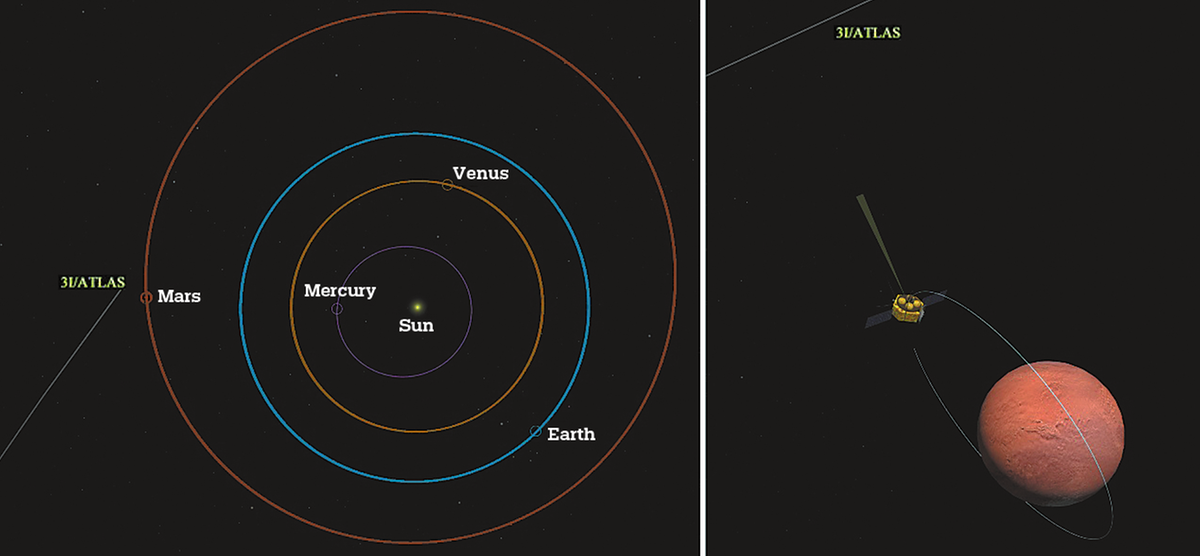
A Chinese orbiter near Mars has spotted and captured images of a rare, interstellar comet speeding through the solar system, the China National Space Administration said on Thursday.
The orbiter, which is part of the nation's ongoing Tianwen 1 mission for Mars exploration, took the images of the comet, coded 3I/ATLAS, on Oct 3 as it whizzed past the Red Planet. It is the third confirmed interstellar object passing through the solar system, after 1I/'Oumuamua and 2I/Borisov.
At the time, the spacecraft was orbiting about 29 million kilometers from the comet, realizing one of the closest observation operations of the celestial body, the CNSA said in a news release.
Scientists and engineers in the Tianwen 1 project team started making preparations for the 3I/ATLAS observation in early September. They carried out rounds of calculations and simulations before working out a specific observation and imaging plan, which was based on 3I/ATLAS' trajectory characteristics, brightness, size and the capabilities of the orbiter's scientific payloads, the CNSA said.
The comet was first discovered on July 1 by the NASA-funded Asteroid Terrestrial-impact Last Alert System, or ATLAS, survey telescope in Rio Hurtado, Chile.
Since the first report, spotting records of the comet before the July observation were gathered from the archives of three different ATLAS telescopes around the world and California Institute of Technology's Zwicky Transient Facility at the Palomar Observatory in San Diego County, California, the United States.
According to scientists, the 3I/ATLAS may have formed around an ancient star at the center of the Milky Way galaxy, with an estimated age of about 3 billion to 11 billion years, possibly older than the age of the solar system. It is a rare sample for detecting the composition, evolution and early stellar history of exoplanets.
The comet reached its closest point to the sun around the end of October, at a distance of about 1.4 astronomical units, or 210 million km, just inside the orbit of Mars.
Liu Jianjun, a senior Tianwen 1 mission planner, said the orbiter's optical imaging apparatus was originally designed to photograph the bright Martian surface, and this is the first attempt for it to take the images of such a distant and relatively obscure celestial body.
Liu said the observation of the 3I/ATLAS is an important extended task of Tianwen 1, and has served as a technical test and accumulated experience for the Tianwen 2 asteroid exploration mission, which was launched in late May.
Wang Yanan, chief editor of Aerospace Knowledge magazine, said that calculations indicate the 3I/ATLAS originated from galactic regions outside the solar system, possibly a fragment ejected by gravity from a stellar system in the early stages of its formation billions of years ago.
"It has drifted through interstellar space for an extremely long time, like a grain of dust from the cosmic frontier, until it accidentally strayed into our solar system recently. It streaks across the sky at an extremely high speed — more than 200,000 km per hour — far exceeding the orbital speed of ordinary comets," he said.
"More notably, the direction of its tail is opposite to that of ordinary comets. This anomalous phenomenon leads scientists to believe it holds significant scientific research value, providing an opportunity to study extraterrestrial icy objects and helping us understand the material composition and evolutionary history of substances not belonging to our solar system," Wang added.
zhaolei@chinadaily.com.cn






- Thai king to pay state visit to China
- Mars orbiter snaps images of interstellar object
- Ten photos from across China: Oct 31 - Nov 6
- China surpasses 100 million kW in new energy storage
- HRC Group's LEU100 drone debuts at CIIE, targeting China's low-altitude mobility sector
- Bird-watching festival in Yunnan unveils new avian discoveries