Chasing secrets of the universe on world's rooftop in SW China










CHENGDU -- On Haizi Mountain in Daocheng in Southwest China's Sichuan province, with an average altitude over 4,400 meters, a silent sentinel keeps watch over the universe.
Spread across 1.36 square kilometers of ancient glacial terrain, the Large High Altitude Air Shower Observatory (LHAASO) resembles a vast, intricate net, tirelessly capturing traces of cosmic rays, which are subatomic messengers from the depths of space.
This month, the formidable instrument in China's southwest announced a monumental discovery -- it had captured crucial observational evidence that black holes, devouring material from their companion stars and producing jets, act as powerful particle accelerators and may play a key role in the production of high-energy cosmic rays in the Milky Way.
Not far away, where the Bang River winds past Daocheng, another giant stirs. The world's largest circular array of telescopes tracks the sun with quiet precision. The Daocheng Solar Radio Telescope, notably, is vital for efforts aimed at improving the accuracy of space weather forecasts.
Situated on the southeastern edge of the Qinghai-Tibetan Plateau, Daocheng county in Sichuan's Garze Tibetan autonomous prefecture has an average altitude of about 3,750 meters.
Blessed with exceptional atmospheric conditions -- thin, stable air and minimal light pollution -- this remote county, which is home to just 30,000 people, is rapidly becoming a powerhouse of China's deep-space exploration endeavors.
COSMIC GAZES
Amid the stark beauty of these highlands, a growing community of scientists is gathering, using monumental instruments to push the boundaries of human knowledge.
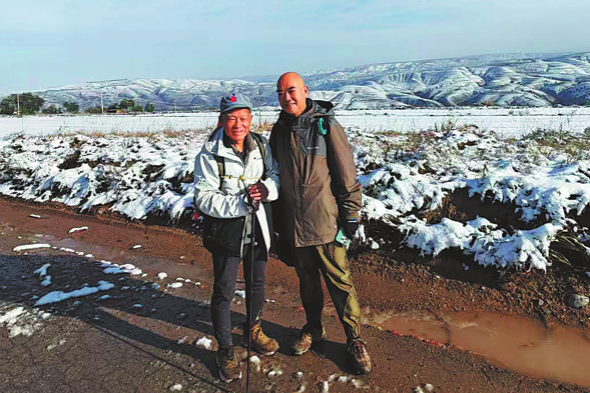
In deep autumn this year, a biting wind carried flurries of snow across Daocheng. At an altitude of 4,411 meters, the world's highest civilian airport welcomed a familiar figure -- Cao Zhen, researcher of the Chinese Academy of Sciences and chief scientist of the LHAASO.
Since its construction began in 2016, Cao has routinely flown to this high-altitude outpost. His task this time -- to check progress on a tracking system.
"When we first came here for site selection in the autumn of 2014, we encountered a wolf, just sitting on a ridge," recalled Cao, his eyes still gleaming with the memory of those pioneering days. "We slept in tents at night -- listening to wolves howling nearby."
It is in this unforgiving, oxygen-thin terrain that Chinese scientists have carved out a frontier for cosmic ray research.
Invisible to the eye, cosmic rays are streams of high-energy particles from outer space. Along with electromagnetic waves and gravitational waves, they are one of three key "messengers" for observing the universe.
Yet, a century after their discovery, their origins and acceleration mechanisms remain one of astrophysics' great unsolved mysteries. Answering this question requires a detector of unprecedented power and the LHAASO was conceived for this very purpose.
From above, the LHAASO looks like a giant circle. Its massive "net" integrates nearly 10,000 detectors. At its heart are three vast, sealed water ponds designed to capture the faint flashes of light created when cosmic rays collide with atmospheric molecules.
Nearby, 18 "blue boxes" house wide-field Cherenkov telescopes. Scattered around them like sesame seeds on a flatbread are 5,216 electromagnetic particle detectors and 1,188 muon detectors -- forming a ground array that identifies gamma-ray photons.
This net is still expanding. Workers, bundled against the cold, could be seen assembling a more powerful tracking system featuring new Cherenkov telescopes. Eventually, 32 such telescopes will be added.
"It's like giving the LHAASO hawk eyes -- improving its spatial resolution by over fivefold," explained Cao. "It will allow us to see more clearly."
An hour's drive from the LHAASO, nestled in a grassy basin near Daocheng, lies the solar telescope array. Its 313 six-meter antennas, arranged in a perfect kilometer-wide ring, pivot in unison like a field of metal sunflowers, all focused on a central calibration tower.
Solar eruptions emit radio waves that reach Earth in just eight minutes, while high-energy particles take much longer. "This time difference allows us to provide forecasts and warnings," said Yan Jingye, chief designer of this array.
"When the sun 'sneezes,' the Earth's space weather can 'catch a cold,' potentially disrupting satellites and communications," Yan explained.
In September 2023, the array successfully predicted a solar storm's arrival time with an error level of less than 1.16 hours. This facility also uncovered a rare long-period pulsar that could end up rewriting how isolated slow-spinning neutron stars are born -- and tracked a radio coronal mass ejection that raced outward for five full solar radii before fading.
Daocheng's unique advantages -- high altitude, flat terrain, relative accessibility and strong local support, are attracting more big science facilities.
On a nearby 4,700-meter peak, construction of a 2.5-meter-wide-field solar telescope is underway. This telescope is set to become the world's largest axisymmetric solar telescope upon completion in around 2026.
"This place is becoming a true frontier for deep-space exploration in China -- a hotbed for science," said Cao.
INTERNATIONAL COLLABORATION
The LHAASO's most spectacular moment to date came on October 9, 2022, with the detection of the brightest gamma-ray burst in recorded history, an event resulting from a dying star 2 billion light-years away.
While other global detectors were effectively "blinded" by the intensity, the LHAASO was the only ground-based instrument to capture the entire event -- collecting over 60,000 gamma-ray photons.
"The LHAASO is revolutionising our understanding of the Galaxy, challenging traditional theories of the origin of cosmic rays," said Elena Amato, an Italian astrophysicist.
The discovery, reported afterward in the journal Science, listed foreign co-authors from Ireland's Dublin Institute for Advanced Studies, Thailand's Mahidol University and Russia's Moscow Institute of Physics and Technology.
Since its inception, the LHAASO has evolved into a global scientific platform open to the worldwide research community. In 2025 alone, it hosted two collaboration meetings with the participation of international research institutes.
France, Russia, Thailand and Pakistan are currently international partners of the LHAASO. This is a microcosm of China's growing leadership in international big science projects.





- Chasing secrets of the universe on world's rooftop in SW China
- Xi sends congratulatory message to 7th China-Russia Energy Business Forum
- Genomic study links China's ancient hanging coffins to modern community
- China's scientific satellites yield key results, refreshing humanity's understanding of universe
- Aerial view of China's Huangyan Island in South China Sea
- Fact box: The development of the under-forest economy in China