Age limit for blood donors may be raised









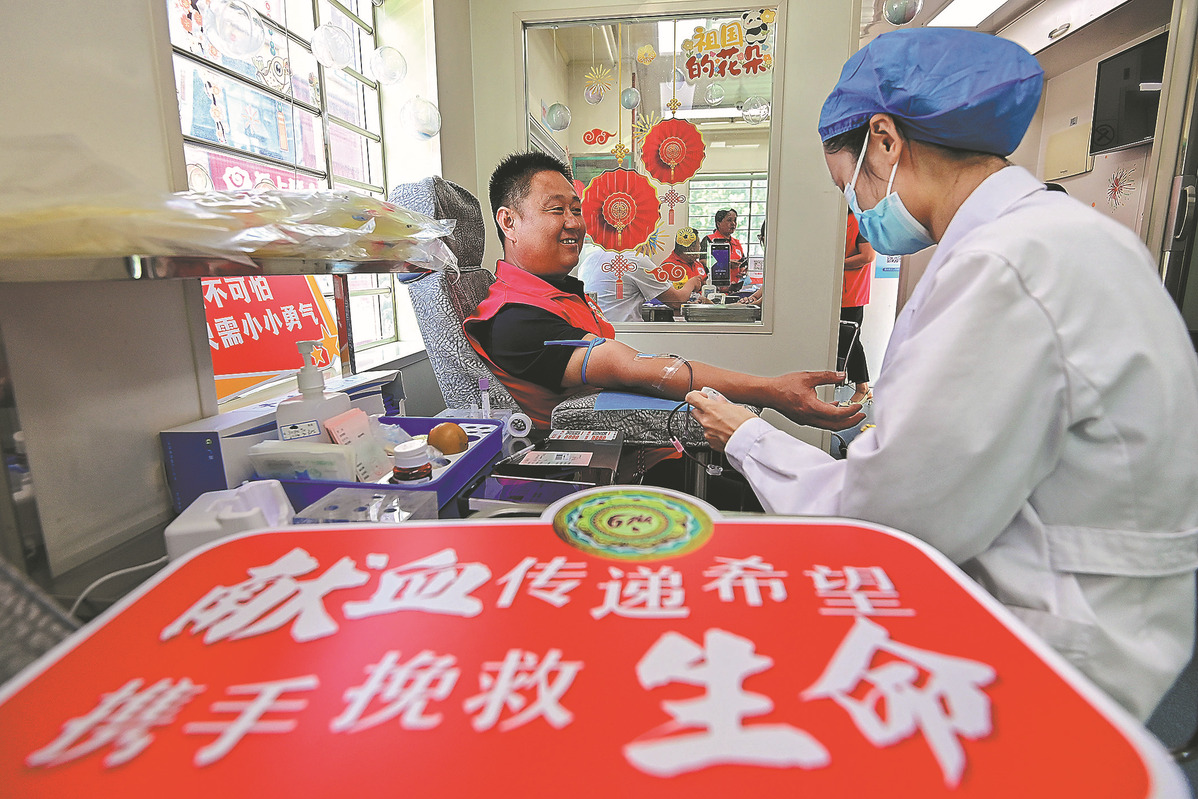
China is considering raising the upper age limit for blood donors from 55 to 65 and shortening the minimum donation interval from six months to 90 days, aligning with international standards and new medical research, the National Health Commission said on Wednesday.
The proposed changes are part of a draft revision to the country's Law on Blood Donation, which has been released by the commission to solicit public opinion. The law, initially passed by the top legislature in late 1997, has remained unchanged since its adoption.
The commission said expanding the donor pool is consistent with global practices.
The World Health Organization recommends donors be aged 18 to 65, while some countries — including the United States, Canada, Australia and Japan — allow older donors or set no strict upper age limit. Many countries also require donation intervals of about eight to 12 weeks.
All donors will undergo health screenings before donation to ensure safety, the commission said. Modern medical research shows that blood regenerates continuously, and a donation of 400 milliliters accounts for less than 10 percent of total blood volume, posing no harm to the body.
Provinces such as Hainan and Jiangxi, as well as the city of Shenzhen in Guangdong province, have already implemented similar relaxations in donor age limits and donation intervals in local regulations, demonstrating the feasibility of the changes.
The commission emphasized that safeguarding donor health and ensuring blood safety are the primary principles of blood donation efforts.
Alongside legal revisions, authorities will strengthen health assessments, establish scientific donation criteria, enhance blood monitoring, improve donor services and care, and refine supervision mechanisms.
The draft revision also proposes stronger protections and incentives for donors, including financial subsidies, additional paid leave and easier access to medical services.
It specifies that blood donors are exempt from paying blood processing and supply costs, while their spouses, parents and children are either fully exempt or eligible for reduced fees. Medical institutions and blood banks should also prioritize providing blood to donors and their close relatives, provided emergency blood supplies are guaranteed.
Under the draft, each county-level region should establish at least one fixed blood donation station, with more set up in areas with larger populations or higher blood demand.
Data released by the commission in June showed the national blood donation rate reached 11.4 donors per 1,000 people in recent years.
However, China continues to face blood shortages due to factors that include a rapidly aging population and changing lifestyles. Demand for blood is rising, with seasonal, regional and blood-type-specific shortfalls still occurring.
Huang Xiaojun, director of the Institute of Hematology at Peking University, said at an earlier news conference that blood accounts for about 7 to 8 percent of total body weight.
An adult weighing 50 kilograms has roughly 3,500 to 4,000 ml of blood, and losing about 10 percent — or 400 ml — has minimal physical impact, he said. The body typically replenishes 400 ml of donated blood within one to two weeks.
Wang Yong, director of the Beijing Red Cross Blood Center, said some donors may experience brief dizziness or fatigue after donating, but such symptoms resolve quickly.
More than a century of widespread practice and clinical research worldwide has shown that blood donation is safe and does not affect health, Wang added.
wangxiaoyu@chinadaiy.com.cn





- Age limit for blood donors may be raised
- Xizang's first ultra-high voltage power link begins operations
- New subsidies provided for HK fire victims' resettlement
- World's longest expressway tunnel to open to traffic in Xinjiang by year-end
- HKSAR govt releases first-ever Chinese medicine development blueprint
- Ten photos from across China: Dec 12 - 18