Researcher reveals secrets of early life on Earth
World-renowned paleontologist Zhu Maoyan elected as CAS academician









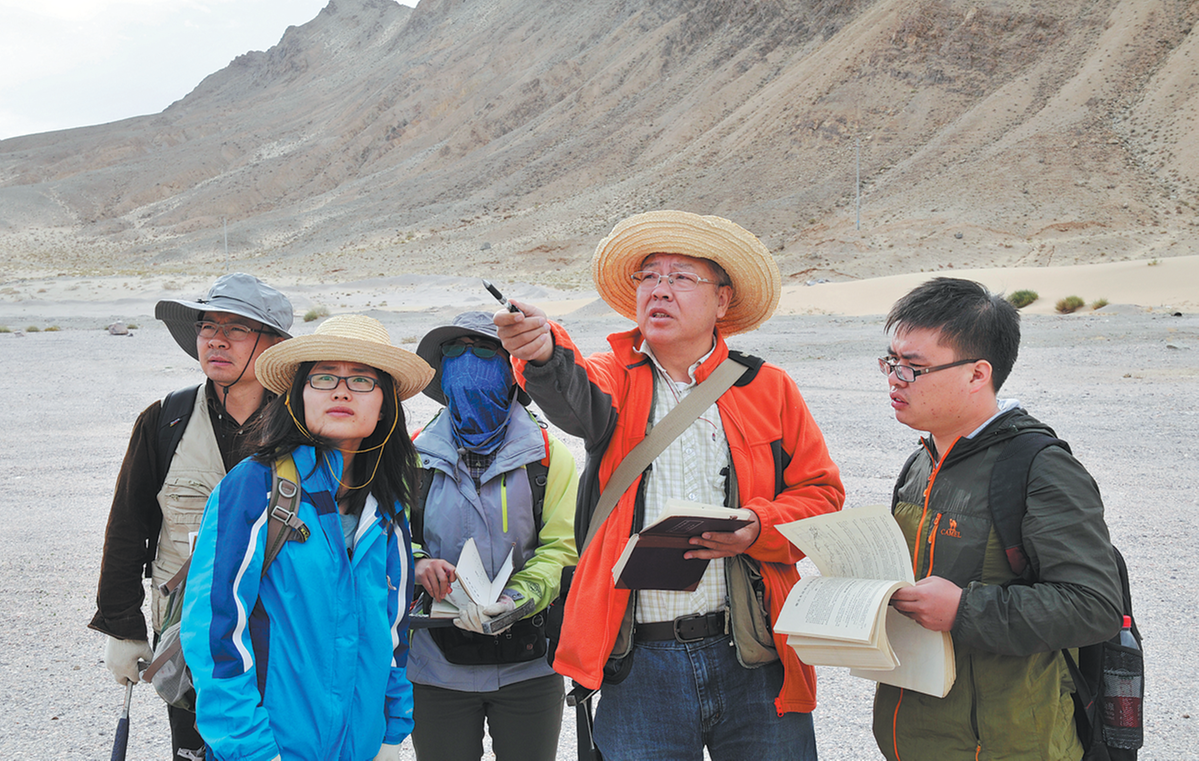
What began as a simple childhood fascination has driven Zhu Maoyan into becoming a globally recognized expert in the field of early life evolution and Earth system history.
On top of honors such as being elected as an honorary fellow of the Geological Society of London, Zhu added the title of academician of the Chinese Academy of Sciences to his repertoire in November.
His pioneering research in paleontology has redefined the understanding of multicellular life before the Cambrian explosion, earning him a spot on Science's 2024 Top 10 Scientific Breakthroughs.
Each year, Science, a leading academic journal, selects the top 10 scientific breakthroughs, honoring the exceptional work of researchers worldwide.
To be elected as a CAS academician is the highest academic title in China for science and research workers.
Zhu's early motivations were rooted in a simple yet profound desire. Growing up in Wangjiang county, Anhui province, a place noted for its flat terrain north of the Yangtze River, he had never climbed a mountain.
"A high school classmate once told me that geologists get to climb mountains every day. That idea captivated me," Zhu said. This offhand remark sowed the seeds for Zhu's future, leading him to pursue geology as a means to explore the mountainous terrain he had long dreamed of.
In the 1980s, Zhu chose to study at the then Changchun College of Geology in Jilin province.
At university, he chose paleontology over other specializations because it was related to biology, a subject he found intriguing.
"I was drawn to study life forms that existed a long time ago," Zhu said. His curiosity quickly evolved into a deep passion, propelling him to study at the Nanjing Institute of Geology and Paleontology at the CAS for his doctorate.
"That was the starting point of my professional research career," he said.
"Just as every child asks their parents, 'Where did I come from?', humans have an inherent desire to understand nature and life. Our research channels this universal childhood curiosity into rigorous scientific exploration," the 61-year-old said.
Zhu's doctoral research focused on the Chengjiang fossils, one of the world's most significant fossil assemblages, providing an unparalleled window into 518-million-year-old fauna in Yunnan province. These fossils are acknowledged internationally as an important world heritage for understanding the evolution of early life.
His first field expedition to Yunnan was both challenging and impressive.
"I spent an entire day traveling to reach a remote site for accommodation, only to find myself in an old wooden house. I was so nervous that night that I placed a wash basin on the door latch as a makeshift alarm."
The following morning, Zhu headed up the mountain with his tools to search for fossils, but he was caught in a heavy rainstorm that made the path slippery. The fossil site was located on a steep slope, he said. "My legs were shaking as I climbed, using both my hands and feet to hold onto the surrounding plants, afraid of slipping."
Zhu said that as he was young and lacking field experience, he relied purely on determination to make it to the site.
From 1997 to 1999, Zhu was a senior visiting scholar, conducting guest research at the Technical University of Berlin, Germany.
In 1999, with the support of the Chinese Academy of Sciences' talent program, he returned to China and established his own research team at the Nanjing Institute of Geology and Paleontology.
"Over the decades, my team has achieved some results in unraveling the mysteries of the Cambrian explosion and exploring the early evolution of complex life," he said.
Over 500 million years ago, during the Cambrian period, all major animal phyla appeared rapidly in what is known as the Cambrian explosion, which established a completely new Earth-life system. This phenomenon has long been a major puzzle for scientists since Darwin, he added.
"My research in stratigraphy provides the foundational timeline for calibrating the evolution of Earth and life, requiring extensive fieldwork. A significant amount of time and effort has been dedicated to this work," he said.
At the institute, Zhu guided his doctoral student, Miao Lanyun, to continue their in-depth research, which led to the discovery of over 200 multicellular eukaryote fossil specimens in the 1.63-billion-year-old strata of the Yanshan Mountain region in North China.
This finding pushed back the appearance of multicellular eukaryotes by 70 million years and was included in Science's 2024 Top 10 Scientific Breakthroughs.
Most complex life forms on Earth today, like animals, plants and fungi, are multicellular eukaryotes. The development of multicellularity in eukaryotes was essential for life to evolve into more complex and larger forms. It was once thought that eukaryotes existed as single cells for about a billion years. However, this new discovery shows that simple multicellular eukaryotes appeared much earlier than previously believed.
"When you believe something is worth doing and have the interest to support it, you won't feel it is arduous or bothersome, nor will you become impatient," Zhu said with regard to his research experience.
"I encourage young people to trust their inner voices and not be overly swayed by family or societal pressures. Don't stress about whether your chosen field will be lucrative or respected. Let go of these worries. Make your own judgments, don't give up easily, and you'll always find hope," he said.
Zhu and his team are currently focused on three main research areas: extending the study of complex life to earlier time, exploring the origins of life and extraterrestrial life, and delving deeper into the Cambrian explosion.
"As a pure basic research endeavor, I am often asked about the practical utility of my work. I believe the core value of basic research lies in satisfying humanity's intrinsic curiosity about nature and life. My research is driven by fundamental questions: Who are we? Where do we come from? Where are we going?"
In China, paleontological research has developed rapidly due to increasing investment. In recent years, numerous natural and science museums have opened, Zhu said.
"This environment encourages both senior and young paleontologists in China to pursue this field. In the future, we should promote the love of nature and life. By doing this, we can inspire more young people to follow their passions and pursue careers in scientific research," he said.
While nurturing domestic talent is the foundation, the spirit of science knows no borders.
"We not only study Chinese paleontological data but also conduct research worldwide," said Zhu.
"Globally, each continent has unique fossil resources. I hope our research involves more international collaboration to fully utilize these global resources. Our perspective is global, and our research is open to international cooperation. We welcome overseas colleagues to study China's resources," he added.
lihongyang@chinadaily.com.cn
- Breakthrough in BMI tech aids patients
- Alliance of Open Life Science expands global reach with new membership invitations
- Beijing Institute of Technology adds journals to SCI Expanded
- 3 foreign satellites among 9 launched by Kinetica 1
- China launches?the 11th Kinetica 1 carrier rocket, sending 9 satellites into orbit






- Researcher reveals secrets of early life on Earth
- Vice-chairman of CPPCC Jiangxi Provincial Committee placed under investigation
- Five trapped in flooding accident at Heilongjiang coal mine
- Long March 5 rocket deploys tech demo satellite into space
- China launches communication technology test satellite
- Spokesperson warns against aggression toward mainland fisherman