GCI can help build global bridges









In an era defined by geopolitical volatility and sharpening economic rivalries, the idea of dialogue between civilizations is regaining diplomatic currency. In this regard, the Global Civilization Initiative proposed by China places inter-civilizational learning at the heart of Beijing's foreign policy.
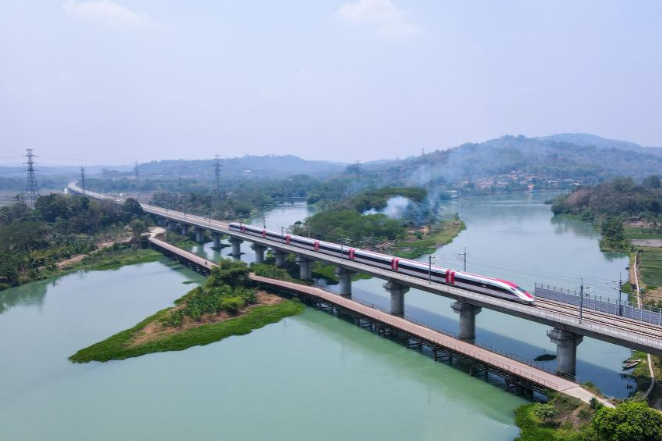
As a strategic partner of China, Indonesia occupies a rare position — capable of bridging the Islamic world and the Confucian sphere.
This is not a new role. In the 15th century, Zheng He, a maritime explorer and diplomat of the Ming Dynasty (1368-1644), made repeated calls at ports across the Indonesian archipelago, bringing gifts, navigational expertise and diplomatic goodwill. His voyages embodied the meeting of two civilizational traditions.
The mid-20th century offered another chapter. In 1957 during the Cold War, then Indonesian president Sukarno met with Chairman Mao Zedong in Beijing. Both leaders realized that the Global South was capable of charting its own course, independent of the binary logic imposed by the rival superpowers. Their meeting demonstrated that cross-civilizational dialogue could be wielded as strategic leverage.
Today's landscape is different, yet the resonance is unmistakable. China is a central actor in a slowly consolidating multipolar system. Through the GCI, it seeks to position itself as a norm entrepreneur committed to promoting inclusivity and mutual learning.
Beyond Indonesia, the GCI offers a platform for broader collaboration between China and the Association of Southeast Asian Nations, enabling Southeast Asian countries to jointly engage in initiatives spanning environmental governance, digital ethics and maritime sustainability.
For Indonesia, an ASEAN member state, the initiative opens the space for wider cooperation, beyond infrastructure and trade, in the realm of knowledge standards, technology ethics and equitable environmental governance.
On climate change, digital governance and trade, divergences in approach are inevitable. These are not weaknesses, but an opportunity to learn from each other.
The Islamic principle of amanah — trust as a moral obligation — and the Confucian ideal of harmony could be combined into a richer metric, one that values ecosystem restoration, community resilience and fair distribution of benefits alongside economic growth or carbon-reduction targets.
A concrete example is the China-Indonesia Dialogue on Sustainable Development, held in Jakarta in May, which was centered on revitalizing mangrove ecosystems, linking environmental recovery with the economic empowerment of coastal communities. The dialogue showed that culturally grounded, multilateral collaboration can generate results that cross borders. In a framework of Islamic-Confucian exchanges, such a model could be adopted. China's record in coastal restoration and land rehabilitation offers a parallel body of experience for reciprocal learning.
Technology offers a similar scope. Artificial intelligence is advancing faster than the ethical frameworks meant to govern it. Indonesia, now drafting a national "AI ethics framework", could bring its perspective to joint platforms with China. With China's deep research capacity and Indonesia's complex social fabric, the two sides could co-author international guidelines to guard against algorithmic bias, ensure equitable access, and channel technology toward the public good. Involving regional partners such as Singapore, Thailand and the Philippines could ensure that these AI guidelines are sensitive to varied social contexts and regulatory landscapes across Southeast Asia.
Trade is another arena where civilizational values could be made tangible. Islamic teachings on transactional justice and Confucian ethics of propriety could underpin contracts for strategic commodities, and these contracts could include enforceable sustainability clauses and social protection. Such arrangements would shift economic cooperation from profit-seeking toward a vehicle for environmental stewardship and human well-being.
Jakarta's long-standing doctrine of "independent and active" foreign policy demands a careful balance, avoiding alignment because that would narrow its diplomatic room for maneuvering in the G20, ASEAN and other groupings.
The Global Civilization Initiative's potential is evident. It provides a nonconfrontational channel through which Indonesia can advance its priorities. The development of its new capital, Nusantara, with Chinese investment and consultancy, could be tied to sustainability norms drawn from both Islamic and Confucian thoughts.
Indonesia also brings historical credibility to the table. The 1955 Bandung Conference and its formative role in the Non-Aligned Movement stand as reminders that Indonesia's crucial role in the Global South is neither accidental nor recent. These historical precedents resonate across Southeast Asia. Linked to the GCI, this legacy could support cross-regional coalitions spanning Africa, the Middle East and South Asia.
But realizing these ambitions will require diplomatic and technical readiness: skilled negotiators, adept public diplomacy and strong interministerial coordination.
Joint research centers established by Indonesian and Chinese universities, particularly in Islamic and Confucian studies, could act as dedicated policy think tanks. Their outputs should feed into the G20,ASEAN and United Nations discussions, while private-sector and civil-society engagement would broaden ownership, preventing their capture by state actors.
Zheng He's voyages and the Sukarno-Mao meeting both show that harmony is built on the courage to address differences, not on concealing them. Today, as China advances the GCI and Indonesia stands at a crossroads, the opportunity is once again before us.
The author is executive director of PARA Syndicate, a Jakarta-based independent think tank.
The views do not necessarily reflect those of China Daily.