ROK leader begins state visit to China
Lee says he hopes to explore key areas for cooperation, take ties to new level









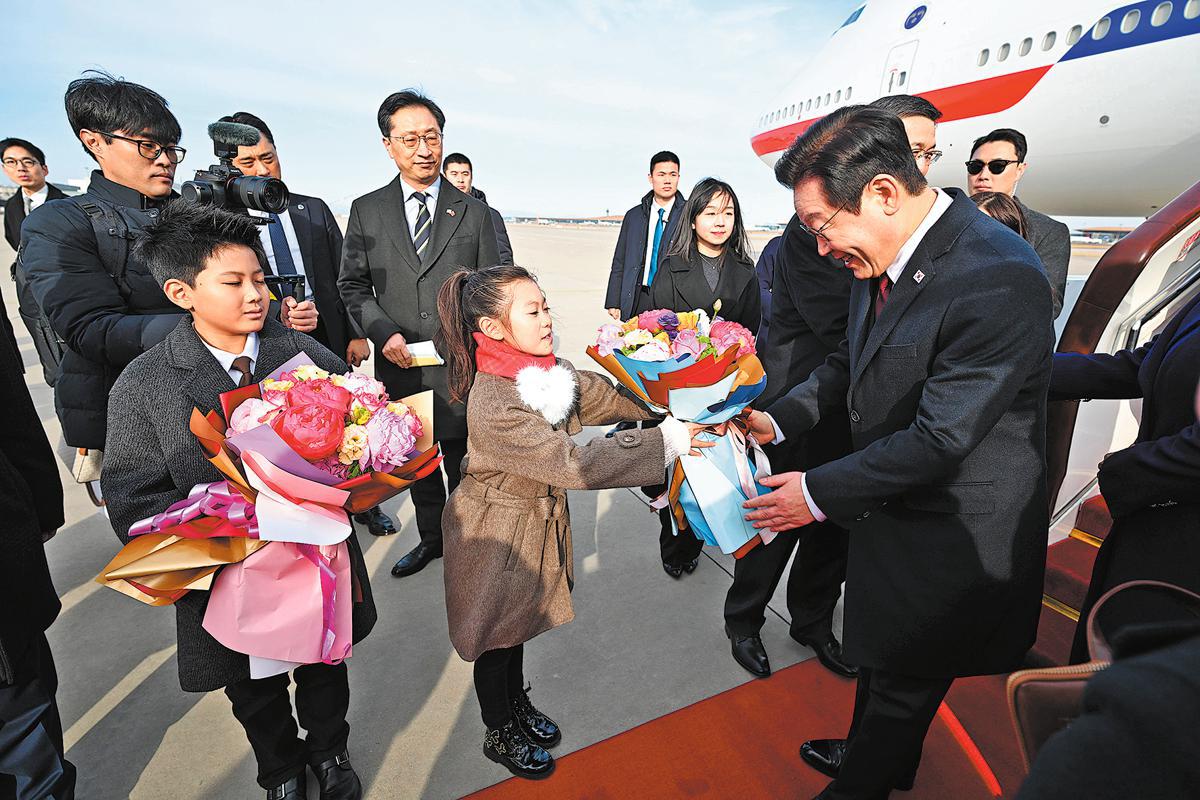
President of the Republic of Korea Lee Jae-myung arrived in Beijing on Sunday afternoon, becoming the first head of state to visit China in the new year.
It is Lee's first visit to China since assuming office in June. During his stay, Lee will meet with President Xi Jinping, their second engagement in just two months. The two presidents met in November in Gyeongju, the ROK, as Xi made a state visit to the neighboring country.
The four-day state visit will also take Lee to Shanghai, where he will visit the historic site of the Provisional Government of the Republic of Korea during Japan's colonial rule.
In an interview with China Central Television before the trip, Lee said the purpose of his visit is to minimize or eliminate past misunderstandings or contradictions, and elevate bilateral relations to a new level.
Lee said that Seoul should seek coexistence and cooperation with Beijing to the greatest extent possible, and actively and deeply explore areas that could achieve mutual benefits.
China has remained the ROK's largest trading partner for more than two decades, while in 2024, the ROK surpassed Japan to become China's second-largest trading partner.
Statistics from China Customs show that bilateral trade value totaled 2.14 trillion yuan ($306 billion) in the first 11 months of 2025, marking a 1.6 percent year-on-year increase.
Lee said that in recent years, China's economy has achieved significant growth and development, and the country has surpassed the ROK in many fields in terms of technology and capital.
He expressed hope that in areas such as artificial intelligence and high-tech industries, the two sides would build new, equal partnerships and foster a cooperative economic relationship that benefits both countries.
Li Jiacheng, an associate professor at Liaoning University's School of International Studies, said the two leaders' second meeting in such a short time has shown Lee's emphasis on further putting bilateral ties back on the right track after a stagnation under the previous government, while achieving new progress.
Lee, who is accompanied by a large business delegation, expects to expand, deepen and upgrade bilateral trade cooperation, especially at a time when the two countries are set to advance the second phase of negotiations on their free trade agreement to achieve closer economic ties, he added.
Wang Junsheng, a researcher at the Chinese Academy of Social Sciences' National Institute of International Strategy, said the top priority for Lee's administration is to promote domestic economic growth, which makes closer cooperation with China more essential.
Deep integration across industrial and supply chains has formed a close bond between the two economies, which highlights the resilience and potential of China-ROK economic and trade relations, Wang said.
Only by adhering to rationality and pragmatism can the two countries promote the sound and stable development of their relationship, he added.
zhoujin@chinadaily.com.cn